

 Поделиться
 Поделиться
 Детали произведения
 Руководство

 Скачать
 Похожие предметы
 Слайд-шоу
 Вопросы и ответы
 Статистика просмотров
Fancy

- 133.0 x 114.0 cm


 Читать далее
Произведение искусства, представленное на этой странице, защищено законом об авторском праве, что исключает возможность законного создания или продажи его точной репродукции. Данная защита обеспечивается международными соглашениями, такими как Бернская конвенция и национальным законодательством, включая положения, изложенные в Закон США об авторском праве — Раздел 17.
Этот метод полностью соответствует нормам авторского права, так как он не предполагает копирования или дублирования защищенного произведения. Напротив, это творческая реинтерпретация — создание новой картины, которая вдохновлена оригиналом, но не является его точной копией.
Жикле и арт-принты
Печать (жикле) или холст музейного качества с быстрыми сроками изготовления и широким выбором вариантов отделки. ( Купить картину ручной работы Перейти к цифровым изображениям)




































Выберите один из наших стандартных размеров, соответствующих оригинальным пропорциям произведения искусства.

Введите необходимую ширину и высоту, чтобы репродукция подошла к вашей раме или стене. При печати изображение можно только уменьшить, но нельзя увеличить больше оригинала, поэтому при выборе другого формата часть изображения может быть обрезана. Перед печатью мы отправим вам цифровой макет на утверждение. Изображение на этой странице не отображает реальную обрезку — ее можно увидеть только на макете.
Доставка по всему миру () за 2 недели вместо стандартных 4–5 недель. (8 Ноябрь)

Бесплатная экспресс-доставка по всему миру

Высококачественный льняной холст

Полное страхование при доставке

Гарантия возмещения таможенных пошлин

Гарантия точного цветового соответствия

100-дневная гарантия возврата (только при обнаружении дефектов)

Гарантия возврата 100% средств

Скидка при оптовом заказе
 Вариант со стеклом доступен только для размеров менее 110 см

Fancy
Жикле и арт-принты
Размер репродукции
-


Итоговая стоимость
$ 63
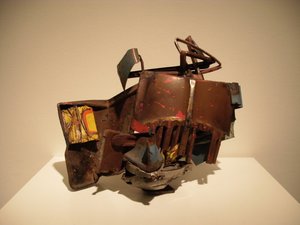
Fancy That: A Monumental Embrace of Assemblage
John Angus Chamberlain’s sculpture “Fancy That,” released in 2025, isn't merely an artwork; it’s a testament to the transformative power of repurposing industrial detritus into breathtaking visual statements. This piece embodies the spirit of Neo-Dada and Abstract Expressionism—movements that questioned artistic conventions and championed spontaneity—demonstrating Chamberlain’s profound understanding of both disciplines.
The sculpture itself is dominated by a striking red chair, constructed from meticulously welded metal framework and a wooden seat. However, its true brilliance lies in the surrounding environment: a couch on the left and another smaller couch on the right create an intriguing spatial dialogue. A dining table anchors the composition, subtly directing the viewer’s gaze back to the central sculptural element.
Chamberlain's technique is revolutionary. He painstakingly crushes automobile parts—rusted fenders, brake drums, chassis components—before welding them together with remarkable precision. This process isn’t simply about assembling materials; it’s about confronting materiality itself. The resulting sculptures are textured surfaces riddled with perforations and fissures, mirroring the scarred landscapes of industrial decay.
Historically, Chamberlain's work aligns with a broader artistic preoccupation with confronting the mundane—the discarded objects of everyday life—and elevating them to the realm of art. Like Marcel Duchamp’s readymades, “Fancy That” challenges viewers to reconsider notions of beauty and originality. It speaks to a fascination with process and materiality, mirroring the ethos of Abstract Expressionism's rejection of traditional artistic formulas.
Emotionally, “Fancy That” evokes a sense of melancholy contemplation. The sculpture’s weathered surfaces whisper tales of forgotten journeys and obsolescence, prompting reflection on time, decay, and the enduring capacity for art to transform seemingly insignificant objects into powerful symbols of creativity and intellectual engagement.
Вопросы и ответы
Кто является автором «Fancy» и к какому направлению относится это произведение?
«Fancy» был создан John Angus Chamberlain в стиле Neo-Dada. Автор и направление определяют художественную традицию этого произведения.
Какова форма и размеры произведения «Fancy», John Angus Chamberlain?
Работа «Fancy», John Angus Chamberlain представляет собой Портретная ориентация размером 133 x 114 cm.
Разрешает ли авторское право на «Fancy», John Angus Chamberlain создание репродукций?
Статус авторского права на «Fancy», John Angus Chamberlain однозначен: произведение находится в находится под защитой авторского права. Его нахождение в Chrysler Museum of Art не меняет этого статуса.
Похожие произведения


Биография художника
The Alchemist of Automobilia: The Life and Legacy of John Angus Chamberlain
In the intersection of industrial decay and high art, few figures loom as large or as provocatively as John Angus Chamberlain. Born in 1927 in Rochester, Indiana, Chamberlain did not merely create sculpture; he orchestrated a metamorphosis of the discarded. To look upon his work is to witness a violent yet poetic dialogue between the mechanical past and the abstract present. He possessed a singular vision that allowed him to see not just rusted scrap, but a vocabulary of form, color, and texture. His journey from the son of a saloonkeeper in the American Midwest to a titan of the Neo-Dada movement is a testament to an unyielding creative impulse that sought to find beauty within the crushed and the broken.
Chamberlain’s artistic consciousness was forged through a diverse and rigorous educational odyssey. After serving in the United States Navy during the pivotal years of World War II, he utilized the GI Bill to immerse himself in the burgeoning avant-garde scenes of America. His time at the Art Institute of of Chicago provided him with a foundational mastery of form, but it was his tenure at the legendary Black Mountain College that truly expanded his intellectual horizons. At Black Mountain, he moved beyond the purely visual, studying under influential poets such as Charles Olson and Robert Creeley. This literary immersion profoundly shaped his sculptural language; he famously viewed his collection of automotive fragments as a reservoir of words, where the act of welding was akin to composing a stanza, seeking the perfect placement of one jagged edge against another to achieve a rhythmic, poetic resonance.
A Symphony of Steel and Spontaneity
The hallmark of Chamberlain’s oeuvre lies in his revolutionary technique of assemblage. While many of his contemporaries were exploring the flat planes of Abstract Expressionist painting, Chamberlain sought to bring that same gestural energy into three-dimensional space. He became a master of the "crushed" aesthetic, meticulously dismantling abandoned automobiles and extracting their vibrant, enamel-coated metal components. Through the intense processes of welding, bending, and compressing, he transformed these industrial remnants into monumental forms that pulsed with an almost organic vitality.
His work defies easy categorization, existing in a fluid state between several major movements:
- Abstract Expressionism: He translated the spontaneous, emotional brushstrokes of painters like Pollock into the physical manipulation of steel and chrome.
- Neo-Dada: By utilizing found objects and "readymades" from the industrial age, he challenged the sanctity of traditional sculptural materials like marble or bronze.
- Pop Art: His use of consumerist detritus—the very skin of the American automobile—connected his high-art ambitions to the burgeoning mass culture of the mid-20th century.
There is a palpable tension in his sculptures, a sense of captured motion and compressed energy. The bright flashes of Cadillac red or Chevrolet blue, often peeking through layers of rust and grime, create a chromatic intensity that mirrors the dynamism of urban life. He did not seek to represent the car, but rather to capture the spirit of its movement and the inevitable entropy of its decay.
Historical Significance and the Enduring Pulse of Art
Throughout his prolific career, Chamberlain’s presence was felt across the most significant art hubs of the world, from Manhattan and Los Angeles to Shelter Island and even Belgium. His ability to disrupt the boundaries between sculpture and painting left an indelible mark on the trajectory of modern art. He proved that the debris of the industrial revolution could serve as the medium for a profound spiritual and aesthetic inquiry. Critics often noted that while his materials were cold and hard, the emotional impact of his work was deeply visceral, aiming—as he himself desired—to "make the viewer’s heart beat."
As we reflect on his life, which concluded in 2011, Chamberlain remains a pivotal figure who bridged the gap between the mechanical and the lyrical. He taught us that art is not merely about the creation of something new, but about the radical reimagining of what already exists. His legacy lives on in every artist who looks at the wreckage of the world and sees the potential for a masterpiece, reminding us that even in the crushed and the discarded, there is an eternal, unyielding beauty waiting to be welded back together.
John Angus Chamberlain
1927 - 2011 , United States of America
Об авторе
- Full Name: John Angus Chamberlain
- Nationality: American
- Date Of Birth: 1927
- Date Of Death: 2011
- Place Of Birth: Rochester, United States of America
- Notable Artworks:
- Fancy
- Sleeping Giant
- Artistic Movement Or Style: Abstract Expressionism
- Artists Who Influenced This Artist:
- Robert Delaunay
- Jean Dubuffet
- Artists Or Movements Influenced By This Artist: ['Neo-Dada']
Похожие статьи

Джон Констебль: 25 шедевров английского пейзажа для вашего интерьера
Погрузитесь в мир английского пейзажа с Джоном Констеблом! 25 шедевров романтизма, история создания картин и вдохновение для вашего интерьера. Репродукции высокого качества на ArtsDot.com – искусство для ценителей.

10 легендарных бронзовых скульптур, изменивших искусство навсегда | ArtsDot
Погрузитесь в мир великих бронзовых скульптур! От Давида Микеланджело до работ Родена – история искусства, техники и вдохновения. Купите репродукции шедевров для вашего интерьера на ArtsDot.com

Топ-10 шедевров абстрактного экспрессионизма: искусство для вашего интерьера от ArtsDot.com
Погрузитесь в мир абстрактного экспрессионизма! Откройте для себя 10 шедевров Поллока, Ротко и других гениев. История искусства, техники живописи и вдохновение для вашего интерьера от ArtsDot.com. Explore the full collection online!

The Enduring Form: Exploring Themes & Techniques in Sculpture Across Historical Periods
Explore the rich history of sculpture from ancient masterpieces to contemporary innovations. Discover key techniques, influential artists & investment potential for discerning art collectors.

Джон Сингер Сарджент: 25 шедевров портретной живописи для вашего интерьера | ArtsDot
Погрузитесь в мир Джона Сингера Сарджента! 25 шедевров импрессионизма и реализма, раскрывающих элегантность эпохи Gilded Age. Купите репродукции картин Сарджента музейного качества для вашего интерьера на ArtsDot.com.
