


Картина подстраивается под ваш выбор: , .
Описание предмета коллекционирования
Explore the Sala del Cinquecento in Florence's Palazzo Vecchio – a masterpiece of Renaissance art featuring monumental frescoes and historical significance.
 Читать далее
Биография художника
Джорджо Вазари – итальянский художник, архитектор и искусствовед, известный своими биографиями мастеров эпохи Возрождения, включая «Жизни художников». Он сыграл ключевую роль в формировании истории искусства и дизайна Уффици.
Масляная репродукция ручной работы
Картина маслом на холсте в выбранном вами размере и раме, написанная на заказ нашими художниками. ( Перейти к печатным копиям Перейти к цифровым изображениям)
Подробнее об этой картине
 Предпросмотр
 Поделиться
 Поделиться
 Детали произведения
 Руководство

 Скачать
 Похожие предметы
 Рентгенография
 Слайд-шоу
 Вопросы и ответы
 Статистика просмотров
Закажите свою картину в четыре простых шага
Не торопитесь. Вы можете изменить любой ответ; цена в вашей корзине будет обновляться после каждого выбора.
1 Шаг первый из четырех
Какой размер вы бы хотели выбрать?
Эти размеры сохраняют пропорции оригинальной картины. На рисунке показано, как выбранный вами вариант будет смотреться на стене над двухметровым диваном.
Или укажите свои размеры
Выберите один из наших стандартных размеров, соответствующих оригинальным пропорциям произведения искусства.

Введите необходимую ширину и высоту, чтобы репродукция подошла к вашей раме или стене. Поскольку работа выполняется вручную, при изменении пропорций художник может немного увеличить область вокруг картины или, наоборот, обрезать края — выбор за вами. Перед началом работы мы пришлем вам цифровой макет на утверждение. Изображение на этой странице не является точным результатом — увидеть реальный вид можно только на макете.
2 Шаг второй из четырех
Как его подготовить: в рулоне, на подрамнике или в раме?
Ниже указаны цены для размера, выбранного вами на первом этапе.
Выберите тип обработки краев холста
Выберите свою раму

Белый торцевой край $1

Размытый край $1

С продолжением изображения $1

P118B $10

P118H $10

P118W $10

P438Z $10

P508JH $12

P508YH $12

P805H $10

P805Z $10

P919BZ $10

P919G $10

P919XJ $10

P959ZH $10

P968JZ $12

W106C $8

W218G $10

W218JH $8

W218Y $10

W307PJ $10

W316G $10

W316PJ $8

W316Y $10

W398PJ $8

W4111J $10

W500HY $15

W500JH $15

W692G $12

W849H $8

W940BG $15

W953PJ $8

H24-GOLD $30

H24-SILVER $30

H36-GOLD $45

H36-SILVER $45
В раме
Багет: . Общий размер в раме: .
3 Третий шаг из четырех
Желаете ли вы внести какие-либо изменения в картину?
Большинство людей отвечают «нет». Но поскольку каждая картина создается вручную, наш художник может адаптировать ее специально для вас.
После оформления заказа команда ArtsDot.com свяжется с клиентом по электронной почте для получения инструкций и предоставит предварительный макет
4 Четвертый шаг из четырех
Несколько вариантов отделки
Все они являются необязательными. Выбранные ответы не влекут за собой дополнительных расходов.
Кто автор?
Доставка по всему миру () за 3–4 недели вместо стандартных 5 недель. (9 Ноябрь). Без компромиссов в качестве.
Табличка, как в музее?
Детали гравировки на бронзовой плакетке
This elegant plaque features the artist's name and the title of the artwork, finely engraved for a timeless presentation.
It is made from bronze with a refined, elegant finish. The text is precisely laser-engraved for a sharp and permanent result. Measuring 9x2 cm, the plaque is compact yet easy to read. It's built to be durable and scratch-resistant, offering a professional, museum-quality look. Mounting is simple thanks to the included adhesive backing.
Детали прозрачной акриловой таблички
The plaque includes essential engraved details such as the artist's name, the title of the artwork, the date it was created, the type of media used-like oil on canvas or watercolor-a brief description of the piece, and a QR code that links to the complete artwork information.
It is crafted from clear acrylic, offering a sleek, modern appearance. The text is UV-engraved in black to ensure strong visual contrast. With a size of 10x15 cm, it ensures optimal readability. It comes equipped with two metal hooks for secure wall mounting. The plaque is designed to be weather-resistant, making it suitable for various environments, and it includes interactive features that work seamlessly with smartphone scanning.
Информация о чёрной акриловой табличке
This elegant plaque includes engraved information such as the artist's name, the title of the artwork, the date it was created, the type of media used (like oil on canvas or watercolor), a short description of the artwork, and a QR code for quick access to more information.
The plaque itself is made from refined black acrylic with a premium finish. The text is laser-engraved in white for high contrast and readability. Its size is 10x15 cm, designed to be easy to read. It comes with two metal hooks for professional mounting. The design is sleek and fits any interior style. It is also weather-resistant and durable, with built-in digital integration for mobile compatibility.
Защитный лак?
Когда вам нужна доставка?
✓ Проверить и заказать
Ваша картина в соответствии с вашим заказом

Sala del Cinquecento
Техника репродукции
Размер репродукции
-

Выдающийся мастер высокого класса
Более высокая детализация, изысканность и дополнительное время на создание работы
-

Оформление репродукции
-
-
Для произведений искусства или репродукций, размер которых превышает 105 см (приблизительно 41 дюйм) по любой из сторон, рама будет доставлена в разобранном виде (в виде комплекта). Этот метод обеспечивает безопасную доставку и предотвращает повреждения при транспортировке.
Требуется профессиональная сборка — это не продукт для самостоятельной сборки (DIY).
Комплект должен быть собран, а холст натянут опытным мастером по багетным рамам с использованием клеевого ПВА (не входит в комплект), струбцин для натяжки холста и зажимов, чтобы удерживать подрамник ровным до полного высыхания клея. Неправильная сборка или неравномерное натяжение холста могут привести к необратимому повреждению произведения искусства и не являются гарантийным случаем.
 Для произведений искусства или репродукций, размер которых превышает 105 см (приблизительно 41 дюйм) по любой из сторон, рама будет доставлена в разобранном виде (в виде комплекта). Этот метод обеспечивает безопасную доставку и предотвращает повреждения при транспортировке.
В комплект входят все бруски из массива дерева, точно вырезанные по размеру.
Собирается с помощью предоставляемых винтов, а также столярного клея для угловых соединений, который не входит в комплект и должен быть приобретен вашим мастером.
Требуются профессиональные инструменты, не входящие в комплект: щипцы для натяжки холста (натяжитель) и зажимы, чтобы удерживать рейки ровно во время высыхания клея.
Важно:
Для соединения углов требуется клей для дерева, перекладины необходимо зафиксировать струбцинами до полного высыхания клея, а для натяжки холста на собранную раму требуются щипцы для натяжки холста. Ни один из этих инструментов не входит в комплект. Пожалуйста, убедитесь в наличии опытного мастера по багетным работам перед заказом рамы такого размера.

Этикетка
-
-

Защитный лак
Глянцевый лак (насыщает цвета, защищает от воздействия света и влаги)
-

Персонализация картины
Примеры возможных изменений: замена лица на фото клиента; добавление домашнего питомца (например, замена кошки на собаку); добавление скрытого сообщения на фоне; изменение пейзажа или элементов фона.
-

Экспресс-доставка
Доставка по всему миру () за 3–4 недели вместо стандартных 5 недель. (9 Ноябрь). Без компромиссов в качестве.
-
Экспресс-доставка
Доставка по всему миру () в течение 5 недель. (16 Ноябрь).
Включено в стоимость
Итоговая стоимость
$ 263
Вариант со стеклом доступен только для размеров менее 110 см
Включено в каждый заказ
- Бесплатная экспресс-доставка по всему миру
- Высококачественный льняной холст
- Полное страхование при доставке
- Гарантия возмещения таможенных пошлин
- Гарантия точного цветового соответствия
- 100-дневная гарантия возврата (только при обнаружении дефектов)
- Гарантия возврата 100% средств
- Скидка при оптовом заказе


Introduction
The Sala del Cinquecento, located in the Palazzo Vecchio in Florence, Italy, is a masterpiece of Florentine Renaissance art. This room was commissioned by Cosimo I de' Medici and designed by Giorgio Vasari between 1555 and 1572. The Sala del Cinquecento is a testament to the artistic and cultural achievements of the Florentine Renaissance, showcasing some of the most impressive frescoes and architectural elements of the period.Giorgio Vasari: A Master Artist of the Florentine Renaissance
Giorgio Vasari (1511-1574) was an Italian painter, architect, and historian who played a crucial role in shaping the course of Florentine Renaissance art. He is best known for his biographies of Italian artists, which were published in 1550 as "Le Vite de' più eccellenti pittori, scultori e architettori." Vasari was also a prolific artist, creating numerous masterpieces throughout his career.The Sala del Cinquecento: A Masterpiece of Florentine Renaissance Art
The Sala del Cinquecento is a stunning example of Florentine Renaissance art, featuring some of the most impressive frescoes and architectural elements of the period. The room measures 54 meters long, 23 meters wide, and 18 meters high, making it one of the largest and most impressive rooms in the Palazzo Vecchio. The Sala del Cinquecento features two large frescoes on its walls: "The Battle of Marciano" and "The Battle of Anghiari." These frescoes were painted by Vasari and his assistants, and they depict some of the most important military victories of the Medici family.The Battle of Marciano
The Battle of Marciano is a stunning fresco that covers the entire north wall of the Sala del Cinquecento. The fresco depicts the Battle of Marciano, which took place in 1554 between the Medici forces and the Florentine Republic. The fresco features numerous figures, including Cosimo I de' Medici, who is depicted on horseback at the center of the composition.The Battle of Anghiari
The Battle of Anghiari is a stunning fresco that covers the entire south wall of the Sala del Cinquecento. The fresco depicts the Battle of Anghiari, which took place in 1440 between the Florentine Republic and the Milanese forces. The fresco features numerous figures, including Leonardo da Vinci, who is depicted at the center of the composition.Conclusion
The Sala del Cinquecento is a stunning example of Florentine Renaissance art, featuring some of the most impressive frescoes and architectural elements of the period. This room is a testament to the artistic and cultural achievements of the Florentine Renaissance, showcasing the work of some of the most important artists of the period, including Giorgio Vasari, Leonardo da Vinci, and Michelangelo. If you are interested in learning more about Florentine Renaissance art or purchasing hand-made oil painting reproductions of your favorite works, please visit our website at https://ArtsDot.com. We offer a wide range of reproductions, including those of the Sala del Cinquecento, that are sure to enhance any art collection.- Sources:
- Giorgio Vasari: The Lives of the Most Excellent Painters, Sculptors, and Architects, translated by Gaston du C. de Vere (New York: Alfred A. Knopf, 1996).
- /en/art/show/art-8y2ux3-en/
- /art/list/?Filter=Florentine%20Renaissance%20art
- Painting by 'Giorgio Vasari' | Giorgio Vasari:View of the Studiolo (Palazzo Vecchio (Florence, Italy),Oil On Panel)
- Painting by 'Giorgio Vasari' | Giorgio Vasari:Perseus and Andromeda (detail) (Palazzo Vecchio (Florence, Italy),Oil)
Вопросы и ответы
Кто создал "Sala del Cinquecento" и в каком стиле выполнено это произведение?
Джорджо Вазари создал(а) «Sala del Cinquecento», работая в стиле Florentine Renaissance.
Насколько насыщенны цвета в «Sala del Cinquecento», Джорджо Вазари?
В работе «Sala del Cinquecento», Джорджо Вазари представлена Monochromatic насыщенность цвета.
Насколько насыщенны и выразительны цвета в работе «Sala del Cinquecento», Джорджо Вазари?
Насыщенность цвета в работе «Sala del Cinquecento» составляет Subtle Color, а интенсивность — Monochromatic.
Похожие произведения


Джорджо Вазари
1511 - 1574, Италий
Биография художника
A Life Woven into the Renaissance Fabric
Giorgio Vasari, born in Arezzo, Tuscany, on July 30, 1511, was more than simply a painter; he was a quintessential embodiment of the Italian Renaissance spirit. His life unfolded as a vibrant tapestry woven with threads of artistic creation, architectural innovation, insightful historical writing, and an unwavering dedication to celebrating the masters who came before him. From his earliest training under Guglielmo da Marsiglia, a skilled artisan in stained glass, young Giorgio’s path was steered towards visual artistry. However, it was his move to Florence at sixteen that truly ignited his potential. Immersing himself within the dynamic circle of Andrea del Sarto and absorbing the influences of Rosso Fiorentino and Jacopo Pontormo, Vasari began a journey that would see him become one of the most influential figures of his era. His formative years were also deeply marked by the patronage and friendship of the powerful Medici family, a relationship that would shape both his career and his perspective on art’s role in society.The Artist's Hand and Eye
Vasari’s artistic style is often categorized as Mannerist, reflecting the prevailing aesthetic trends of the mid-16th century. His paintings are characterized by elongated figures, dynamic compositions, and a sophisticated use of color—qualities highly admired during his lifetime. While perhaps not achieving the same level of enduring fame as some of the artists he chronicled, Vasari’s skill was undeniable. Notable works such as *The Studio of the Painter*, a fresco housed in Casa Vasari in Arezzo, offer a fascinating glimpse into the artistic practices of the time. The sheer scale and ambition of his frescoes for the Palazzo Vecchio in Florence, undertaken between 1555 and 1572, demonstrate his mastery of large-scale decorative schemes. His final monumental undertaking, *The Last Judgement*, adorning the cupola of Florence Cathedral—completed after his death by Federico Zuccari—stands as a testament to his unwavering commitment to grand artistic visions. Beyond painting, Vasari’s architectural contributions were equally significant. He designed the elegant loggia of the Palazzo degli Uffizi, transforming it into a public piazza and creating a vital link within Florence's urban landscape. Perhaps most famously, he conceived and oversaw the construction of the Vasari Corridor, a secret passageway connecting the Uffizi Gallery with the Palazzo Pitti—a feat of engineering and architectural ingenuity that continues to captivate visitors today.A Historian Forging a Legacy
However, it is arguably as an art historian that Giorgio Vasari secured his most lasting legacy. His monumental work, *Lives of the Most Excellent Painters, Sculptors, and Architects*, published in 1550 (with a revised edition in 1568), revolutionized the way art was understood and appreciated. This groundbreaking text wasn’t merely a collection of biographies; it established a narrative framework for the development of Italian Renaissance art, tracing its evolution from the early masters like Cimabue and Giotto to his contemporaries Michelangelo and Raphael. Vasari's work introduced the very concept of the “Renaissance” – a rebirth of classical ideals—and laid the foundation for modern art history as a discipline. While acknowledging that Vasari’s accounts are not without their biases and inaccuracies, particularly concerning artists predating his own time, the impact of *Lives* remains profound. It provided a crucial historical context for artistic creation, elevating the status of artists from skilled craftsmen to intellectual figures worthy of scholarly attention.Influences and Enduring Significance
Vasari’s artistic development was profoundly shaped by his exposure to the works of Renaissance masters. His visit to Rome in 1529, where he studied the art of Raphael and other High Renaissance artists, proved pivotal. He absorbed their principles of composition, anatomical accuracy, and idealized beauty, incorporating them into his own style. Michelangelo, whom Vasari greatly admired, exerted a particularly strong influence on both his painting and architecture. The grandeur and dynamism characteristic of Michelangelo’s work are evident in many of Vasari’s projects. Beyond specific artists, the broader intellectual currents of the Renaissance—humanism, classical learning, and a renewed interest in empirical observation—also informed Vasari's approach to art and history. Giorgio Vasari died on June 27, 1574, in Florence, leaving behind a multifaceted legacy that continues to resonate today. He was not only a talented artist and architect but also a pioneering historian whose writings shaped our understanding of one of the most transformative periods in Western art history. His work remains essential for anyone seeking to explore the rich cultural heritage of the Italian Renaissance.Major Achievements
- The Studio of the Painter (1563): This monumental fresco, housed in Casa Vasari in Arezzo, is a cornerstone of his artistic output, offering an unparalleled insight into the practices and theories of painting during the Renaissance.
- Frescoes for the Palazzo Vecchio (1555-1572): Vasari’s ambitious frescoes decorating the halls of Florence's town hall showcase his mastery of large-scale decorative schemes and his ability to integrate narrative and symbolism into monumental works.
- The Last Judgement (1573-1579): This colossal fresco on the cupola of Florence Cathedral, completed after his death by Federico Zuccari, represents Vasari’s ultimate architectural and artistic ambition – a testament to his vision and skill.
- The Uffizi Gallery (1560-1579): His design for the Uffizi Palace fundamentally reshaped Florence's urban landscape, creating a harmonious blend of architecture and public space.
- Lives of the Most Excellent Painters, Sculptors, and Architects (1550, 1568): This seminal work established a new paradigm for art historical writing, shaping our understanding of Renaissance artists and their contributions.
Key Influences
- Guglielmo da Marsiglia: Vasari’s early training under the stained-glass master instilled in him a deep appreciation for craftsmanship and technical skill.
- Andrea del Sarto: His time with Andrea del Sarto exposed him to Florentine artistic traditions and fostered his understanding of composition and color theory.
- Raphael & Michelangelo: Vasari’s admiration for these High Renaissance masters profoundly influenced his own style, particularly in terms of anatomical accuracy and idealized beauty.


Похожие статьи

The Enduring Legacy of Fresco: Technique, History & Artistic Expression
Explore the rich history & enduring artistry of fresco painting. Discover techniques from Giotto to Michelangelo, conservation efforts, & modern applications. Learn how ArtsDot brings this timeless art form to your home.
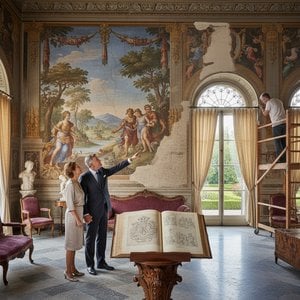
Фреска как Семейное Наследие: Сохранение Истории в Искусстве Стен
Узнайте о фресках как семейном наследии! История, техника создания, реставрация и сохранение. Экспертные советы и вдохновение для вашего дома. .

Искусство, живущее с вами: эмоциональная сила индивидуальной интерьерной фрески
Узнайте о фресках в интерьере: история, технологии, выбор и уход. Создайте уникальный дизайн с экспертами! Качество и индивидуальный подход гарантированы.