
- Главная

- Печать на холсте
- Александр Дейнека
- Evening

 Заказать репродукцию Купить цифровое изображение
 Поделиться
 Поделиться
 Детали произведения
 Добавить в избранное

 Скачать
 Похожие работы
 Рентгенография
 Слайд-шоу
Evening

 Читать далее
Жикле / Арт-принт
Печать (жикле) или холст музейного качества с быстрыми сроками изготовления и широким выбором вариантов отделки.




P118B $10

P118H $10

P118W $10

P438Z $10

P508JH $12

P508YH $12

P805H $10

P805Z $10

P919BZ $10

P919G $10

P919XJ $10

P959ZH $10

P968JZ $12

W106C $8

W218G $10

W218JH $8

W218Y $10

W307PJ $10

W316G $10

W316PJ $8

W316Y $10

W398PJ $8

W4111J $10

W500HY $15

W500JH $15

W692G $12

W849H $8

W940BG $15

W953PJ $8




Выберите один из наших стандартных размеров, соответствующих оригинальным пропорциям произведения искусства.

Вы можете указать свои собственные размеры, чтобы репродукция идеально подошла под конкретную раму или пространство. Если выбранный вами размер не будет соответствовать пропорциям оригинала, мы либо обрежем произведение, либо дополним изображение зеркальным отражением краев или однотонной заливкой. Перед началом производства вам будет отправлен цифровой макет для утверждения.
Пожалуйста, обратите внимание, что предварительный просмотр на экране не отображает фактическую обрезку или расширение изображения. Только макет точно покажет финальную композицию.
Несмотря на возможность заказа индивидуальных размеров, мы рекомендуем выбирать размер из предопределенного списка, чтобы сохранить оригинальные пропорции.
Доставка по всему миру () за 2 недели вместо стандартных 4/5 недель. (20 Июль)

Бесплатная экспресс-доставка по всему миру

Высококачественный льняной холст

Полное страхование доставки

Гарантия возмещения таможенных пошлин

Гарантия точного соответствия цветов

Политика возврата в течение 60 дней (только при наличии дефектов)

Гарантия возврата 100% средств

Предложение оптовых скидок
 Вариант со стеклом доступен только для размеров менее 110 см

Evening
Жикле / Арт-принт
Размер репродукции
-


Итоговая стоимость
-
Описание предмета коллекционирования
A Glimpse into Rural Life: Aleksandr Deyneka’s “Evening”
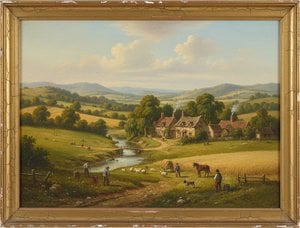
Aleksandr Deyneka's "Evening" (1934) offers a serene and evocative depiction of rural Russia, capturing a moment of quiet industry as the day draws to a close. The painting portrays two figures – a man and a woman – guiding a small herd of cows along a path. A horse grazes nearby, while in the distance, a subtle inclusion of a car hints at the encroaching modern world. Deyneka masterfully balances realism with impressionistic touches, creating an atmosphere that is both grounded and dreamlike. The composition isn’t about dramatic action; it's about the rhythm of daily life, the connection between people and animals, and the peaceful beauty of the countryside.Style & Technique: Socialist Realism Infused with Modern Sensibility
Deyneka was a pivotal figure in Socialist Realism, an artistic style favored by the Soviet regime that aimed to depict everyday life and celebrate the working class. However, Deyneka’s approach wasn't simply propagandistic. He infused this prescribed style with elements of modernism – particularly a dynamic sense of form and a bold use of color. The figures in “Evening” are rendered with a solidity and monumentality characteristic of Socialist Realism, yet the brushwork is loose and expressive, suggesting movement and atmosphere. His technique blends careful observation with artistic license, resulting in a work that feels both authentic and idealized. The painting’s palette is muted but warm, dominated by earthy tones that evoke the feeling of dusk settling over the landscape.Historical Context & Symbolism: A Changing Russia
Created during a period of rapid industrialization and collectivization in the Soviet Union, “Evening” can be interpreted as a representation of a nation undergoing profound transformation. The cows symbolize traditional rural life, while the distant car represents the advance of technology and modernization. The figures leading the cattle could be seen as embodying the spirit of progress – guiding Russia towards a new future. However, Deyneka avoids overt political messaging; instead, he focuses on the human element, presenting a scene that is both timeless and specific to its era.- The painting reflects the Soviet emphasis on labor and agriculture.
- It subtly acknowledges the changing landscape of rural Russia.
- The peaceful atmosphere suggests a harmonious relationship between people and nature, even amidst societal shifts.
Emotional Impact & Interior Design Considerations
“Evening” evokes a sense of tranquility, nostalgia, and quiet dignity. It’s a painting that invites contemplation and offers a respite from the frenetic pace of modern life. The artwork's subdued color palette and balanced composition make it incredibly versatile for interior design. It would complement a variety of styles, including farmhouse chic, mid-century modern, or even minimalist spaces seeking a touch of warmth and character. A high-quality reproduction of “Evening” could serve as a focal point in a living room, dining room, or bedroom, adding a layer of sophistication and cultural depth to any space. The painting’s themes of nature and simplicity also make it an ideal choice for creating a calming and inviting atmosphere.Похожие произведения


Биография художника
A Life Forged in Revolution: The Artistic Journey of Aleksandr Deyneka
Aleksandr Aleksandrovich Deyneka, born in 1899 in the provincial Russian city of Kursk, was an artist inextricably linked to the tumultuous currents of the twentieth century. His life and work mirrored the dramatic shifts of his nation – from the waning days of Tsarist Russia through the fervor of revolution, the industrialization of the Soviet era, and the shadow of war. Deyneka wasn’t merely a recorder of these events; he was an active participant, shaping and being shaped by the ideological forces that swept across his homeland. His early life offered little hint of the artistic prominence to come. He initially pursued studies at a railway college, simultaneously attending art workshops – a practical grounding that would later inform the dynamic energy and structural clarity present in his compositions. This period was cut short by the upheaval of 1917, propelling him towards Moscow and enrollment at Vkhutemas, the Higher State Artistic and Technical Workshops, a crucible of avant-garde thought and experimentation. It was here, under the tutelage of Vladimir Favorsky, that Deyneka honed his skills in graphic arts and printmaking, absorbing the principles of constructivism and developing a keen understanding of form and space.The Rise of Socialist Realism and Defining an Era
Deyneka’s artistic development unfolded alongside the evolving aesthetic demands of the Soviet state. Initially aligned with groups like OST (Society of Easel Artists), he embraced modernist principles, exploring dynamic compositions and a bold visual language. His early works reflected this influence – vibrant color palettes, energetic brushstrokes, and a fascination with movement were hallmarks of his style during this period. However, as Stalin consolidated power and Socialist Realism became the officially sanctioned style, Deyneka adapted – not by abandoning his artistic vision entirely, but by channeling it into forms acceptable to the regime. This wasn’t simply capitulation; rather, it was a strategic negotiation that allowed him to continue creating impactful work while navigating a politically fraught landscape. His paintings of the 1930s, such as *Collective Farmer on a Bicycle* (1935), became iconic representations of Soviet ideals – celebrating labor, athleticism, and the promise of a new socialist society. The painting is not merely a depiction of rural life; it’s an embodiment of forward momentum, a visual manifesto of progress and optimism. He skillfully blended these modernist elements with the prescribed themes and stylistic conventions of Socialist Realism, creating works that were both visually engaging and politically aligned. This period also saw his involvement with the *Windows of ROSTA* project, creating powerful propaganda posters that disseminated revolutionary messages throughout the country. These weren’t just advertisements; they were carefully constructed narratives designed to inspire loyalty and promote the virtues of the new Soviet order.Beyond Propaganda: Monumentality and Mosaic Mastery
While often categorized as a Socialist Realist painter, to limit Deyneka to this label is to overlook the breadth of his artistic talent. His ambition extended beyond easel paintings into monumental works and public art. He created large-scale canvases depicting historical events – *The Defense of Petrograd* (1928) being a prime example – imbued with dramatic intensity and a sense of epic scale. These weren’t simply illustrations of battles; they were attempts to capture the spirit of revolutionary struggle, transforming historical moments into mythic narratives. The figures in these paintings are often depicted in dynamic poses, conveying a sense of urgency and heroism. Deyneka's use of color is particularly striking – bold reds, yellows, and blues create a vibrant and emotionally charged atmosphere. Perhaps less known but equally significant is his work in mosaics. Deyneka’s designs for the Mayakovskaya metro station in Moscow are breathtaking examples of public art seamlessly integrated with architecture. These vibrant, dynamic compositions – depicting scenes of Soviet life and aspirations – transformed a utilitarian space into a palace of the people, demonstrating his versatility and mastery of different artistic mediums. These mosaics stand as enduring testaments to his ability to elevate everyday themes into grand visual statements. The intricate details and bold colors of these works are a testament to Deyneka’s technical skill and artistic vision.A Complex Artistic Identity
Aleksandr Deyneka's artistic identity is one of compelling complexity. He was an artist who navigated a shifting political landscape with both pragmatism and passion, adapting his style while maintaining a distinctive visual voice. His work wasn’t simply propaganda; it was a reflection of the hopes and anxieties of a nation undergoing radical transformation.- He embraced modernity but also sought to connect with the traditions of Russian art.
- He celebrated collective ideals yet retained a sense of individual artistic expression.
- His work continues to spark debate about the relationship between art, politics, and ideology.
Deyneka’s Major Achievements
Throughout his career, Aleksandr Deyneka achieved significant recognition and produced numerous impactful works:- Monumental Paintings: *Collective Farmer on a Bicycle* (1935), *The Defense of Petrograd* (1928) – These paintings exemplify his ability to convey complex themes through dynamic composition and vibrant color.
- Metro Station Mosaics: His designs for the Mayakovskaya metro station in Moscow are considered masterpieces of Soviet public art, showcasing his skill in creating large-scale, visually engaging mosaics.
- Graphic Art & Posters: He created numerous posters and graphic works for magazines like *Bezbozhnik u Stanka* and *Krasnaya Niva*, contributing to the visual culture of the Soviet era.
- Book Illustrations: Deyneka illustrated several notable books, including *Bustle* by N. Aseev and *Through the Pole to America* by G. F. Baidukov, demonstrating his versatility as an illustrator.

Александр Дейнека
1899 - 1969 , Россия
Основные сведения
- Artistic Movement Or Style: Социалистический реализм
- Artists Or Movements Influenced By This Artist: ['Конструктивизм']
- Artists Who Influenced This Artist: ['Фаворский В.А.']
- Date Of Birth: 20 мая 1899 г.
- Date Of Death: 12 июня 1969 г.
- Full Name: Aleksandr Aleksandrovich Deyneka
- Nationality: Русский
- Notable Artworks:
- «Колхозники»
- «Битва за Севастополь»
- «Спорт»
- Place Of Birth: Горск, Россия
Похожие статьи

Cultivating Visions: A Historical Exploration of Rural Life in Painting
Explore the rich history of rural life in painting! Discover masterpieces from Dutch Masters to Courbet & Watteau. Uncover the artistic and social significance of idyllic landscapes and peasant scenes.

Evoking Arcadia: A Historical & Aesthetic Exploration of Rural Landscape Art
Explore the rich history of pastoral landscape art, from classical Arcadia to Impressionism & beyond. Discover key artists, movements, and how to collect serene rural scenes for your home. Expert insights at ArtsDot.

Альфред Муннингс: 25 шедевров британского импрессионизма для вашего интерьера | ArtsDot
Погрузитесь в мир Альфреда Муннингса! 25 шедевров британского импрессионизма, запечатлевших красоту лошадей и сельской Англии. Репродукции картин высокого качества для вашего интерьера на ArtsDot.com.

Echoes of Rural Life: Nostalgia, Labor & Identity in Art History
Explore the rich history of rural life in art! Discover how Realism captured labor & identity through masterpieces by Van Gogh, Millet & more. Expert analysis for collectors and enthusiasts.
Evocations of Rural Life: A Historical Journey Through Landscape Painting
Explore the rich history of rural life in painting! Discover Impressionist masterpieces, Italian Macchiaioli scenes & the enduring appeal of pastoral landscapes. Find your perfect artwork at ArtsDot.



