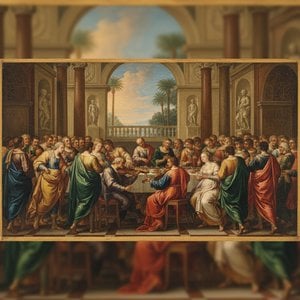
The Veronese Renaissance
Verona, 1484. The air in the city carries the weight of a changing era as Zenone Veronese enters the world. He moves through the Italian Renaissance not as a solitary figure, but as a painter deeply embedded in the shifting currents of the North Italian School. His brushwork begins to take shape under the shadow of giants, absorbing the visual language of his predecessors and contemporaries.
His early development is a process of absorption. He looks to the works of Giovanni Francesco Caroto and Girolamo dai Libri, finding in their compositions the foundation for his own emerging hand. As his career progresses, the influence of the Venetian mainland becomes undeniable. He draws from the palettes and structures of Palma Vecchio, il Romanino, and Giovanni Cariani, weaving these disparate threads into a singular, recognizable style.
A Life in Motion
The geography of his career is defined by movement across the Italian landscape. He does not remain tethered to a single studio, but carries his craft to various centers of patronage and religious devotion. His presence is felt in the following locations:
- Sala in the Ticino on Lago di Garda
- Rimini, where he worked in 1521
- The possibility of a period spent in Rome
His style carries a specific resonance, one that recalls the hand of Niccolo Giolfino. This connection places him within a specific lineage of Venetian-influenced painting, where the tension between form and color begins to define the visual experience of the sixteenth century.
The Final Years
The timeline of his life remains a subject of historical debate. While some records suggest he passed away in 1542, other accounts place his death as late as 1552 or 1554. This ambiguity reflects the nature of the period, where the boundaries of a life often blurred into the legacy of the work left behind. He eventually finds his end in Salò, a quiet conclusion to a life spent navigating the artistic complexities of the Republic of Venice.
His surviving legacy is anchored by works such as The Virgin and Child with the young Saint John the Baptist and five cherubs in the clouds, dated to 1550. Through such compositions, the quiet intensity of his Renaissance vision remains preserved, offering a window into the devotional and aesthetic priorities of a painter working at the heart of the Cinquecento.
Întrebări și răspunsuri
Unde pot găsi statistici despre operele lui Zenone Veronese?
Statistici despre lucrările lui Zenone Veronese sunt disponibile pe pagina de Statistici a artistului.
Unde pot fi găsite operele lui Zenone Veronese, grupate pe mișcări artistice?
Stilurile în care a activat Zenone Veronese pot fi vizualizate pe pagina de Toate mișcările de artă a artistului, care grupează operele pe mișcări artistice.
Unde pot vedea profilul cromatic al lucrărilor lui Zenone Veronese?
Modul în care Zenone Veronese utilizează culoarea în lucrările enumerate pe acest site web poate fi explorat pe pagina Genoma Paletei a artistului.
Unde pot vedea toate operele create de Zenone Veronese?
Toate lucrările lui Zenone Veronese de pe acest site web pot fi explorate în pagina Toate operele de artă a artistului.