

Cuprins
Detalii rapide
- Born: 1916, Ульжин, Южная Корея
- Works on APS: 30
- Nationality: Южная Корея
- Gift suitability: cadou de business
- Top-ranked work: Work
- Copyright status: Under copyright
- Color intensity:
- vibrant
- echilibrat
- Emotional tone: plin de energie
- Best occasions: punct focal
- Room fit: living room
- Mai multe…
- Art period: Modernism
- Movements:
- abstract art
- abstract expressionism
- Top 3 works:
- Work
- CIRCLE_A
- Work
- Also known as: Liu Yongguo
- Vibe: impactant
- Died: 2002
- Mediums: pictură
- Creative periods: mature period
- Typical colors:
- închis la culoare
- other
- Lifespan: 86 years
Test de cunoștințe despre artă
Fiecare întrebare are un singur răspuns corect.
Întrebare 1:
¿Quién fue Yoo Youngkuk?
Întrebare 2:
¿Dónde nació Yoo Youngkuk?
Întrebare 3:
¿Qué grupo artístico lideró Yoo Youngkuk?
Întrebare 4:
¿Cuál fue el tema favorito de las pinturas de Yoo Youngkuk?
Întrebare 5:
¿Qué movimiento artístico influyó en el estilo temprano de Yoo Youngkuk?
Yoo Youngkuk: A Pioneer of Korean Abstract Art
Yoo Youngkuk (劉永國; denoted as YYK) stands as a monumental figure in the history of Korean art, recognized universally as the first abstract painter and one of the foremost masters of modern Korean painting. His artistic journey began amidst profound societal transformations—the annexation by Japan, World War II, and the Korean War—yet he steadfastly pursued his vision of abstraction, forging a unique aesthetic that continues to inspire artists today. Born in 1916 in Uljin-gun, Gyeongsangbuk-do Province, Yoo’s formative years were steeped in the majesty of Taebaek Mountains, an experience that would subtly permeate even his most geometrically precise compositions. This connection to nature instilled within him a deep appreciation for its elemental forces and translated into a profound artistic impulse. ### Early Life & Education Yoo’s formal education commenced at Bunka Gakuin University in Tokyo in 1938, where he immersed himself in Western abstract movements spearheaded by Murai Masanari and Hasegawa Saburo—influences that irrevocably shaped his nascent style. Recognizing the transformative potential of experimentation, Yoo actively participated in avant-garde circles during Japan’s wartime occupation, absorbing inspiration from Russian Constructivism and Suprematism. Following liberation in 1943, he returned to Korea and joined forces with Kim Whanki and Lee Kyusang to establish *Sinsasil-pa* (新寫實派), marking the genesis of Korean abstract art as a collective endeavor. This group’s manifesto championed an artistic expression rooted in the realities of postwar Korea—interpreted through the lens of abstraction—challenging established conventions and sparking critical debate within the Korean art community. ### The Mountain Motif & Artistic Evolution Throughout his prolific career, Yoo Youngkuk consistently revisited the motif of the mountain, transforming it into a symbol of Korea itself: resilience, endurance, and an unwavering spirit. Unlike literal depictions, Yoo abstracted the mountain’s essence—its solidity, grandeur, and spiritual resonance—into powerful canvases dominated by color fields and geometric forms. His artistic evolution progressed from early explorations of color palettes influenced by Constructivism to increasingly complex compositions incorporating interlocking shapes and lines. Notably, his work during the 1960s and ’70s achieved a remarkable synthesis between organic textures and minimalist aesthetics, reflecting both his personal engagement with nature and his mastery of formal principles. ### Recognition & Legacy Yoo Youngkuk’s contributions to Korean art were widely acknowledged during his lifetime, culminating in a comprehensive survey by *Monthly Art* magazine that hailed him as the most outstanding artist among over a hundred contemporaries. His paintings—characterized by bold color fields, geometric precision, and an evocative portrayal of natural landscapes—were exhibited extensively both domestically and internationally, cementing his position as a pivotal figure within the global abstract art scene. Yoo Youngkuk’s enduring legacy resides not merely in his artistic output but also in his role as a catalyst for subsequent generations of Korean artists to embrace abstraction and explore innovative visual languages. His unwavering dedication to artistic experimentation—coupled with his profound connection to Korean culture—continues to inspire creativity and provoke contemplation.Articole conexe

Orphism: A Symphony of Color and Form – Exploring the Abstract Roots of Modern Art
Explore Orphism, the vibrant abstract art movement pioneered by Robert & Sonia Delaunay. Discover its unique color theory, lasting influence on modern art, and how to bring this 'symphony of color' into your home with ArtsDot.


Top 10 Capodopere Acrilic pe Pânză care au Schimbat Arta | ArtsDot.ro
Descoperă Top 10 capodopere acrilic pe pânză care au revoluționat arta! Explorează poveștile lui Pollock, Rothko și Warhol. Reproduceri de artă de lux & inspirație decor interior pe ArtsDot.com.
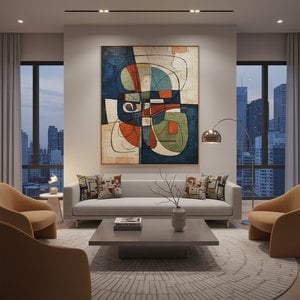
Farmecul Abstracțiunii: De Ce Rezonează în Designul Interior Modern
Descoperă farmecul artei abstracte și cum o poți integra cu succes în designul interior modern. Ghid expert pentru decoratori freelancer, tendințe actuale și inspirație de la .



