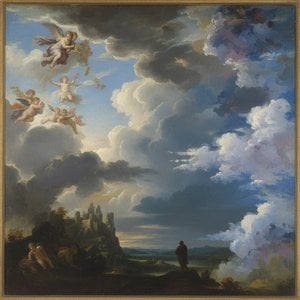
The Alpine Ideal
To look at a landscape by Wilhelm Scheuchzer is to see the Alps through a lens of deliberate, structured perfection. He did not merely record the terrain; he curated it. His work belongs to the Romanticism movement, yet it avoids the chaotic gloom often found in the era's more turbulent pieces. Instead, Scheuchzer focused on extensively idealised views of the alpine landscape, presenting a version of nature that feels both monumental and controlled. He stripped away the messy unpredictability of the mountains to present a vision of grandeur that satisfied the aesthetic demands of the mid-19th century.
His technical approach relied on a specific clarity. He captured the ruggedness of the peaks without sacrificing the order of the composition. This was not the art of the casual observer, but the work of a professional who understood how to translate the scale of Switzerland into a format suitable for the salons and royal courts of Europe.
A Munich Career
Scheuchzer’s trajectory took him from his birthplace in Hausen am Albis, Switzerland, to the influential art centers of Germany. By 1830, he had established himself in Munich, a city that functioned as a gravitational pull for the era's most ambitious painters. His presence in Munich was not merely incidental; he became a fixture of the local scene, securing a level of patronage that few of his contemporaries could claim.
His professional standing is marked by several key factors:
- His long-term residency and work within Munich starting in 1830.
- His direct connection to the Bavarian court through his work for Maximilian II of Bavaria.
- His ability to translate Swiss topography into the preferred Romantic style of the German-speaking world.
Historical Weight
The significance of Scheuchzer lies in his role as a bridge between the raw topography of the Alps and the refined tastes of the Bavarian monarchy. By painting for Maximilian II of Bavaria, he moved beyond simple landscape documentation into the realm of courtly art. He provided the visual language for a specific type of European Romanticism—one that was grand, orderly, and deeply tied to the identity of the mountain landscape. He died in Munich in 1866, leaving behind a body of work that remains a definitive example of how the natural world was reimagined during the Romantic period.
Întrebări și răspunsuri
Unde pot fi găsite lucrările lui Wilhelm Scheuchzer, grupate pe tehnici?
Pagina Toate tehnicile grupează operele lui Wilhelm Scheuchzer pe tehnici.
Unde pot fi găsite operele lui Wilhelm Scheuchzer, grupate pe mișcări artistice?
Pagina Toate mișcările de artă grupează operele lui Wilhelm Scheuchzer pe mișcări artistice.
Cum s-a evoluat creația lui Wilhelm Scheuchzer de-a lungul timpului?
Cariera lui Wilhelm Scheuchzer se desfășoară etapă cu etapă pe pagina Cronologie a artistului: o cronologie orizontală a operelor de artă, grupate în capitole reprezentative ale perioadelor de activitate.
Ce stări exprimă operele lui Wilhelm Scheuchzer?
Pagina Galerie pe stări de spirit a artistului prezintă operele lui Wilhelm Scheuchzer organizate în funcție de atmosfera lor.