If you remember one Academicist pictor, make it Paul Delaroche (1797–1856), the name behind Bonaparte Traversând Alpii și Napoleon Crossing the Alps. After that come Friedrich von Amerling, Eugene de Blaas, Jean-Paul Laurens și Édouard Debat-Ponsan. Our 20 picks go from Johann Christian von Mannlich (born 1741) to Charles Chaplin (born 1889), from 13 countries.
APicked by the ArtsDot.com team
How we picked them. We list the artists our catalogue links to Academicist, from the most famous down. Artists born after 1955 that we cannot yet check on Wikidata are left out. The Wikipedia number shows in how many of our 32 languages Wikipedia writes about them.
FrancezFrom ParisRomantism & NeoclasicismOn Wikipedia in 26 of 32 languages
Paul Delaroche (1797-1856) reprezintă o figură crucială în arta franceză a secolului al XIX-lea, întruchipând tensiunile dintre fervoarea Romanticismului și rigorile academismului.
AustrianFrom VienaAcademicismOn Wikipedia in 20 of 32 languages
Friedrich Ritter von Amerling (n. 1803, Viena, d. 1887, Viena) se impune ca o figură proeminentă în istoria artei austriene, fiind celebrat pentru devotamentul său neclintit față de tradiția academică și pentru capacitatea sa remarcabilă de a surprinde demnitatea și grația subiectelor aristocratice din era Romanticismului.
ItalianFrom Albano LazialeClasicism AcademicOn Wikipedia in 19 of 32 languages
Născut în Albano, lângă Roma, în 1843, Eugen de Blaas (cunoscut ulterior sub numele de Eugene von Blaas) a înflorit într-o familie profund împletită cu tradiția artistică. Tatăl său, Karl von Blaas, era el însuși un pictor respectat și profesor la Academia din Veneția, oferindu-i tânărului Eugen o fundație fără precedent în istoria artei, tehnici de frescă și principiile compoziției clasice.
FrancezFrom FourquevauxArt Academic FrancezOn Wikipedia in 19 of 32 languages
Jean-Paul Laurens (1838–1921) se impune ca o figură monumentală în ultima floare a artei academice franceze, întruchipând atât măreția sa, cât și contradicțiile inerente. Născut la Fourques, în Franța, el a evoluat sub îndrumarea prestigioasă a lui Léon Cogniet și Alexandre Bida, moștenind un spirit republican neînduplecat, nuanțat de o devotare neclintită față de tradiția artistică.
FrancezFrom ToulouseArt academicOn Wikipedia in 14 of 32 languages
În peisajul vibrant și adesea turbulent al artei franceze de la sfârșitul secolului al XIX-lea, puține figuri au întruchipat tensiunea dintre tradiția clasică și conștiința socială modernă atât de profund precum Édouard Debat-Ponsan. Născut la Toulouse în 1847, călătoria sa artistică a fost modelată de sălile prestigioase ale tradiției Beaux-Arts, după ce a studiat sub îndrumarea estimatului Alexandre Cabanel.
Născut sub numele de Charles Spencer Chaplin pe 16 aprilie 1889, în inima săracului East End din Londra, viața acestui geniu comic a fost, în sine, o dramă profundă. Ambii părinți ai săi, Hannah Harriet Hill și Charles Spencer Chaplin Sr., erau artiști de music-hall, o lume a aplauzelor trecătoare și a mișcării constante care avea să modele profound sensibilitățile artistice ale tânărului Charlie.
GermanFrom Frankfurt pe MainȘcoala DüsseldorfuluiOn Wikipedia in 9 of 32 languages
Adolf Schreyer, născut în Frankfurt în 1828, a fost un pictor ale cărui viață s-a împleticit inextricabil cu frumusețea puternică a cailor și cu lumina evocatoare a Orientului. Drumul său artistic a început în zidurile structurate ale Institutului Städel din oraș natal, urmat de studii formative în Stuttgart și München—o fundație clasică pe care să o construiască un stil remarcabil de sine însuși.
AmericanFrom PhiladelphiaPictură academicăOn Wikipedia in 8 of 32 languages
Jean Leon Gerome Ferris (1863 – 1930) ocupă un loc unic în peisajul istoriei artei americane, fiind recunoscut mai ales pentru monumentalul său ciclu ‘Pageant of a Nation’ – cea mai ambițioasă întreprindere de acest gen realizată de un singur artist la sfârșitul secolului al XIX-lea.
FrenchFrom La Ferté-sous-JouarreIllustration, Romanticism
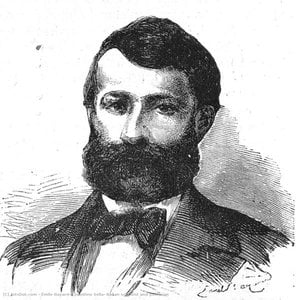
Émile-Antoine Bayard, born in the tranquil French town of La Ferté-sous-Jouarre in 1837, emerged as a pivotal figure in 19th-century illustration. The years between 1857 and 1864 were formative for Bayard, a period dedicated to exhaustive exploration across various artistic mediums. From 1864 onward, Bayard's career blossomed as an illustrator, initially documenting current events for magazines—including the tumultuous period of the Franco-Prussian War (1870–71).
FrenchFrom CoucouronAcademic artOn Wikipedia in 9 of 32 languages
Delphin Enjolras a fost un pictor academic francez născut în Courcouronnes, Ardèche, Franța, în anul 1857, și a plecat la nơi în Toulouse în 1945. Fiul lui Casimir Enjolras și Delphine Laurens, călătoria sa artistică a început prin formarea riguroasă la „École de dessin de la ville de Paris”, sub îndrumarea acuaciului Gaston Gérard.
Born: December 17, 1796, in Kinghorn, Fife, Scotland (though records indicate Edinburgh). Early Training: She received foundational training from her uncle, George Saunders, in London, mastering the art of miniature painting before expanding into oils and watercolors.
Manzel’s formative years were marked by exposure to influential artistic currents circulating in Berlin. The Academy's curriculum emphasized classical sculpture techniques, drawing inspiration from Michelangelo and Canova, shaping Manzel’s stylistic sensibilities profoundly.
GermanFrom StrasbourgOn Wikipedia in 5 of 32 languages
Born in the city of Strasbourg, Johann Christian von Mannlich entered a world where art was deeply intertwined with the service of nobility. He was the son of Konrad von Mannlich, a man who held the position of court painter to Christian IV, Duke of Zweibrücken. Under Charles II August, Duke of Zweibrücken, his responsibilities expanded from the canvas to the very stones of the landscape.
AustrianFrom ViennaRealistOn Wikipedia in 6 of 32 languages
In the golden light of the nineteenth century, few artists captured the rhythmic pulse of Mediterranean life with as much tenderness and precision as Ludwig Johann Passini. Born in Vienna on July 9, 1832, Passini was a man of dual heritage, an Austrian by birth whose artistic soul became irrevocably entwined with the canals and cobblestones of Italy.
ItalianFrom SalvarosaVenetian Genre PaintingOn Wikipedia in 3 of 32 languages
Noè Bordignon (1841–1920) remains one of the most tender chroniclers of the Venetian spirit, an artist whose brush captured not just the light of the Adriatic, but the very heartbeat of nineteenth-century domesticity. Born in Salvorosa, near Castelfranco Veneto—a region then under the dominion of the Austrian Empire—Bordignon’s early life was steeped in the rich academic traditions of Italy.
RussianFrom Saint PetersburgOn Wikipedia in 2 of 32 languages
In the quiet studios of the nineteenth century, Pyotr Petrovich Zabolotsky sought to capture the very essence of the human countenance. His life was one dedicated to the observation of character, finding truth in the subtle shifts of a gaze or the slight tension of a jawline. He moved through a world of shifting social hierarchies, translating the presence of individuals into the permanent language of oil and canvas.
“In his watercolors, he achieved a luminous quality that captured the fleeting effects of light, while his oil paintings, such as the evocative A Bridge in Venice, utilized masterful composition to draw the viewer into the heart of the scene.” — from our biography of Ludwig Passini (#17).