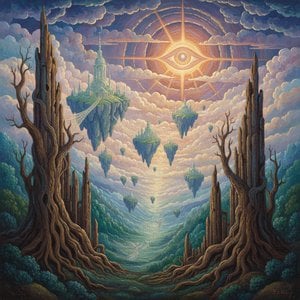
The Line and the Landscape
The work begins with a certain clarity of edge. In the early years, the focus remained on the world as it appeared: animals, still lifes, and the quiet geometry of landscapes. These pieces were defined by a specific way of seeing, using varied coloring and lines that emphasized the contour of a subject. There was a discipline in how a shape was bounded, a way of separating the subject from the space around it through a clear, deliberate stroke. This period of work was marked by a steady presence in the exhibition circuit, beginning with a solo show in Ulm in 1967 and growing into over 200 exhibitions in the decades that followed.
The studio was a place of constant movement between different geographies. The work carries the influence of the places where life was lived—Stuttgart, Munich, the hills of Tuscany, and the landscapes of Styria. These locations provided a backdrop for a practice that was as much about the hand as it was about the eye. Through the use of aquatint etchings and painting, the focus shifted from the literal to the conceptual.
A Shift Toward Abstraction
As the years progressed, the strictness of the early outlines began to soften and change. The figurative subjects—the people and the things that occupied a room—started to lean toward an abstract tendency. It was a transition from capturing the likeness of a thing to exploring the idea of it. This evolution saw the artist moving into more complex compositions, where the subject was no longer a fixed point but a part of a larger, more fluid arrangement.
This development was supported by a formal education at the Berlin Academy of Fine Arts, where the foundations of draughtsmanship were laid. The later works reflect this depth, moving away from the simple depiction of a landscape toward a more layered understanding of form. The themes became more varied, moving through several distinct phases:
- Portfolios exploring the weight of myths.
- Studies of historical figures such as Kant and Kleist.
- Interpretations of cityscapes and urban structures.
A Life in Print and Paint
The practice was never confined to a single medium. There was a constant dialogue between the precision of graphic art and the fluidity of painting. This was evident in the monographs and portfolios that emerged from the mid-seventies onward. The work was not merely about the finished image, but about the process of etching and the way ink sits on a surface. This technical rigor is visible in the way a composition is built, layer by layer, until the final form is achieved.
The legacy of this work is found in both private and public collections, spanning Germany and other regions. It is a body of work that tracks a life spent observing the world, from the sharp, defined lines of a young painter to the more abstract, thoughtful compositions of later years. The presence in the Munich and Darmstadt Secessions marked a place within the professional circles of the time, a recognition of a career built on the steady application of technique and a changing perspective on the visible world.
Întrebări și răspunsuri
Unde pot găsi statistici despre operele lui Simon Dittrich?
Statistici despre lucrările lui Simon Dittrich sunt disponibile pe pagina de Statistici a artistului.
Unde și când s-a născut Simon Dittrich?
Simon Dittrich s-a născut în Teplice, în anul 1940.
Din ce epocă face parte Simon Dittrich?
Simon Dittrich a activat în perioada Modern. Această perioadă situează activitatea artistului în context istoric.
Unde pot fi găsite operele lui Simon Dittrich grupate pe palete de culori?
Pentru a găsi lucrări de Simon Dittrich dintr-o anumită paletă de culori, accesați pagina După paletă de culori a artistului.