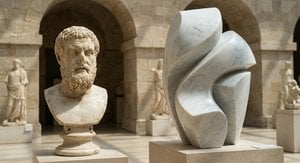
Rui Manuel de Carvalho e Vasconcelos Chafes: Sculptor of Minimalism and Memory
Rui Chafes, born in Lisbon in 1966, stands as a prominent figure in contemporary Portuguese sculpture. His artistic journey began with formal training at Faculdade de Belas Artes Lisboa in 1989, where he honed his skills before embarking on a transformative period of study at Kunstakademie Düsseldorf in Germany between 1990 and 1992 under the mentorship of Gerhard Merz – an encounter that profoundly shaped his artistic vision. This influence is palpable throughout his oeuvre, mirroring Merz’s dedication to geometric abstraction and exploring fundamental concepts of space and time. Early Influences: Merz's conceptual approach instilled in Chafes a belief in the power of simplicity as a conduit for conveying complex ideas. He recognized that profound statements could emerge from stripped-down forms, prioritizing essence over embellishment—a principle that would become central to his artistic practice. This conviction stemmed directly from observing Merz’s unwavering commitment to exploring core philosophical questions through geometric abstraction. Material Exploration: Primarily utilizing steel, Chafes meticulously crafts sculptures that prioritize form and texture over ornamentation. The chosen material speaks volumes about his artistic philosophy – robustness, permanence, and an unwavering commitment to geometric precision. He understood that steel's inherent qualities—its strength, its ability to withstand the passage of time, and its capacity for achieving remarkable textural variations—provided an ideal medium for expressing these concepts. This deliberate selection wasn’t merely aesthetic; it was a conscious decision to embody the core tenets of his artistic worldview. Conceptual Themes: Recurring motifs in Chafes’s work delve into themes of memory, loss, and the passage of time. These explorations are not literal representations but rather subtle gestures that invite contemplation on human experience. He sought to capture intangible emotions—the echoes of past events, the melancholic beauty of decay—translating them into sculptural forms that resonated with viewers on a visceral level. His sculptures functioned as visual meditations on mortality and remembrance, prompting audiences to confront their own relationship with time’s relentless flow. Notable Projects: Among his most celebrated works are “Depois de para sempre,” “Depois de para sempre XII,” and “Debaixo da pele XIV”—each demonstrating Chafes's mastery of steel sculpture and his ability to evoke profound emotional resonance. These pieces, often monumental in scale, inhabit public spaces across Europe and North America, establishing him as a respected voice within the international art scene. The artist’s meticulous attention to detail ensures that each piece possesses a quiet dignity and invites prolonged observation—a testament to his unwavering dedication to crafting sculptures that transcend mere visual appeal and engage viewers intellectually and emotionally. His work has been recognized by institutions such as Culturgest – Fundação Caixa Geral de Depósitos, where “Debaixo da pele XV” was showcased in 2018. Recognition & Awards: Rui Chafes’s contribution to contemporary sculpture transcends mere aesthetic beauty; it embodies a philosophical stance rooted in minimalist principles. By stripping away superfluous elements, he compels us to confront the fundamental nature of existence and invites reflection on our relationship with space and time—a legacy that continues to inspire artists and scholars alike. His work serves as a testament to the enduring power of geometric abstraction and its capacity to communicate profound truths about the human condition.Întrebări și răspunsuri
Cum s-a evoluat creația lui Rui Manuel De Carvalho E Vasconcelos Chafes de-a lungul timpului?
O relatare cronologică a creației lui Rui Manuel De Carvalho E Vasconcelos Chafes este disponibilă pe pagina Cronologie a artistului, unde operele se succed în ordinea creației lor, capitol cu capitol.
Din ce epocă face parte Rui Manuel De Carvalho E Vasconcelos Chafes?
Rui Manuel De Carvalho E Vasconcelos Chafes a activat în perioada Contemporan. Această perioadă situează activitatea artistului în context istoric.
Unde pot vedea profilul cromatic al lucrărilor lui Rui Manuel De Carvalho E Vasconcelos Chafes?
Profilul cromatic al lucrărilor lui Rui Manuel De Carvalho E Vasconcelos Chafes este prezentat în pagina Genoma Paletei a artistului.