The Soul of the Tyrolean Landscape
Maximilian Weiler stands as one of the most profound and influential figures in twentieth-century Austrian painting, a master whose work serves as a bridge between classical tradition and the vibrant energy of modernity. Born in Absam, Austria, his artistic journey was deeply rooted in the natural splendor of his homeland. His early experiences were shaped by a spiritual connection to nature, fostered during his youth in the movement Bund Neuland, where an enthusiasm for the wild landscapes of Tyrol became a fundamental pillar of his worldview. This deep-seated reverence for the earth would later manifest in a body of work that seeks not just to depict the landscape, but to capture its very essence and rhythm.
His formal training began at the Academy of Visual Arts in Vienna under the guidance of Professor Karl Sterrer. It was during this formative period that Weiler encountered the delicate beauty of ancient Chinese landscape art from the Sung Dynasty, an influence that would subtly weave into his later compositions, lending them a sense of structural integrity and timelessness. His early career was marked by significant public commissions, though not without controversy; his frescoes for the St. Theresa's Church on the Hungerburg near Innsbruck, which depicted traditional figures within a biblical scene, sparked intense debate due to their unique interpretation. Despite such tensions, his ability to command large-scale spaces through murals, mosaics, and glass paintings established him as a vital voice in the public artistic landscape of Austria.
A Symphony of Color and Abstraction
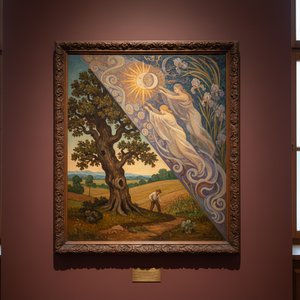
As his career progressed, Weiler’s style underwent a remarkable evolution, moving away from representational objects toward more fluid, abstract compositions. In the 1950s, he began to diverge from literal depictions, gravitating instead toward a language of pure color and texture. This transition reached a pinnacle in his later years when he worked almost exclusively in Eitempera, a technique that allowed for a rich, matte depth and a meticulous control over light and form. His works from this era, such as the evocative As all the Things… Variation, demonstrate a mesmerizing ability to dissolve the boundaries between the human spirit and the natural world. In these pieces, fiery reds and golden yellows dance across the canvas, creating a rhythmic, organic luxury that feels both autumnal and eternal.
The technical mastery of Weiler lies in his rejection of rigid outlines in favor of an expressive application of paint. He utilized texture to breathe life into foliage and landscape, capturing the flickering movement of light as if through a gentle breeze. This painterly approach allowed him to maintain a modern, structural integrity while evoking the emotional resonance of the Impressionist tradition. His work is characterized by:
- A profound meditation on the interconnectedness of life and nature.
- The use of vibrant, rhythmic color palettes to evoke emotional depth.
- A sophisticated interplay between textured layers and fluid movement.
- An ability to harmonize subtle human presences within expansive natural scenery.
Legacy and Recognition
Throughout his long and intensive seventy-year career, Maximilian Weiler earned the highest honors available to an artist in his nation. His significance was recognized on the international stage when he represented Austria at the XXX Venice Biennale in 1960. The accolades bestowed upon him reflect a lifetime of dedication to the refinement of Austrian contemporary painting, including the Grand Austrian State Prize for Fine Arts, the Medal of Tyrol, and the Austrian Decoration for Science and Art. His influence extended into the academic realm as well, serving as a professor at the Academy of Fine Arts Vienna for many years.
Today, his legacy is preserved in prestigious institutions such as the Essl Museum - Kunst der Gegenwart and the Museum Moderner Kunst Stiftung Ludwig (MUMOK). Weiler remains a monumental figure whose work continues to offer a sophisticated window into the soul of the landscape, inviting viewers into a world where color, light, and nature exist in a state of perpetual, beautiful harmony.
Întrebări și răspunsuri
Există o cronologie a operelor lui Maximilian Weiler?
Există o cronologie a lucrărilor lui Maximilian Weiler: pagina Cronologia operelor de artă a artistului ordonează operele în funcție de data creației.
Cum pot găsi toate lucrările lui Maximilian Weiler dintr-un anumit tip de tehnică?
Pagina Toate mediile grupează operele lui Maximilian Weiler pe tehnici.
Cum pot găsi lucrările lui Maximilian Weiler pe o temă specifică?
Operele lui Maximilian Weiler pot fi explorate pe baza cuvintelor cheie, în pagina de După cuvinte cheie a artistului. Fiecare cuvânt cheie grupează operele aferente.