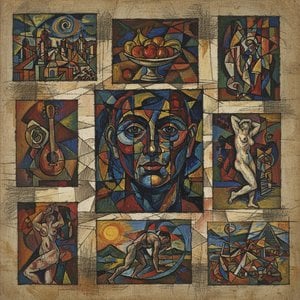
The Life and Artistic Journey of Kuno Veeber
Kuno Veeber was an Estonian painter and graphic artist whose career began in the late 1910s. Born Kuno Bernard Weber at Adila manor, he later Estonianized his surname from Weber to Veeber. His early artistic training commenced at the Ants Laikmaa Studio School in Tallinn in 1916. Following his studies at the Tallinn Nikolai I Gymnasium in 1917, he briefly studied medical science at the University of Tartu. During the Estonian War of Independence from 1919 to 1920, Veeber served as a cyclist in the Estonian Army. He also worked as a laborer on the construction of the new Estonian Parliament building on Toompea Hill in Tallinn.
Artistic Studies and Travels
Veeber studied with Nikolai Triik and sculptor Jaan Koort, and later entered the Higher Art School Pallas in Tartu, where he studied painting in Konrad Mägi's studio and graphic art techniques with Magnus Zeller. In 1923, he traveled to Germany with Zeller. Between 1924 and 1926, Veeber lived in Paris, becoming part of the School of Paris and studying under André Lhote and Demetrios Galanis. In 1927, supported by a grant from the Estonian Cultural Endowment Fine Arts Foundation, he traveled to Italy with his wife, Agaate. In Venice, he copied Tintoretto's Mercury and the Three Graces.
Veeber's works were exhibited in several locations, including:
- Paris
- Riga
- Kaunas
- Helsinki
- Cologne
- Copenhagen
- Moscow
- Rome
- Budapest
Întrebări și răspunsuri
Câte opere de artă ale lui Kuno Veeber pot fi vizualizate în catalog?
Puteți explora cele 1 de opere de artă de opere ale lui Kuno Veeber pe pagina Toate operele de artă.
Ce culori a folosit cel mai des Kuno Veeber?
Genoma Paletei lui Kuno Veeber este o pagină care prezintă profilul cromatic al întregii creații a artistului.
Unde pot vedea toate operele create de Kuno Veeber?
Toate lucrările lui Kuno Veeber de pe acest site web pot fi explorate în pagina Toate operele de artă a artistului.
Din ce epocă face parte Kuno Veeber?
Kuno Veeber a activat în perioada Modern. Această perioadă situează activitatea artistului în context istoric.