The Silent Maestro of Edo Portraits
Katsukawa Shuntei stands as a pivotal figure in the vibrant tapestry of Edo-period Japanese art, specifically within the celebrated Katsukawa school. Though often overshadowed by his more flamboyant contemporaries like Toyokuni I and Utamaro, Shuntei’s meticulous craftsmanship and profound understanding of human psychology cemented his legacy as one of Japan's foremost portrait artists—a distinction earned not through grand spectacle but through an unwavering dedication to capturing subtle nuances of character and emotion. Born Isoda Jirōbei in Tokyo, Shuntei’s artistic journey began under the tutelage of Katsukawa Shunshō, a master whose influence shaped his stylistic sensibilities and established him firmly within the school's tradition. Shunshō instilled in Shuntei a meticulous approach to composition and color—characteristics that would become hallmarks of his oeuvre.
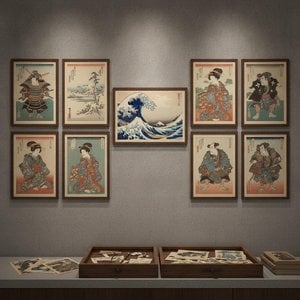
Unlike many artists of his time who prioritized dramatic poses and theatrical settings, Shuntei favored understated elegance, prioritizing accuracy and psychological insight above all else. This preference is particularly evident in his portraits of kabuki actors, where he skillfully rendered their expressions and postures with remarkable precision, conveying not merely physical likeness but also the inner spirit of the performer. His artistic output spanned a prolific career, encompassing depictions of sumo wrestlers, samurai warriors, and geisha—subjects that reflected the social landscape of Edo Japan. His prints are notable for their subtle tonal gradations and masterful use of chiaroscuro, techniques honed through years of observation and experimentation. He wasn't merely reproducing appearances; he was striving to distill the essence of his subjects into visual representations that resonated with viewers on an emotional level.
A Legacy of Precision and Soul
The brilliance of Shuntei lies in his ability to move beyond the surface. While the Katsukawa school was renowned for its realistic actor portraits, Shuntei elevated this tradition by infusing his subjects with a sense of quiet introspection. Consider his masterful handling of various genres:
- Yakusha-e (Actor Prints): His ability to capture the intense focus and momentary vulnerability of kabuki performers, moving away from stylized masks toward true human expression.
- Sumo and Warrior Prints: Depictions that balanced the raw power of wrestlers and samurai with a refined sense of dignity and anatomical accuracy.
- Bijin-ga (Beautiful Women): Portraits of geisha and elegant women that emphasized grace and subtle atmosphere rather than mere ornamentation.
Through these works, Shuntei contributed to a significant shift in the ukiyo-e movement, where the focus moved from the purely decorative toward the psychologically profound. His work remains a testament to the era's cultural richness, serving as a window into the souls of the people who inhabited the bustling streets of Edo. Even today, his ability to capture a contemplative gaze or a fleeting emotion continues to captivate art historians and enthusiasts alike, ensuring his place as a master of the silent, powerful portrait.
Întrebări și răspunsuri
Pot vizita un muzeu virtual al lucrărilor lui Katsukawa Shuntei?
Pagina Galerie 3D a lui Katsukawa Shuntei prezintă operele de artă ale artistului într-o galerie virtuală tridimensională.
Unde pot vedea operele lui Katsukawa Shuntei în ordine cronologică?
Operele lui Katsukawa Shuntei pot fi vizualizate în ordine cronologică pe pagina Cronologia operelor de artă a artistului.
Câte opere de artă ale lui Katsukawa Shuntei pot fi vizualizate în catalog?
Puteți explora cele 2 de opere de artă de opere ale lui Katsukawa Shuntei pe pagina Toate operele de artă.