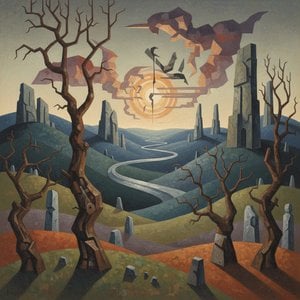
The Draughtsman's Shift
Born in Eindhoven in 1952, Hans de Wit has spent a career navigating the delicate boundary between what is seen and what is imagined. For many years, his practice was defined by the medium of painting, but a significant shift occurred roughly a decade ago when he abandoned the brush to focus on the precision of drawing. This transition was not a retreat but an expansion, as he began to utilize charcoal, pastel, and crayon to create works that possess the physical weight and scale of substantial paintings. His drawings often demand a slow, patient observation, revealing layers of detail that only emerge after the viewer has spent time within their constructed spaces.
His technical skill is rooted in a mastery of perspective and light, creating a sculptural quality that pulls the viewer into a virtual, often unsettling, reality. He possesses a particular ability to manipulate scale and proportion, frequently misleading the eye so that the familiar becomes unfathomable. In his hands, the structural and the organic become intertwined, creating a visual language where the distinction between the two begins to dissolve.
Motifs and Allegories
The imagery in De Wit's work often stems from the mundane observations of daily life, transformed through a lens of intense scrutiny. A simple walk or a cycle through a landscape can yield the foundation for a complex composition. His work frequently explores the following elements:
- The intersection of man-made structures and natural forms, such as steel constructions meandering like vines.
- The presence of biological life, including wasps' nests, snails, and mudskippers, rendered with startling clarity.
- The use of wax models to explore physical presence and the direction of sight.
- The tension between collapsed architecture and the persistent growth of thorny plants.
These subjects are rarely mere studies of nature; instead, they function as allegorical representations of existence. He draws upon a tradition of observation that echoes the sixteenth-century masters, yet he avoids the moral certainty often found in their work. Instead, De Wit creates a world defined by ambiguity, where the meaning of a shape or a creature remains perpetually open to interpretation.
The Architecture of the Image
The scale of his drawings is a defining characteristic, often reaching dimensions that require the viewer to engage with the work physically. In pieces such as Toad or The Vehicle, the sheer size of the paper allows for a density of detail that feels almost overwhelming. He uses mixed media, including ink and watercolour, to build up textures that feel surprisingly real despite their surrealist undertones. This technical precision allows him to render the most minute details of a subject while maintaining a sense of atmospheric depth.
His work exists in a space where the observer is invited to contemplate the act of seeing itself. By presenting motifs that are both highly detailed and strangely distorted, he challenges the viewer to look past the initial impression. The result is a body of work that feels both grounded in the physical world and entirely detached from it, a quiet expedition into the complexities of form and shadow.
Întrebări și răspunsuri
Există o cronologie a operelor lui Hans de Wit?
Există o cronologie a lucrărilor lui Hans de Wit: pagina Cronologia operelor de artă a artistului ordonează operele în funcție de data creației.
Unde pot fi găsite lucrările lui Hans de Wit, grupate pe tehnici?
Pagina Toate tehnicile grupează operele lui Hans de Wit pe tehnici.
Unde pot găsi statistici despre operele lui Hans de Wit?
Există o pagină Statistici pentru Hans de Wit, care prezintă statistici despre operele de artă ale acestuia pe acest site web.
Câte opere de artă ale lui Hans de Wit pot fi vizualizate în catalog?
Puteți explora cele 1 de opere de artă de opere ale lui Hans de Wit pe pagina Toate operele de artă.