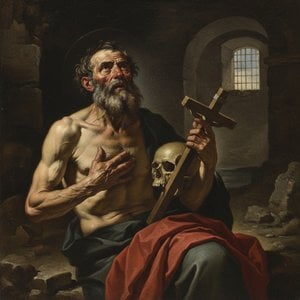
The Luminous Path of Giovanni Francesco Guerrieri
In the vibrant, shadow-drenched landscape of the seventeenth century, few painters captured the delicate equilibrium between classical grace and Baroque intensity as masterfully as Giovanni Francesco Guerrieri. Born in 1589 in Fossombrone, Guerrieri emerged from a lineage steeped in artistic tradition, a beginning that would eventually lead him to become a pivotal figure in the Italian Caravaggist movement. His life was a journey of profound stylistic evolution, moving through the intellectual corridors of Rome and the emotive landscapes of the Bolognese school, always seeking to bridge the gap between the anatomical precision of classicism and the visceral, dramatic fervor of the Baroque era.
The trajectory of Guerrieri’s talent was irrevocably altered by his formative years in Rome. Arriving in 1606, he found himself at the very epicenter of artistic revolution. It was here that he sought the mentorship of luminaries such as Orazio Gentileschi, an encounter that would leave an indelible mark on his aesthetic DNA. From Gentileschi, Guerrieri inherited a sophisticated approach to light—not merely the stark, punishing chiaroscuro of Caravaggio, but a more nuanced, lyrical interplay of shadow and illumination. This influence allowed him to prioritize naturalistic observation while maintaining an idealized beauty, creating works that felt both tangibly real and spiritually elevated.
A Legacy of Devotion and Drama
Guerrieri’s career was marked by significant commissions that showcased his ability to navigate the complex demands of both religious and aristocratic patrons. His time in Rome was not solely spent in a studio; he immersed himself in the Accademia Filosofica Romana, where humanist scholarship enriched his understanding of classical narratives. This intellectual depth is palpable in his religious compositions, such as his celebrated depictions of the Miracles of St. Nicholas of Tolentino. In these works, the artist does not merely recount a miracle; he invites the viewer into a moment of divine intervention, using expressive dynamism and anatomical accuracy to convey the weight of spiritual truth.
His reputation as a formidable painter was further cemented through his engagement with powerful figures like Marcantonio II Borghese. The commission to execute frescoes and paintings for the Borghese palazzo allowed Guerrieri to demonstrate his mastery of large-scale narrative, blending the structural discipline of the Bolognese disegno with the emotional urgency required by the Baroque style. His ability to command both the intimate scale of a devotional panel and the grand scale of a fresco solidified his standing among the elite artists of his generation.
Personal Resilience and Artistic Continuity
Beyond the grandeur of his commissions, Guerrier of Guerrieri’s life was touched by profound personal tragedy. The loss of his wife and daughter in a devastating accident cast a long shadow over his later years, yet even amidst such grief, his commitment to the craft remained steadfast. This period of his life saw him moving to Pesaro, where he lived with his surviving daughter, Camilla Guerrieri. A talented painter in her own right, Camilla carried forward the artistic legacy of her father, eventually serving as a court painter for the House of Medici.
The historical significance of Giovanni Francesco Guerrieri lies in his role as a stylistic bridge. He stood at the crossroads of several monumental movements:
- The Caravaggist Influence: Bringing the dramatic tension and naturalism of the Roman revolution to a broader audience.
- Bolognese Classicism: Maintaining the rigorous technical standards of form and composition inherited from the great Italian schools.
- Baroque Emotion: Infusing religious and secular subjects with a palpable, humanized sense of drama and movement.
Întrebări și răspunsuri
Din ce epocă face parte Giovanni Francesco Guerrieri?
Giovanni Francesco Guerrieri a activat în perioada Early Modern. Această perioadă situează activitatea artistului în context istoric.
Pot studia utilizarea culorii de către Giovanni Francesco Guerrieri în toate lucrările sale?
Profilul cromatic al lucrărilor lui Giovanni Francesco Guerrieri este prezentat în pagina Genoma Paletei a artistului.
Pot să explorez lucrările lui Giovanni Francesco Guerrieri în funcție de starea de spirit?
Lucrările lui Giovanni Francesco Guerrieri pot fi explorate în funcție de starea de spirit pe pagina Galerie pe stări de spirit a artistului, unde operele sunt organizate după stările lor de spirit.