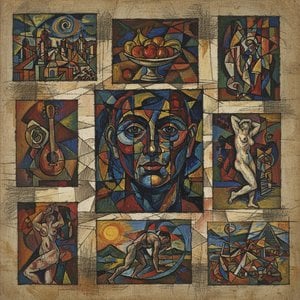
The Thread of Identity: The Art of Ghada Amer
Born in the vibrant, culturally complex atmosphere of Cairo in 1963, Ghada Amer’s journey is one of profound movement and shifting perspectives. Her early life was marked by the nomadic existence of a diplomat's daughter, traversing the landscapes of France, Libya, Morocco, and Algeria. This early exposure to diverse geographies and languages laid the foundation for an artistic practice that would eventually bridge the gap between Eastern heritage and Western contemporary discourse. Moving to France at age eleven, Amer immersed herself in the academic rigor of Paris and Nice, eventually finding her voice through the transformative years spent studying at the Villa Arlev in Nice. It was during this formative period that she began to grapple with the very essence of her identity, a realization sparked by the exclusionary boundaries of traditional art education which, at the time, often reserved painting instruction for men.
Amer’s artistic evolution is a captivating narrative of reclaiming the feminine. Her work serves as a powerful subversion of gendered expectations, particularly through her innovative use of embroidery—a medium historically relegated to the domestic sphere and dismissed as mere "women's work." By elevating needlework from a craft to a high-art form, she challenges the masculine hegemony of abstract expressionism. Her early explorations, such as the 1991 series Cinq Femmes Au Travail, focused on the repetitive, often stifling nature of domesticity, depicting women engaged in the mundane tasks of childcare and cleaning. However, as her practice matured, so did her thematic courage. She moved away from the depiction of "bored women" toward a radical re-imagination of female desire, utilizing imagery traced from pornographic magazines to reclaim the female body from the voyeuristic male gaze.
A Tapestry of Desire and Politics
The hallmark of Amer’s technique is a breathtakingly complex layering of media. Her most celebrated works are large-scale canvases where abstract, monochromatic washes of acrylic paint meet the delicate, tactile precision of embroidery. In these pieces, erotic figures—often captured in moments of ecstasy or autoeroticism—are stitched directly into the canvas, partially obscured by tangled threads and thick layers of gel medium. This technique creates a sense of depth and mystery, suggesting that much of female pleasure and identity remains veiled or hidden behind social constructs. Through this method, she transforms "forbidden" imagery into a site of empowerment, turning the objectification found in mass media into a celebration of female agency and subjecthood.
Beyond the canvas, Amer’s sculptural and installation works expand her dialogue on postcolonial identity and Islamic culture. Her 2001 installation, Encyclopedia of Pleasure, serves as a poignant example, where she utilized gold thread to embroider passages from a twelfth-century Arabic text onto stacked boxes. This work highlights the tension between historical progressive eras of Islamic culture and the contemporary restrictions placed upon women's bodies and voices. Similarly, her public installations, such as Love Park in Santa Fe, translate the intimacy of embroidery into the expansive landscape of the outdoors, inviting the public to contemplate the intersection of nature, gender, and social perception.
Legacy and Global Resonance
Ghada Amer’s significance in the contemporary art world lies in her ability to navigate the "politically incorrect" with immense grace and intellectual depth. Her work does not merely depict women; it actively constructs a new language for them. By integrating the aesthetics of abstraction with the politics of feminism, she has created a body of work that resonates far beyond the borders of Egypt or France. Her career has been marked by prestigious solo exhibitions at venues such as the Venice Biennale, Gagosian Gallery, and the P.S.1 Contemporary Art Center, cementing her status as a leading figure in global contemporary art.
Ultimately, Amer’s oeuvre is a testament to the power of reclamation. Whether she is addressing the complexities of American-Muslim identity, the weight of religious tradition, or the universal quest for beauty and pleasure, she remains steadfast in her commitment to speaking as a woman. Her art stands as a bridge between the seen and the unseen, the domestic and the monumental, ensuring that the threads of female experience are woven inextricably into the grand tapestry of art history.
Întrebări și răspunsuri
Pot explora operele lui Ghada Amer în funcție de tematică?
Pagina Atlas pe teme clasifică operele lui Ghada Amer pe teme.
Cum pot găsi lucrările lui Ghada Amer dintr-o anumită paletă de culori?
Pagina După paletă de culori grupează operele lui Ghada Amer în funcție de paletele de culori.
Care sunt cele mai vizionate opere ale lui Ghada Amer?
Pagina Statistici a lui Ghada Amer prezintă statistici calculate pe baza operelor de artă ale artistului listate pe acest site web.
Pot vizita un muzeu virtual al lucrărilor lui Ghada Amer?
Operele de artă ale lui Ghada Amer pot fi vizualizate într-o galerie 3D, pe pagina Galerie 3D a artistului.