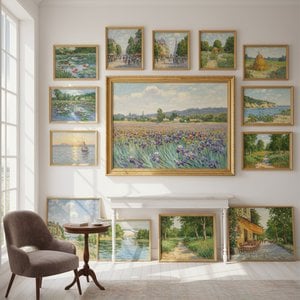
Geoffrey Hamilton-Rhoades: A Master of English Pastoral
Geoffrey Hamilton-Rhoades, born in Balham, London, in 1898, wasn’t a figure destined for the tumultuous currents of modern art initially. His early life, steeped in the traditions of his middle-class family – his father a respected civil servant and author – instilled within him a deep appreciation for classical culture and meticulous observation. This foundation, coupled with a formative education at Dulwich College, where he honed his artistic skills through drawing from classical casts, laid the groundwork for a career that would ultimately blossom into a celebrated depiction of the serene beauty of the English countryside.
His journey began not with grand pronouncements or revolutionary techniques, but with quiet dedication. After serving in the Mercantile Marine during World War I – an experience that undoubtedly broadened his perspective – he enrolled at the Slade School of Fine Art under the tutelage of Professor Henry Tonks. It was here, amidst a cohort of aspiring artists, that Rhoades’s innate talent truly began to emerge. Tonks's astute observation, famously noting Rhoades’s “something which I have not – imagination,” proved pivotal, recognizing a unique ability to imbue his landscapes with a subtle emotional resonance.
Early Influences and the Ruskin School
Rhoades’s artistic development was profoundly shaped by several key figures. The Slade provided him with technical mastery, but it was also through fellow students like John Mansbridge that he encountered the vibrant community of artists emerging in London. He found kinship with Charles Mahoney and James Laver, absorbing their perspectives on contemporary art and design. Crucially, Rhoades’s life took a transformative turn when he became associated with the Rothenstein family, particularly Michael Rothenstein, who introduced him to the influential Great Bardfield group – a collective of artists centered in the idyllic village of Bawden in Hertfordshire.
This connection to Great Bardfield proved instrumental. Rhoades’s work during this period began to reflect the group's emphasis on celebrating rural life and capturing the essence of the English landscape. He spent time at Stoke Rochford House, a retreat for artists, where he created murals and portraits, further refining his style and developing a distinctive approach to color and composition. The Turnor family’s hospitality fostered a sense of belonging and provided him with invaluable artistic guidance.
Teaching and Artistic Evolution
Rhoades's career wasn't solely defined by his own creative output; he also dedicated himself to nurturing the next generation of artists. From 1935 to 1945, he served as an art master at Bishop’s Stortford College, a role that allowed him to share his knowledge and passion for painting. Later, in 1953, he accepted a position as a tutor at the Ruskin School of Drawing in Oxford, a prestigious institution renowned for its focus on traditional techniques and artistic principles. This tenure at Ruskin spanned nearly two decades, culminating in 1972, during which time he developed close relationships with figures like Percy Horton and Richard Naish.
During this period, Rhoades’s work evolved subtly, reflecting a deepening understanding of light, atmosphere, and the nuances of rural life. He continued to produce evocative landscapes – scenes of rolling hills, meandering rivers, and charming villages – often imbued with a sense of quiet contemplation. His subjects included the River Evenlode, capturing its tranquil flow and the surrounding countryside with remarkable detail and sensitivity.
Later Years and Legacy
In 1934, Geoffrey married Joan Jenner, and they built a life together in Cuddington, Buckinghamshire. The tragic loss of his sister, Esmee, in 1980 marked a profound sorrow for Rhoades, but he continued to create art until his death in 1980. Throughout his career, Rhoades’s work was exhibited at prestigious galleries such as the Ashmolean Museum, Mall Galleries, and Sally Hunter Fine Art, and his paintings are now held by institutions including the Tate Gallery and the British Museum.
Geoffrey Hamilton-Rhoades's legacy lies in his ability to capture the timeless beauty of the English countryside with a quiet grace and understated elegance. His paintings offer a poignant reminder of a simpler time, inviting viewers to pause and appreciate the subtle wonders of the natural world. He remains a significant figure in British landscape art, celebrated for his mastery of technique, his sensitive portrayal of rural life, and his enduring contribution to the artistic heritage of England.
Întrebări și răspunsuri
Pot sorta operele lui Geoffrey Hamilton Rhoades după culoare?
Pagina Indice Spectral organizează operele lui Geoffrey Hamilton Rhoades în funcție de culoare.
Pot să explorez lucrările lui Geoffrey Hamilton Rhoades în funcție de starea de spirit?
Pagina Galerie pe stări de spirit lui Geoffrey Hamilton Rhoades organizează operele de artă ale artistului în funcție de starea de spirit.
În ce mișcări artistice a activat Geoffrey Hamilton Rhoades?
Operele lui Geoffrey Hamilton Rhoades pot fi explorate pe baza stilului artistic în pagina Toate mișcările de artă a artistului.