The Lyrical Landscapes of Ferdinand Brunner
Born in the vibrant heart of Vienna on May 1, 1870, Ferdinand Brunner emerged as one of the most evocative voices in Austrian landscape painting during the late 19th and early 20th centuries. His journey into the world of fine art began not with a canvas, but within the dramatic shadows of the stage. At the tender age of fourteen, Brunner entered an apprenticeship with the esteemed court theatre painters—Carlo Brioschi, Hermann Burghart, and Johann Kautsky. This early immersion in scenography likely gifted him with a unique sense of composition and atmosphere, teaching him how to manipulate light and space to evoke profound emotion before he ever picked up a brush for the easel.
His formal transition from stage designer to master painter was solidified at the Academy of Fine Arts, Vienna. Under the mentorship of the renowned Eduard Peithner von Lichtenfels, Brunner refined his technical prowess, moving away from the theatrical toward the naturalistic. His talent was recognized almost immediately; by 1894, he had been honored with the Academy's prestigious Gundel-Prize for excellence. This period of academic rigor provided him with the foundation to explore the vast, undulating terrains of his homeland, eventually leading him to find his true vocation through a transformative study trip to Carinthia.
A Vision of Serenity and Light
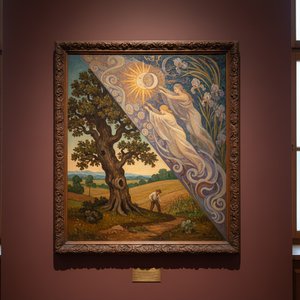
Brunner’s oeuvre is defined by a profound, almost spiritual connection to the landscape. He did not merely document geography; he captured the very soul of the terrain. His preferred motifs—the rolling hills of Lower and Upper Austria, the pastoral stretches of Bohemia, and the sweeping vistas of Hungary—were rendered with a characteristic lyricism. There is a latent yearning for serenity in his work, a quietude that invites the viewer to step into a world of calm and poetic reflection. Whether depicting a lonely boat on a still waterway or a farmhouse nestled within the Weinviertel hills, Brunner possessed an uncanny ability to freeze a specific mood, capturing the fleeting interplay of light and shadow.
His technique was marked by a delicate balance of precision and atmosphere. While his training allowed for meticulous detail, his heart sought the Stimmung—the atmospheric mood that defines the German and Austrian landscape tradition. This mastery earned him significant acclaim on the international stage, with notable exhibitions in Düsseldorf and Munich’s Glaspalast. His contributions to the art world were punctuated by several high honors, including:
- The Großen Goldenen Staatsmedaille, awarded in 1910 for his exceptional service to Austrian art.
- The Gustav-Figdor-Preis, received in 1935, recognizing his enduring impact on the painterly tradition.
- Honorary Professorship, bestowed upon him in 1922, cementing his status as a pillar of the Vienna artistic community.
Legacy and Enduring Presence
As the world moved through the tumultuous decades of the early 20th century, Brunner remained a steadfast chronicler of the natural world's enduring peace. His membership in the prestigious Vienna Künstlerhaus since 1901 placed him at the center of the era's most important artistic dialogues. Though his life came to an end in Vienna in 1945, his visual legacy remains vibrantly alive in some of Europe's most esteemed institutions. His works serve as a window into a lost era of pastoral tranquility, preserved within the collections of the Österreichische Galerie Belvedere, the Wien Museum, and the Gemäldegalerie of the Vienna Academy.
Today, Brunner is remembered not just as a painter of scenery, but as a poet of the earth. His ability to translate the quiet majesty of the Austrian landscape into a language of light and color ensures that his name continues to resonate with anyone seeking beauty in the stillness of nature. Through his eyes, the landscapes of Central Europe are forever imbued with a sense of timeless, melancholic grace.
Întrebări și răspunsuri
De unde este Ferdinand Brunner?
Ferdinand Brunner s-a născut în Austria.
În ce oraș și țară s-a născut Ferdinand Brunner?
Ferdinand Brunner s-a născut în Vienna, în Austria.
Ce stări exprimă operele lui Ferdinand Brunner?
Pagina Galerie pe stări de spirit a artistului prezintă operele lui Ferdinand Brunner organizate în funcție de atmosfera lor.
Pot să explorez lucrările lui Ferdinand Brunner în funcție de tehnică?
Operele lui Ferdinand Brunner pot fi explorate pe baza mediului utilizat în pagina de Toate tehnicile a artistului.