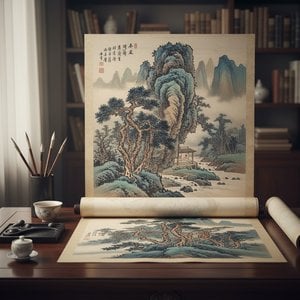
The Quiet Brush of She County
In the hills of She County, Anhui, a man named Jiang Fang began a life that would eventually be known by many other names. He was a man of many disciplines, moving between the precision of seal cutting and the fluid grace of calligraphy. His hands were accustomed to the weight of a brush and the sharp edge of a carving tool. He lived through the transition of dynasties, a period of shifting loyalties and changing landscapes in China. His work was not a loud declaration, but a steady presence in the shifting currents of the Ming and Qing eras.
His landscapes were built with a specific kind of intention. He favored dry and dark brushstrokes, a technique that allowed the texture of the paper to speak alongside the ink. There is a certain weight to his compositions, a sense of the earth and stone captured through deliberate, unhurried movements. He did not seek to decorate, but to record the essence of the terrain through the interplay of light and shadow created by the ink's density.
A Life of Many Names
To understand his presence in history, one must look at the various identities he carried. He was a man who existed within several layers of tradition, often referred to by names that reflected his character or his scholarly pursuits. His life was defined by these various roles:
- Painter of landscapes
- Poet and writer
- Seal cutter
- Calligrapher
His connection to the Xin'an School placed him within a specific lineage of thought and style. This was not a matter of mere membership, but a way of seeing the world through the lens of his surroundings. His landscapes were not just views, but reflections of a specific way of being in the world, captured through the ink and the brush.
The Mark of the Ink
The legacy of his work remains in the quiet details of his brushwork. His landscapes, such as those held in the Palace Museum in Beijing, show a mastery of the dry stroke. This method requires a certain restraint; one cannot hide a mistake behind a heavy wash of ink. Every line is a choice. Every dark stroke is a decision about where the mountain meets the sky. He lived until 1691, leaving behind a body of work that speaks of a man who understood the value of a single, well-placed mark.
Întrebări și răspunsuri
Unde pot fi găsite lucrările lui Cheng Sui, grupate pe tehnici?
Pentru a găsi toate lucrările lui Cheng Sui dintr-un anumit mediu, accesați pagina Toate tehnicile a artistului.
Există o cronologie a operelor lui Cheng Sui?
Pagina Cronologia operelor de artă a artistului prezintă lucrările lui Cheng Sui ordonate cronologic, an de an.
Sub ce alte nume sau pseudonime este cunoscut Cheng Sui?
Cheng Sui este cunoscut și sub numele de Jiang Fang, Muqian, Gou Daoren, Gouqu, Qingxi.
Pot sorta operele lui Cheng Sui după culoare?
Pagina Indice Spectral organizează operele lui Cheng Sui în funcție de culoare.