Early Life and Artistic Training
Born in Hamburg, Germany, on 1 January 1837, Adolf Mosengel began his artistic development within the familiar confines of his home city. His initial training was provided by Gensler in Hamburg, a period that established the foundational technical skills necessary for a career in landscape painting. This early instruction provided the groundwork for a formal education that would eventually take him across the major artistic centers of Europe.
The trajectory of his training moved toward the prestigious Kunstakademie Düsseldorf, where he studied from 1854 to 1857. During these years, he worked under the guidance of Hans Gude, a period that likely deepened his understanding of the natural world. Following his time in Düsseldorf, Mosengel sought further refinement in Paris, remaining there from 1858 to 1859. This exposure to the French school added a new dimension to his developing perspective.
His education continued in 1861 when he moved to Geneva to study with Alexandre Calame. This period in Switzerland was significant, as it placed him in direct contact with the Alpine environments that would become central to his subject matter. By the time he settled in Hamburg and joined the Hamburg Artists' Association, Mosengel had gathered a diverse range of influences from Germany, France, and Switzerland, shaping the technical precision and atmospheric sensibility of his later works.
Landscape Painting and Travels
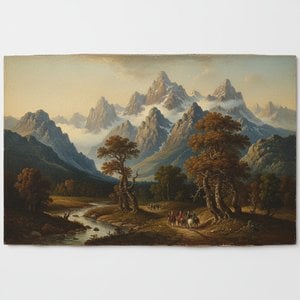
Mosengel was primarily a landscape painter who sought his subjects within the immediate textures of his surroundings. His early reputation was built upon the rugged majesty of Alpine scenes, capturing the dramatic topography of the mountains. As his career progressed, his focus shifted toward the more subdued landscapes of Westphalia, demonstrating a versatility in how he interpreted the natural world.
His artistic development was marked by significant movement across Europe. In 1879, he traveled to the lakes of Northern Italy, where he embraced the practice of painting en plein air. This period of direct observation allowed him to capture the shifting light of the Italian landscape firsthand. His works from the 1870s reflect these stays, documenting the specific atmosphere of the northern Italian lakes and the surrounding terrain.
- Chapel on the Lake of Lowerz
- Cattle and sheep in a landscape in the surroundings of Geneve
Notable Works and Artistic Subjects
Mosengel’s artistic output was defined by a deep connection to the topography of the regions he inhabited. His early focus on the German landscape is evidenced by his 1857 work, Westphalian Landscape. As his travels expanded, his subjects shifted toward the dramatic elevations of the Alps. He captured the quietude of Swiss life in pieces such as Mill near Geneva (1861) and Motif from the Bernese Oberland (1866). These works reflect a steady interest in the atmospheric qualities of mountainous terrain and the pastoral elements found within them.
The artist’s later years saw a continued devotion to the natural world, often working en plein air to capture immediate light and form. His oeuvre contains many landscapes from Italy and the Alpine regions, documenting the varied textures of these environments. In his depictions of the surroundings of Geneva, he focused on the coexistence of livestock and terrain, as seen in his painting of cattle and sheep in a landscape. This ability to render both the grand scale of the mountains and the intimate details of rural life became a hallmark of his practice.
- Chapel on the Lake of Lowerz
- Isola Bella from Stresa (1879)
- Village in the Bernese Alps
Social Circles and Personal Life
Mosengel was deeply integrated into the professional fabric of his home city, maintaining a steady presence within the Hamburg Artists' Association. His connection to this group was significant enough that, following his death, the association chose to honor him with a memorial exhibition in 1885. This recognition underscored his standing among his peers in the German art community.
His social orbit included an unexpected intersection with the intellectual figures of the era. In the summer of 1870, while staying at the Hotel Alpenclub in the Maderanertal, he met Friedrich Nietzsche and his sister. This encounter in the mountain valley remains a notable footnote in his biography, as he is likely the only painter known to have maintained a personal acquaintance with the philosopher.
Întrebări și răspunsuri
De unde este Adolf Mosengel?
Adolf Mosengel s-a născut în Germany.
Din ce epocă face parte Adolf Mosengel?
Adolf Mosengel a activat în perioada 19th Century. Această perioadă situează activitatea artistului în context istoric.
Pot să explorez lucrările lui Adolf Mosengel pe categorii de mișcări artistice?
Operele lui Adolf Mosengel pot fi explorate pe baza stilului artistic în pagina Toate mișcările de artă a artistului.