

Salvador Dalí: Surrealism, Subconscious Exploration & Artistic Innovation
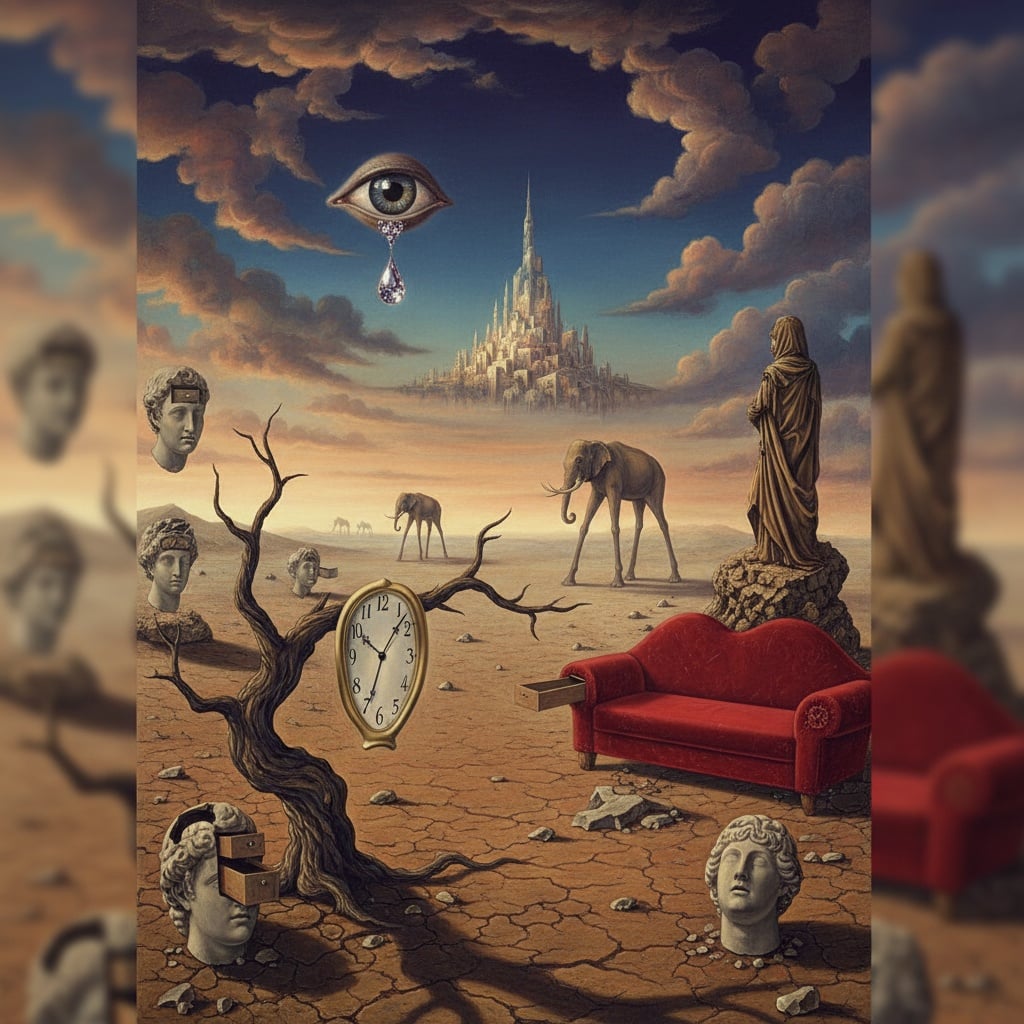
Cuprins
The Genesis of Surrealism: A Post-War Rejection of Rationality
Surrealism is an art and cultural movement that developed in Europe in the aftermath of World War I in which artists aimed to allow the unconscious mind to express itself, often resulting in the depiction of illogical or dreamlike scenes and ideas. I...
The aftermath of the First World War irrevocably shattered established norms, leaving a generation grappling with disillusionment and a profound sense of societal breakdown. From this fertile ground of existential questioning arose Surrealism, an artistic and intellectual movement that sought to liberate thought, expression, and perception from the constraints of reason. Born in Paris in 1924, largely through the writings of André Breton, Surrealism wasn’t merely a style; it was a philosophical revolt against the perceived failures of logic and the horrors unleashed by unchecked rationality. Breton advocated for accessing the unconscious mind – a realm of dreams, desires, and primal instincts – as the true source of artistic inspiration. This rejection of conventional thought processes paved the way for artists to explore illogical juxtapositions, bizarre imagery, and automatic techniques designed to bypass conscious control. It was an attempt to reconcile dream and reality into what Breton termed “surreality,” a higher plane of existence where the boundaries between inner and outer worlds dissolved.
Dalí's Early Influences & The Development of His Unique Style
 Salvador Dalí
Explore Salvador Dalí (1904-1989), the master of Surrealism! Discover dreamlike landscapes, iconic imagery like melting clocks & his lasting impact on art & pop culture. #SalvadorDali #Surrealism
Salvador Domingo Felipe Jacinto Dalí i Domènech, born in Figueres, Catalonia, in 1904, was a figure uniquely positioned to embrace the tenets of Surrealism. His early artistic training at the Madrid Academy of Fine Arts exposed him to both Impressionism and Renaissance masters – influences that would later manifest in his meticulous technique and dramatic compositions. However, it wasn’t simply academic skill that set Dalí apart; it was an innate fascination with the irrational, a penchant for self-promotion bordering on theatricality, and a deeply personal exploration of his own subconscious. His initial experiments flirted with Cubism and Futurism, but these were quickly superseded by a burgeoning obsession with psychoanalysis, particularly the work of Sigmund Freud. Dalí didn’t just *adopt* Surrealist principles; he embodied them, transforming his anxieties, desires, and obsessions into a highly personal visual language characterized by hyper-realistic detail, distorted forms, and unsettling symbolism. The precise rendering of impossible scenes became his signature, a deliberate paradox that heightened the dreamlike quality of his work.
Unlocking the Subconscious: Freud, Dreams, and Dalí’s Imagery
 Sketch of Sigmund Freud by Salvador Dali
Witness Salvador Dalí's captivating sketch of Sigmund Freud – a surrealist study capturing the famed psychoanalyst’s essence. Explore this unique piece at the Freud Museum London.
Dalí's encounter with Freud’s *Interpretation of Dreams* in 1928 proved to be a pivotal moment. He saw within Freudian psychoanalysis a framework for understanding his own inner world and a justification for the bizarre imagery that populated his canvases. Dreams, according to Freud, were not random occurrences but rather expressions of repressed desires and unconscious conflicts. Dalí embraced this notion wholeheartedly, attempting to systematically translate his own dreamscapes onto canvas. He developed what he called the “paranoiac-critical method,” a self-induced state of induced paranoia designed to unlock the subconscious and generate hallucinatory imagery. This wasn’t simply about *depicting* dreams; it was about creating images that were deliberately ambiguous, open to multiple interpretations, and capable of triggering associations within the viewer's own unconscious mind. The sketch of Sigmund Freud himself, a captivating study capturing the famed psychoanalyst’s essence, exemplifies this fascination – a testament to Dalí’s intellectual debt and personal connection to the father of psychoanalysis.
Iconic Works & Recurring Motifs: Clocks, Landscapes, and Symbolic Depth
Perhaps no image is more synonymous with Surrealism than the melting clocks in *The Persistence of Memory* (1931). This deceptively simple painting encapsulates Dalí’s exploration of time, decay, and the fluidity of reality. The soft watches, draped languidly over branches and rocks in a desolate landscape, are often interpreted as symbols of subjective experience – time not as a rigid construct but as something malleable and personal. Beyond clocks, recurring motifs permeate Dalí's oeuvre: ants representing death and decomposition; eggs symbolizing pre-life and hope; crutches signifying fragility and support; and the ever-present figure of Gala, his muse and wife, often depicted as a divine or idealized presence. The landscapes themselves are frequently barren and dreamlike, evoking a sense of isolation and psychological unease. *Sugar Sphinx* (1933), for example, presents a seemingly solid form rendered in an ephemeral material, challenging our perceptions of permanence and stability. Even his designs for posters, like the one for *The Secret Life of Salvador Dalí* (1942), showcase his mastery of pen & ink, distorted figures, and symbolic depth – a microcosm of his larger artistic concerns.
The Dalí Theatre-Museum: A Living Embodiment of Surrealist Vision
 Dalí Theatre and Museum
Explore Salvador Dalí's surreal masterpiece at the Dalí Theatre and Museum in Figueres! Immerse yourself in his largest collection of art, architectural illusions & a dreamlike theatrical experience.
To truly understand Dalí’s vision, one must experience the Dalí Theatre-Museum in Figueres. More than just a repository for his art, it is an immersive environment – a labyrinthine structure that embodies the artist's own subconscious mind. Built on the ruins of a former theatre, the museum is a theatrical spectacle in itself, filled with architectural illusions, unexpected juxtapositions, and deliberately disorienting spaces. The building *is* the artwork, blurring the lines between reality and fantasy. Visitors are invited to wander through Dalí’s largest collection of art, encountering his iconic paintings alongside sculptures, installations, and personal objects. The museum is a testament to Dalí's belief in self-promotion and his desire to create a total work of art – an environment that fully immerses the viewer in his unique worldview. It’s a space where logic is suspended, and the boundaries between dream and waking life become increasingly porous.
Dalí's Enduring Legacy: Impact on Art, Film, and Popular Culture
Salvador Dalí’s influence extends far beyond the realm of painting. His distinctive style has permeated popular culture, inspiring filmmakers, fashion designers, and artists across various disciplines. His collaborations with Alfred Hitchcock, most notably on *Spellbound* (1945), brought Surrealist imagery to a wider audience, demonstrating the power of dreams and symbolism in cinematic storytelling. Dalí’s exploration of psychological themes continues to resonate today, influencing contemporary art that delves into the subconscious mind and challenges conventional perceptions of reality. His meticulous technique, dramatic compositions, and unwavering commitment to his own unique vision have cemented his place as one of the most important artists of the 20th century. ArtsDot.com offers a stunning collection of Dalí’s masterpieces, allowing you to bring the captivating world of Surrealism into your own home. Explore our range of handmade oil paintings and museum-quality prints – each reproduction meticulously crafted to capture the essence of this visionary artist's enduring legacy. Discover dreamlike landscapes, iconic imagery like melting clocks, and experience the lasting impact of Dalí’s artistic innovation.
Articole conexe
Max Ernst: Cele Mai Iconice Lucrări – Artă Suprarealistă pentru Decorul Tău
Descoperă cele mai emblematice 25 de opere ale lui Max Ernst, pionierul suprarealismului! Explorează tehnicile inovatoare, simbolismul profund și inspirația din Dadaism. Găsește reproducerea perfectă pentru decorul tău pe ArtsDot.com – artă modernă de calitate muzeală.


