


 Vezi în context
 Trimite
 Distribuie
 Detalii
 Ghid
Ghid

 Descarcă
 Produse similare
 Radiografie
 Diaporama
 Statistici
Maithuna
 Oil On Canvas
- WallArt
- Madras Movement
 2006
2006- Contemporary
 176.0 x 104.0 cm
 Cholamandal Artists' Village
 Citește mai mult
Giclée / Imprimare artistică
Printuri giclée sau pe canvas de calitate muzeală, cu proces de producție rapid și opțiuni flexibile de finisare. ( Comandă pictură realizată manual Treci la imagine digitală)




P118B $10

P118H $10

P118W $10

P438Z $10

P508JH $12

P508YH $12

P805H $10

P805Z $10

P919BZ $10

P919G $10

P919XJ $10

P959ZH $10

P968JZ $12

W106C $8

W218G $10

W218JH $8

W218Y $10

W307PJ $10

W316G $10

W316PJ $8

W316Y $10

W398PJ $8

W4111J $10

W500HY $15

W500JH $15

W692G $12

W849H $8

W940BG $15

W953PJ $8




Alegeți dintre dimensiunile noastre prestabilite, care respectă proporțiile originale ale operei de artă.

Puteți introduce propriile dimensiuni pentru a se potrivi unui anumit cadru sau spațiu. Dacă dimensiunea selectată nu corespunde proporțiilor imaginii originale, vom decupa lucrarea de artă sau vom extinde imaginea cu margini oglindite sau cu o culoare uniformă. Un mockup digital va fi trimis pentru aprobarea dumneavoastră înainte de începerea producției.
Vă rugăm să rețineți că previzualizarea de pe ecran nu reflectă decuparea sau extinderea reală. Doar mockup-ul va arăta cu exactitate compoziția finală.
Deși dimensiunile personalizate sunt disponibile, vă recomandăm să selectați o dimensiune din lista predefinită pentru a păstra proporțiile originale.
Livrare în întreaga lume () în 2 săptămâni, în loc de cele 4/5 săptămâni standard. (23 Septembrie)

Livrare expres gratuită la nivel mondial

Pânză de in premium

Asigurare completă pentru transport

Garanție de rambursare a taxelor vamale

Garanția fidelității culorilor

Politica de retur în 100 de zile (doar pentru defecte)

Garanție de rambursare 100%

Reducere pentru comenzi multiple
 Opțiunea cu sticlă este disponibilă doar pentru dimensiuni de sub 110 cm

Maithuna
Giclée / Imprimare artistică
Dimensiune reproducere
-


Preț total
$ 62
Opere similare


Biografie artist
Robert Delaunay: A Pioneer of Color and Rhythm
Robert Delaunay, born Robert-Victor-Felix Delaunay in Paris on April 12, 1885, was a pivotal figure in the early development of modern art. His life, marked by both artistic innovation and personal drama, profoundly shaped his distinctive style – a vibrant synthesis of Cubism, Orphism, and Simultanism. Initially apprenticed to a theatrical designer, Delaunay’s early career focused on stagecraft, but it was his burgeoning interest in painting that ultimately defined him. He found himself drawn to the radical ideas circulating within Parisian artistic circles, particularly those championed by figures like Henri Matisse and Pablo Picasso, yet he forged his own unique path, one characterized by an intense exploration of color and its dynamic relationships. His work reflects a deep engagement with the world around him, from the bustling streets of Paris to the serene beauty of the Mediterranean coast.Early Influences and the Birth of Orphism
Delaunay’s artistic journey began in the early 20th century, coinciding with significant shifts in European art. He was deeply influenced by Neo-Impressionism, particularly the work of Paul Gauguin and Georges Seurat, which emphasized the use of pure colors and scientific color theory. However, Delaunay quickly moved beyond mere imitation, developing his own distinct approach – Orphism. This movement, named after the Greek word for “light,” sought to liberate color from its traditional representational function. Instead of depicting objects realistically, Delaunay used color as an independent element, creating dynamic rhythms and harmonies on the canvas. He collaborated closely with his wife, Sonia Delaunay, who was a key figure in developing Orphism’s visual language, often exploring geometric abstraction and textile design alongside him. Their shared aesthetic vision became a cornerstone of their artistic partnership.Key Characteristics and Artistic Techniques
Delaunay's paintings are immediately recognizable by their bold use of color – vibrant reds, yellows, blues, and greens—applied in flat planes with minimal shading or modeling. He employed techniques reminiscent of Cubism, breaking down forms into geometric shapes and presenting multiple viewpoints simultaneously. However, unlike the fragmented forms of Picasso’s Cubism, Delaunay's compositions are characterized by a sense of dynamism and movement. His canvases often feature overlapping circles, squares, and rectangles, arranged in rhythmic patterns that evoke feelings of energy and excitement. He frequently incorporated elements of Simultanism, a technique developed alongside Orphism, which aimed to capture the simultaneous perception of objects – how they appear at different moments in time. Delaunay’s use of color was not merely decorative; it served as a means of expressing emotion and conveying abstract ideas about space, light, and rhythm.Major Works and Historical Significance
Throughout his career, Delaunay produced a vast body of work encompassing paintings, sculptures, textiles, and designs. Notable examples include *Endless Rhythm* (1913), a dynamic composition dominated by overlapping circles and squares; *The Eiffel Tower* (1910-1914), which captures the iconic Parisian landmark through an abstracted lens; and his monumental panels for the Aeronautics pavilion at the 1937 Paris International Exhibition, showcasing his mastery of scale and color. His work was exhibited widely in Europe and America, gaining recognition from influential critics and collectors. Delaunay’s influence extended beyond painting, impacting fields such as graphic design and textile art. He played a crucial role in shaping the development of abstract art in the early 20th century, paving the way for later movements like Constructivism and Bauhaus.Later Years and Legacy
Robert Delaunay continued to paint and exhibit throughout his life, though his style evolved somewhat during his later years. He increasingly focused on exploring color relationships and creating abstract compositions that were both visually striking and emotionally resonant. He died in Montpellier, France, on October 25, 1941, leaving behind a rich legacy of artistic innovation. His pioneering work in Orphism helped to liberate color from its traditional role and opened up new possibilities for abstraction. Today, his paintings are celebrated for their vibrant energy, dynamic rhythms, and profound exploration of the relationship between color, form, and emotion. The Musée Matisse de Nice houses an extensive collection of his works, offering a valuable insight into the life and art of this extraordinary artist.
setlur gopal vasudev
1941 - , India
Informații rapide
- Artistic Movement Or Style:
- Divisionism
- Cubism
- Orphic Cubism
- Simultanism
- Artists Or Movements Influenced By This Artist:
- Klee
- Marc
- Apolinaire
- Artists Who Influenced This Artist:
- Neo-Impressionism
- Cézanne
- Date Of Birth: 1885-04-12
- Date Of Death: 1941-10-25
- Full Name: Robert Delaunay
- Nationality: French
- Notable Artworks:
- Endless Rhythm
- The Eiffel Tower
- City
- Place Of Birth: Paris, France
Articole conexe

The Language of Closeness: Intimacy & Representation in Art History
Explore the rich history of intimacy in art, from Renaissance courts to contemporary portraits. Discover how artists evoke emotion & connection – and commission a unique artwork at ArtsDot.

Pavel Filonov's Analytical Art: A Journey into Colorism & Cosmic Vision
Explore the revolutionary Analytical Realism of Pavel Filonov. Discover his unique color theory, cosmic vision & lasting impact on modern art. Expert insights for collectors.

Alfred Stevens: Capturing Parisian Elegance & Fin-de-Siècle Intimacy
Discover the captivating world of Alfred Stevens, master of Parisian elegance & intimate portraiture. Explore his techniques, influences, and legacy – a prized collection for discerning art enthusiasts.

Josep Mompou Dencausse: Exploring Intimacy & Catalan Identity Through Minimalist Expression
Explore the captivating world of Josep Mompou Dencausse, a master of Post-Impressionism whose intimate paintings reflect Catalan identity and minimalist beauty. Discover his life, style & legacy.
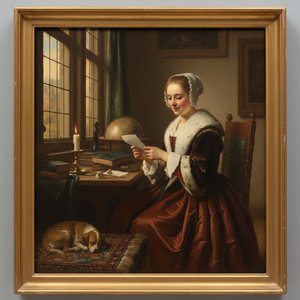
Gerrit Dou: Intimacy & Light in the Dutch Golden Age
Explore the exquisite world of Gerrit Dou, a master of Dutch Golden Age painting. Discover his intimate genre scenes, signature use of light, and lasting legacy. Learn about collecting Dou's works & their value.