


 Vezi în context
 Trimite
 Distribuie
 Detalii
 Ghid
Ghid

 Descarcă
 Produse similare
 Radiografie
 Diaporama
 Statistici
Happy Union
 Oil On Canvas
- WallArt
- Venetian Renaissance
 Renaissance
 186.0 x 186.0 cm
 Citește mai mult
Reproducere pictată manual în ulei
Pictură în ulei pe pânză, realizată manual de artiștii noștri la dimensiunea și ramele dorite de dumneavoastră, pe comandă. ( Comută pe versiunea Print Treci la imagine digitală)




P118B $10

P118H $10

P118W $10

P438Z $10

P508JH $12

P508YH $12

P805H $10

P805Z $10

P919BZ $10

P919G $10

P919XJ $10

P959ZH $10

P968JZ $12

W106C $8

W218G $10

W218JH $8

W218Y $10

W307PJ $10

W316G $10

W316PJ $8

W316Y $10

W398PJ $8

W4111J $10

W500HY $15

W500JH $15

W692G $12

W849H $8

W940BG $15

W953PJ $8




Alegeți dintre dimensiunile noastre prestabilite, care respectă proporțiile originale ale operei de artă.

Puteți introduce propriile dimensiuni pentru a se potrivi unui anumit cadru sau spațiu. Dacă dimensiunea selectată nu corespunde proporțiilor imaginii originale, vom decupa opera de artă sau vom extinde pictura cu elemente suplimentare pictate manual. O simulare digitală vă va fi trimisă pentru aprobare înainte de începerea producției.
Vă rugăm să rețineți că previzualizarea de pe ecran nu reflectă decuparea sau extinderea reală. Doar macheta va arăta cu exactitate compoziția finală.
Deși sunt disponibile dimensiuni personalizate, vă recomandăm să selectați o dimensiune din lista predefinită pentru a păstra proporțiile originale.
După plasarea comenzii, echipa ArtsDot.com va contacta clientul prin e-mail pentru instrucțiuni și îi va furniza o previzualizare a machetei
Livrare în întreaga lume () în 3-4 săptămâni, în loc de cele 5 săptămâni standard. (25 Septembrie). Fără compromisuri în ceea ce privește calitatea.

Livrare expres gratuită la nivel mondial

Pânză de in premium

Asigurare completă pentru transport

Garanție de rambursare a taxelor vamale

Garanția fidelității culorilor

Politica de retur în 100 de zile (doar pentru defecte)

Garanție de rambursare 100%

Reducere pentru comenzi multiple
 Opțiunea cu sticlă este disponibilă doar pentru dimensiuni de sub 110 cm

Happy Union
Tip de reproducere
Dimensiune reproducere
-


Preț total
$ 263
A Tapestry of Joy: Exploring "Happy Union"
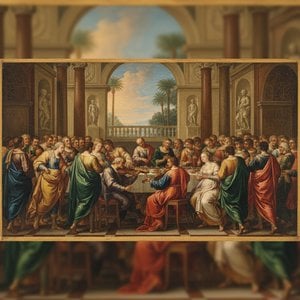
To gaze upon Paolo Veronese's "Happy Union" is to step directly into a moment suspended in golden light—a vibrant tableau vivant brimming with human connection and opulent grace. This painting does not merely depict a gathering; it captures the very essence of conviviality, the warm resonance found when souls connect over shared laughter and whispered secrets. The composition draws the eye deep into a richly appointed room, where every figure seems to contribute to an overwhelming atmosphere of pleasure. It is a masterclass in capturing ephemeral joy, making the viewer feel as if they have stumbled upon a private celebration within history's grandest salon.
Veronese’s Venetian Splendor and Technique
Paolo Veronese, that quintessential Venetian visionary, was renowned for his breathtaking use of color and his ability to infuse even domestic scenes with monumental grandeur. His technique here is nothing short of spectacular. One can almost feel the richness of the pigments applied by hand, the way the light seems to bounce off silk garments and polished wood. While Veronese absorbed influences from masters like Titian, his signature remained a dazzling palette—a celebration of jewel tones set against luminous skin and sumptuous drapery. The handling of paint suggests an effortless mastery, allowing the narrative action to remain paramount while the technical brilliance supports every gesture.
The Dynamics of Community and Symbolism
At the heart of the scene lies the human element—a gathering of at least nine individuals whose interactions suggest deep familiarity and mutual affection. The arrangement is carefully orchestrated; some figures anchor the foreground, drawing us in immediately, while others recede into the background, creating a wonderful sense of depth. Notice the subtle details that enrich this narrative: the gentle presence of the dog on the right, an unexpected touch of domestic life grounding the spectacle, and the elegant vase near the center, perhaps holding symbolic blooms. These elements transform what could be a simple portrait group into a complex meditation on community, companionship, and the enduring beauty of shared experience.
Bringing Renaissance Warmth Home
For those who seek to infuse their own spaces with the drama and warmth of High Renaissance artistry, "Happy Union" offers unparalleled inspiration. Reproducing this work allows one to bring not just an image, but an entire mood—one of sophisticated delight and enduring human connection—into a modern setting. The scale, at 186 x 186 cm, suggests its power as a central focal point for a grand hall or drawing-room. Owning a reproduction is acquiring a piece of emotional architecture; it promises to elevate any interior space with the timeless allure and masterful colorism that only Veronese could achieve.
Opere similare


Biografie artist
A Venetian Visionary: The Life and Art of Paolo Veronese
Paolo Caliari, known to the world as Paolo Veronese, emerged from the vibrant artistic landscape of 16th-century Venice as a master of color, composition, and opulent spectacle. Born in Verona in 1528, the son of a stonecutter, his early life was steeped in the visual richness of his surroundings – the classical architecture, sculpted forms, and burgeoning humanist ideals that characterized the region. His initial training under Antonio Badile and Giovanni Francesco Caroto laid a foundation in traditional techniques, but it was his move to Venice in the 1550s that truly ignited his artistic genius. The city itself became his muse, its bustling marketplaces, grand palazzi, and shimmering waterways informing the scale and drama of his work. He quickly absorbed the influences of established Venetian masters like Titian, whose mastery of color profoundly impacted Veronese’s palette, yet he forged a distinct style characterized by an unparalleled sense of theatricality and grandeur.The Painter of Feasts and Grand Narratives
Veronese's reputation rests upon his monumental paintings, particularly those depicting lavish feasts and biblical scenes transformed into dazzling displays of Venetian life. The Wedding at Cana, completed in 1563 for the Benedictine monastery of San Giorgio Maggiore, stands as a testament to his skill. This colossal canvas isn’t merely an illustration of the miracle; it's a vibrant panorama of 16th-century society, teeming with elegantly dressed figures, musicians, and architectural details rendered with breathtaking precision. The painting is not just about what happened at Cana but *how* it would have looked if it had occurred in Venice during Veronese’s time – a deliberate choice that challenged conventional religious depictions. Similarly, The Feast in the House of Levi, originally titled The Last Supper, caused controversy with the Inquisition due to its inclusion of contemporary figures and a seemingly irreverent atmosphere. Veronese defended his artistic license, asserting that painters were entitled to the same creative freedom as poets and jesters – a bold statement reflecting his belief in art’s power to interpret and reimagine sacred narratives. These works weren't simply religious depictions; they were celebrations of life, wealth, and the splendor of Venice itself. He wasn’t interested in austere spirituality but rather in capturing the joy and abundance of existence. His ability to seamlessly blend historical accuracy with imaginative storytelling cemented his place as one of Venice’s most celebrated artists.Influences and Artistic Development
While Titian’s influence on Veronese’s colorism is undeniable, his artistic development was a complex interplay of various influences. The architectural precision he brought to his compositions owes much to the classical tradition prevalent in Verona during his formative years, particularly the work of architects like Michele Sanmicheli. He also absorbed elements from Central Italian masters such as Raphael and Parmigianino, evident in the graceful lines and harmonious arrangements within his paintings. However, Veronese didn’t simply imitate these influences; he synthesized them into a uniquely Venetian style characterized by its dramatic use of light, vibrant color palettes, and meticulous attention to detail. He excelled at creating illusions of space and depth, employing perspective techniques to draw viewers into the heart of his elaborate scenes. His mastery of oil painting allowed him to achieve an unparalleled luminosity and richness of texture. He also ran a large workshop, with contributions from his brother Benedetto and his sons Gabriele and Carlo (or 'Carletto'), ensuring that his style continued to flourish even after his death in 1588.Major Achievements and Notable Works
Veronese’s career was marked by a remarkable output of significant works, each showcasing his distinctive style and technical prowess. Beyond the aforementioned *Wedding at Cana* and *Feast in the House of Levi*, he produced numerous altarpieces for churches throughout Venice and the surrounding region, including masterpieces such as The Reconciliation of St. Peter and Paul (1575-76) and a series of paintings for the Villa Barbaro at Maser, depicting mythological scenes with an astonishing level of detail and theatricality. His decoration of the library of S. Marco in Venice – featuring intricate ceiling frescoes – remains one of his most ambitious projects. His work during this period demonstrated not only technical skill but also a profound understanding of Venetian society and its values. The *Sacred Life of St. Francis* (1573-76) is another prime example, showcasing his ability to depict both the saint’s spiritual journey and the vibrant life of his followers.Legacy and Historical Significance
Paolo Veronese's impact extends far beyond the realm of Renaissance art. His work has resonated through centuries, inspiring artists across various disciplines. His dramatic compositions and vibrant color schemes have been cited as influences on everything from Baroque painting to modern cinema – even finding echoes in the visual aesthetics of Spaghetti Westerns. He was part of the “great trio” of Venetian painters—alongside Titian and Tintoretto—each contributing uniquely to the city’s artistic legacy, yet Veronese often stands apart for his sheer exuberance and celebration of earthly pleasures. His paintings continue to captivate audiences with their grandeur and spectacle, offering a glimpse into the opulent world of 16th-century Venice. Veronese's legacy is a testament to his artistic genius, his ability to capture the essence of an era, and his enduring contribution to the history of art.
Paolo Veronese
1528 - 1588 , Italia
Informații rapide
- Artistic Movement Or Style: Renaștere, Maneirism
- Artists Or Movements Influenced By This Artist: ['Raphael']
- Artists Who Influenced This Artist: ['Titian']
- Date Of Birth: 1528
- Date Of Death: 1588
- Full Name: Paolo Caliari Veronese
- Nationality: Italian
- Notable Artworks:
- Cana
- Levi
- Place Of Birth: Verona, Italia
Articole conexe
Paolo Veronese: A Renaissance Master of Color, Composition, and Venetian Splendor
Explore the vibrant world of Paolo Veronese, a Renaissance master renowned for his opulent compositions, masterful use of color, and dramatic Venetian scenes. Discover key artworks & legacy.

Jacopo Tintoretto: Cele Mai Remarcabile 25 de Capodopere – Artă Clasică pentru Decorul Tău
Descoperă cele mai frumoase 25 de picturi ale lui Jacopo Tintoretto! Explorează capodopere renascentiste venețiene, scene biblice dramatice și stilul unic al artistului. Reproduceri artă de calitate muzeală pentru decorul tău pe ArtsDot.com.

The Enduring Power of Painting: A Historical & Contemporary Exploration of Form and Emotion
Explore the rich history & enduring techniques of oil painting with ArtsDot. Discover masterpieces, learn about art collecting, and find authentic handmade reproductions crafted by skilled artists.

Drama Barocă: Cum să Aduceți Splendoare și Emoție în Interioarele Contemporane
Descoperiți cum să integrați splendoarea stilului baroc în locuința dumneavoastră! Ghid complet cu elemente de design, culori și inspirație pentru interioare luxoase și pline de emoție.

Barocul în Splendoare: Cele Mai Reprezentative 10 Capodopere Artistice | ArtsDot.ro
Descoperă splendoarea Barocului! Explorează cele mai importante 10 capodopere ale lui Caravaggio, Rembrandt și Rubens. Află poveștile din spatele picturilor iconice și adu eleganța clasică în casa ta cu reproduceri de artă premium pe ArtsDot.ro


