


Imaginea respectă alegerile tale: , .
Descriere obiect de colecție
Descoperă pictura impresionistă "Violinist Verde" de Marc Chagall! O operă emblematică în stil Cubism și simbolism, inspirată de tradiția muzicală evreiască și de lumea copilăriei artistului.
 Vezi mai mult
Biografie artist
Descoperă universul unic al lui Marc Chagall (1887-1985), pictorul simbolist și suprarealist cu influențe puternice din folclorul evreiesc! Admira opere impresionante și înțelepciunea artistică a unui geniu!
Reproducere pictată manual în ulei
Pictură în ulei pe pânză, pictată manual de artiștii noștri la dimensiunea și ramele dorite de dumneavoastră, pe comandă. ( Comută pe versiunea Print Comută pe Imagine Digitală)
Această lucrare este protejată de drepturile de autor
Lucrarea de artă afișată pe această pagină este protejată de legile privind drepturile de autor, ceea ce înseamnă că nu putem crea sau vinde în mod legal o reproducere identică. Această protecție este garantată prin acorduri internaționale, precum Convenția de la Berna și de legile naționale, inclusiv cele prevăzute de Legea dreptului de autor din S.U.A. – Titlul 17. Toate drepturile rezervate. Orice reproducere neautorizată este interzisă.
Ca alternativă respectuoasă și legală, oferim tablouri pictate manual, personalizate, inspirate de original. Artistii noștri experimentați și profesioniști studiază cu atenție stilul, starea de spirit și esența artistică a originalului pentru a crea o piesă nouă și unică, care evocă aceeași emoție – rămânând, în același timp, o creație originală în sine.
Această metodă respectă pe deplin reglementările privind drepturile de autor, deoarece nu implică copierea sau duplicarea operei protejate. În schimb, este o reinterpretare creativă – o pictură nouă, influențată de original, dar care nu este identică cu acesta.
Mai multe detalii despre această pictură
 Previzualizare
 Trimite prin felicitare
 Distribuie
 Detalii despre lucrare
 Ghid
Ghid

 Descarcă imaginea
 Produse similare
 Radiografie
 Galerie foto
 Întrebări și răspunsuri
 Statistici
Comandați tabloul dumneavoastră în patru pași simpli
Nu vă grăbiți. Puteți modifica orice răspuns; prețul din coșul de comandă se actualizează în funcție de fiecare alegere.
1 Pasul unu din patru
Ce dimensiune doriți?
Aceste dimensiuni păstrează proporțiile tabloului original. Ilustrația prezintă alegerea dumneavoastră pe un perete, deasupra unei canapele de doi metri.
Sau introduceți propriile dimensiuni
Alegeți dintre dimensiunile noastre prestabilite, care respectă proporțiile originale ale operei de artă.

Introduceți lățimea și înălțimea necesare pentru a se potrivi ramei sau peretelui dumneavoastră. Această lucrare este pictată manual, așa că, pentru o dimensiune cu o formă diferită, artistul poate picta puțin mai mult în jurul imaginii sau poate tăia puțin din margini — dumneavoastră decideți. Vă vom trimite o simulare digitală pentru aprobare înainte de a începe pictarea. Imaginea afișată pe această pagină nu reprezintă rezultatul real — doar simularea este reprezentativă.
2 Pasul doi din patru
Cum ar trebui pregătită: rulată, întinsă pe pânză sau înramată?
Prețurile de mai jos sunt pentru dimensiunea aleasă la primul pas.
Alege marginile tabloului pe pânză întinsă
Alege cadrul tău

Alb lei1

Margini difuze lei1

Extins lei1

P118B lei10

P118H lei10

P118W lei10

P438Z lei10

P508JH lei12

P508YH lei12

P805H lei10

P805Z lei10

P919BZ lei10

P919G lei10

P919XJ lei10

P959ZH lei10

P968JZ lei12

W106C lei8

W218G lei10

W218JH lei8

W218Y lei10

W307PJ lei10

W316G lei10

W316PJ lei8

W316Y lei10

W398PJ lei8

W4111J lei10

W500HY lei15

W500JH lei15

W692G lei12

W849H lei8

W940BG lei15

W953PJ lei8

H24-GOLD lei30

H24-SILVER lei30

H36-GOLD lei45

H36-SILVER lei45
Înramat
Ramă: . Dimensiuni cu ramă: .
3 Pasul trei din patru
Doriți să modificați ceva în tabloul respectiv?
Majoritatea oamenilor răspund negativ. Deoarece fiecare pictură este realizată manual, artistul nostru poate adapta lucrarea și pentru dumneavoastră.
După plasarea comenzii, echipa ArtsDot.com va contacta clientul prin e-mail pentru instrucțiuni și va furniza o previzualizare (mockup)
4 Pasul patru din patru
Câteva opțiuni de finisare
Toate sunt opționale. Răspunsurile deja selectate nu implică costuri suplimentare.
Cine este autorul?
Livrare în întreaga lume () în 3-4 săptămâni, în loc de cele 5 săptămâni standard. (3 Noiembrie). Fără compromisuri în ceea ce privește calitatea.
O plăcuță de identificare, ca la muzeu?
Detalii plăcuță din bronz gravat
This elegant plaque features the artist's name and the title of the artwork, finely engraved for a timeless presentation.
It is made from bronze with a refined, elegant finish. The text is precisely laser-engraved for a sharp and permanent result. Measuring 9x2 cm, the plaque is compact yet easy to read. It's built to be durable and scratch-resistant, offering a professional, museum-quality look. Mounting is simple thanks to the included adhesive backing.
Detalii plăcuță din acril transparent
The plaque includes essential engraved details such as the artist's name, the title of the artwork, the date it was created, the type of media used-like oil on canvas or watercolor-a brief description of the piece, and a QR code that links to the complete artwork information.
It is crafted from clear acrylic, offering a sleek, modern appearance. The text is UV-engraved in black to ensure strong visual contrast. With a size of 10x15 cm, it ensures optimal readability. It comes equipped with two metal hooks for secure wall mounting. The plaque is designed to be weather-resistant, making it suitable for various environments, and it includes interactive features that work seamlessly with smartphone scanning.
Detalii placă din acril negru
This elegant plaque includes engraved information such as the artist's name, the title of the artwork, the date it was created, the type of media used (like oil on canvas or watercolor), a short description of the artwork, and a QR code for quick access to more information.
The plaque itself is made from refined black acrylic with a premium finish. The text is laser-engraved in white for high contrast and readability. Its size is 10x15 cm, designed to be easy to read. It comes with two metal hooks for professional mounting. The design is sleek and fits any interior style. It is also weather-resistant and durable, with built-in digital integration for mobile compatibility.
Un lac protector?
Când aveți nevoie de el?
✓ Verifică și comandă
Tabloul tău, exact așa cum l-ai comandat

Violinist Verde
Tehnică de reproducere
Dimensiune reproducere
-

Selecție de artiști de elită
Mai multe detalii, rafinament și timp suplimentar de execuție
-

Ramă pentru reproducere artistică
-
-
Pentru opere de artă sau reproduceri care depășesc 105 cm (aproximativ 41 de inch) pe oricare dintre laturi, cadrul va fi livrat demontat, sub formă de kit. Această metodă asigură o livrare sigură și previne deteriorarea în timpul transportului.
Este necesară asamblarea profesională – acest produs nu este de tip DIY (de făcut singur).
Kitul trebuie asamblat, iar pânza întinsă, de către un legător de cadre experimentat, utilizând adeziv pentru lemn (neinclus în colet), o cheie pentru întinderea pânzei și cleme pentru a menține barele la unghi drept în timp ce adezivul se usucă. Asamblarea incorectă sau tensiunea neuniformă a pânzei pot deteriora permanent opera de artă și nu sunt acoperite de garanția noastră.
 Pentru opere de artă sau reproduceri care depășesc 105 cm (aproximativ 41 de inch) pe oricare dintre laturi, cadrul va fi livrat demontat, sub formă de kit. Această metodă asigură o livrare sigură și previne deteriorarea în timpul transportului.
Toate barele din lemn masiv sunt incluse, tăiate cu precizie la dimensiunea necesară.
Asamblat cu șuruburile incluse, plus adeziv pentru lemn pentru îmbinările de colț, care nu este furnizat și trebuie achiziționat de către tâmplarul dumneavoastră.
Sunt necesare unelte profesionale care nu sunt incluse: o șipte de întindere a pânzei (tensionator) și cleme pentru a menține barele la unghi drept în timp ce adezivul se usucă.
Important:
Îmbinările de colț necesită adeziv pentru lemn, barele trebuie fixate cu clești de strângere până când adezivul este complet uscat, iar întinderea pânzei pe cadrul asamblat necesită un clește pentru întins pânza. Niciunul dintre aceste elemente nu este inclus în kit. Vă rugăm să consultați un încadrator profesionist cu experiență înainte de a comanda această dimensiune.

Etichetă de prezentare
-
-

Lac de protecție
Lac lucios (intensifică nuanțele și oferă protecție împotriva luminii și a umidității)
-

Personalizează opera mea de artă
Exemple de elemente ce pot fi personalizate: Înlocuirea feței cu fotografia clientului; Adăugarea unui animal de companie (de exemplu, înlocuirea unei pisici cu un câine); Includerea unui mesaj ascuns în fundal; Modificarea peisajului sau a elementelor din fundal.
-

Livrare rapidă
Livrare la nivel mondial () în 3-4 săptămâni, în loc de cele 5 săptămâni standard. (3 Noiembrie). Fără compromisuri când vine vorba de calitate.
-
Livrare rapidă
Livrare la nivel mondial () în 5 săptămâni. (10 Noiembrie).
Inclus
Preț total calculat
lei 1252
Opțiunea cu sticlă este disponibilă doar pentru dimensiuni de sub 110 cm
Inclus în fiecare comandă
- Livrare expres gratuită la nivel mondial
- Pânză de in de înaltă calitate
- Asigurare completă pentru transport
- Garanție de rambursare a taxelor vamale
- Garanția fidelității culorilor
- Politica de retur în 100 de zile (doar pentru defecte de fabricație)
- Garanție de rambursare 100%
- Ofertă pentru comenzi multiple


The Green Violinist: A Symphony of Color and Memory
Marc Chagall's "Green Violinist," painted in 1924, is more than just a painting; it’s an evocative dreamscape rendered in oil on canvas. Housed within the esteemed Solomon R. Guggenheim Museum, this masterpiece exemplifies Chagall's unique blend of Cubism, Expressionism, and Surrealism, creating a visual experience that resonates with both intellectual depth and emotional warmth. The artwork depicts a violinist, strikingly dressed in purple with a vibrant green hat and red tie, seemingly floating above a misty village. This isn’t merely a depiction of a musician; it's an exploration of memory, tradition, and the enduring power of music within a changing world.
Style and Technique: A Fusion of Movements
Chagall’s artistic style defies easy categorization, yet "Green Violinist" beautifully illustrates his signature approach. Following his return to Paris after a significant period in Russia, Chagall channeled the influences of Cubism—evident in the fragmented forms and flattened perspective—while retaining a distinctly personal and expressive touch. The use of bold, saturated colors – particularly the striking green of the violinist’s hat and the contrasting purple of his suit – creates a dynamic visual harmony. Unlike strict Cubist works that prioritize geometric abstraction, Chagall infuses his composition with a lyrical quality, allowing elements to float and intertwine in a dreamlike fashion. The loose brushstrokes and sketchy details contribute to this sense of spontaneity and emotional immediacy.
Historical Context: Echoes of Russia and the Birth of "Fiddler on the Roof"
The creation of “Green Violinist” is deeply rooted in Chagall’s personal history and the cultural landscape of his time. The painting builds upon his earlier work, "Music" (1920), commissioned by the Moscow State Jewish Theatre. This commission significantly impacted the theatre's acting style, demonstrating Chagall’s profound influence beyond the canvas. The imagery—a fiddler suspended above a village—is believed to have served as direct inspiration for the title of the beloved 1964 musical "Fiddler on the Roof," highlighting the painting’s enduring cultural significance. The work reflects a period of transition and change, both personally for Chagall returning to Europe after time in Russia, and more broadly within European society.
Symbolism and Emotional Impact: Tradition, Change, and Spiritual Resonance
Beyond its aesthetic appeal, "Green Violinist" is rich with symbolic meaning. The violinist himself represents the enduring spirit of Jewish musical tradition—a vital presence in ceremonies and festivals as described by Chagall's Hasidic upbringing. His floating posture suggests a detachment from earthly concerns, symbolizing spiritual transcendence. The misty village below evokes a sense of nostalgia for a vanishing world, while the vibrant colors hint at hope and resilience. The painting’s emotional impact is profound; it evokes feelings of longing, joy, and a deep connection to cultural heritage. It's a celebration of the tension between change and continuity, material and spiritual elements in life.
A Timeless Masterpiece: Owning a Piece of Art History
"Green Violinist" stands as a testament to Marc Chagall’s genius—a work that continues to captivate audiences with its vibrant colors, dreamlike imagery, and profound emotional depth. Whether you are an art enthusiast, collector, or interior designer seeking a statement piece, a hand-painted reproduction of "Green Violinist" offers a unique opportunity to bring the beauty and spirit of this iconic artwork into your space.
Întrebări și răspunsuri
Cum se încadrează stilul operei „Violinist Verde” în contextul epocii creatorului său?
"Violinist Verde" de Marc Chagall face parte din mișcarea Cubism, reprezentativă pentru epoca Era modernă a creatorului său.
Ce culori domină în "Violinist Verde" de Marc Chagall?
Identitatea cromatică a operei "Violinist Verde" de Marc Chagall: o paletă Culori neutre, dominată de Espresso (#412d27).
Cât de saturată este paleta culorilor din "Violinist Verde"?
"Violinist Verde" de Marc Chagall prezintă o saturație de Culori discrete.
Opere similare


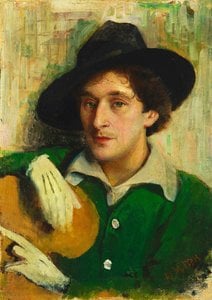
Marc Chagall
1887 - 1985, Білорусь
Biografie artist
A Life Painted in Dreams: The World of Marc Chagall
Marc Chagall, born Moishe Shagal in 1887 in the small Belarussian town of Liozna near Vitebsk, wasn’t merely a painter; he was a poet of color, a weaver of dreams, and a chronicler of memory. His life, spanning nearly a century, mirrored the tumultuous currents of the 20th century, yet his art remained steadfastly rooted in a deeply personal vision—one infused with the folklore of his Hasidic Jewish upbringing and an unwavering belief in the power of imagination. Vitebsk itself was more than just a birthplace; it became the emotional core of his artistic universe, a recurring motif populated by flying figures, whimsical animals, and the vibrant hues of remembered landscapes. The town’s unique blend of cultures—Russian Orthodox churches alongside bustling Jewish marketplaces—forged an aesthetic sensibility that would defy easy categorization throughout his long career. Though he sought formal training first with a local sign painter and later in St. Petersburg under Léon Bakst, and then in Paris at the Académie de la Grande Chaumière, Chagall never fully embraced any single artistic movement. He absorbed elements of Cubism, Symbolism, and Fauvism, but always filtered them through his own intensely personal lens, creating a style that was uniquely, unmistakably Chagall.Early Years and Artistic Beginnings
Chagall’s formative years were marked by hardship and displacement. Born into a family of impoverished Jewish artisans, he experienced the trauma of pogroms—violent anti-Jewish riots—which instilled in him a profound awareness of persecution and loss. Despite these challenges, he pursued his artistic ambitions with unwavering determination, initially studying sign painting before enrolling at St. Petersburg’s Imperial Academy of Arts. However, he quickly rejected the academic conventions of the time, preferring to explore alternative approaches to representation. His early canvases—works like I and the Village (1911)—already demonstrated his distinctive style: fragmented landscapes imbued with symbolic meaning, figures rendered in a stylized manner that defied realistic proportions, and a palette dominated by bold, expressive colors. This stylistic choice wasn’t merely aesthetic; it reflected Chagall's desire to convey emotion rather than simply depicting the external world. He sought to capture the essence of experience—the weight of memory—and to express his inner life through visual imagery.The Symbolist Influence and Vitebsk
Chagall’s artistic development was profoundly shaped by Symbolism, a movement that prioritized emotional expression over literal depiction. Artists like Gustave Moreau and Edvard Munch served as important influences, encouraging him to embrace dreamlike imagery and explore the subconscious mind. Vitebsk remained an enduring presence in Chagall's imagination—a town he revisited repeatedly throughout his life, both physically and artistically. The juxtaposition of Orthodox churches and Jewish marketplaces became a recurring motif in his paintings, symbolizing the tensions between tradition and modernity that characterized Russian Jewish culture. This visual language—characterized by flattened perspectives, stylized figures, and fantastical landscapes—became synonymous with Chagall’s artistic vision.The Revolution and Parisian Years
The Russian Revolution of 1917 irrevocably altered Chagall's life trajectory. He returned to Vitebsk, where he established an art school that briefly flourished before succumbing to the pressures of Soviet repression. This period was marked by both creative energy and political disillusionment—a tension that would continue to inform his artistic output. Simultaneously, Chagall moved to Paris in 1923, immersing himself in the vibrant cultural landscape of the city and engaging with fellow Surrealists like André Breton and Pablo Picasso. He experimented with new techniques and explored themes related to mythology and folklore, solidifying his reputation as a visionary artist.Mature Style and Major Achievements
Chagall’s mature style—characterized by lyrical abstraction and emotionally charged imagery—reached its zenith in the 1930s and 1940s. Paintings like Over Vitebsk (1920-1922) exemplify his masterful blending of Cubist influences with Symbolist sensibilities, creating canvases that are both intellectually stimulating and profoundly moving. The horrors of World War II prompted him to relocate to New York City, where he continued to produce monumental works—including The Four Seasons (1946-1948)—that captured the anxieties of the era while reaffirming his belief in beauty and transcendence. He received numerous prestigious commissions, including the ceiling of the Paris Opera (1964), a breathtaking spectacle of color and form that celebrated musical masterpieces. Chagall’s legacy extends beyond his paintings; he became an internationally recognized icon—a symbol of Jewish culture and artistic innovation—whose work continues to inspire artists and audiences alike. His enduring influence testifies to the power of art to transcend boundaries, to connect us to our shared humanity, and to illuminate the beauty and mystery of life.


Articole similare

Expresionismul German: 10 Capodopere Iconice pentru Decoruri de Artă
Descoperă cele mai importante 10 capodopere ale Expresionismului German! Explorează poveștile din spatele picturilor Kandinsky, Munch și Kirchner. Reproduceri de artă premium pentru un decor unic pe ArtsDot.com

Top 10 Picturi Celebre Dominate de Nuanțe de Cadmiu Verde | Artă, Decorațiuni Interioare & Inspirație ArtsDot.com
Descoperă Top 10 picturi celebre dominate de nuanțe vibrante de cadmiu verde! Explorează poveștile lui Monet, Van Gogh și alți maeștri ai artei impresioniste. Găsește inspirație pentru decorul tău și tablouri de perete excepționale pe ArtsDot.com.

Verdant Visions: Exploring the Symbolism & Aesthetic Impact of Green in Art History
Explore the rich history & symbolism of green in art! Discover iconic paintings, techniques, and how to bring verdant harmony into your home with ArtsDot's expert guide.