


 Previzualizare
 Trimite
 Distribuie
 Detalii despre lucrare

 Descarcă
 Produse similare
 Radiografie
 Diapozitive automate
Field of Mars
 Oil On Canvas
- WallArt
- Surrealism
 1955
1955- Modern
 149.0 x 105.0 cm
 Vezi mai mult
Reproducere pictată manual în ulei
Pictură în ulei pe pânză, realizată manual de artiștii noștri la dimensiunea și ramele dorite de dumneavoastră, pe comandă. ( Comandă printul Cumpără imaginea)




P118B $10

P118H $10

P118W $10

P438Z $10

P508JH $12

P508YH $12

P805H $10

P805Z $10

P919BZ $10

P919G $10

P919XJ $10

P959ZH $10

P968JZ $12

W106C $8

W218G $10

W218JH $8

W218Y $10

W307PJ $10

W316G $10

W316PJ $8

W316Y $10

W398PJ $8

W4111J $10

W500HY $15

W500JH $15

W692G $12

W849H $8

W940BG $15

W953PJ $8




Alegeți dintre dimensiunile noastre prestabilite, care respectă proporțiile originale ale operei de artă.

Puteți introduce propriile dimensiuni pentru a se potrivi unui anumit cadru sau spațiu. Dacă dimensiunea selectată nu corespunde proporțiilor imaginii originale, vom decupa opera de artă sau vom extinde pictura cu elemente suplimentare pictate manual. O simulare digitală vă va fi trimisă pentru aprobare înainte de începerea producției.
Vă rugăm să rețineți că previzualizarea de pe ecran nu reflectă decuparea sau extinderea reală. Doar macheta va arăta cu exactitate compoziția finală.
Deși sunt disponibile dimensiuni personalizate, vă recomandăm să selectați o dimensiune din lista predefinită pentru a păstra proporțiile originale.
După plasarea comenzii, echipa ArtsDot.com va contacta clientul prin e-mail pentru instrucțiuni și îi va furniza o previzualizare a machetei
Livrare în întreaga lume () în 3-4 săptămâni, în loc de cele 5 săptămâni standard. (6 Septembrie). Fără compromisuri în ceea ce privește calitatea.

Livrare expres gratuită la nivel mondial

Pânză de in de înaltă calitate

Asigurare completă pentru transport

Garanție de rambursare a taxelor vamale

Garanția fidelității culorilor

Politica de retur în 100 de zile (doar pentru defecte)

Garanție de rambursare 100%

Ofertă pentru comenzi multiple
 Opțiunea cu sticlă este disponibilă doar pentru dimensiuni de sub 110 cm

Field of Mars
Tehnică de reproducere
Dimensiune reproducere
-


Preț total calculat
$ 263
A Journey into the Heart of Dreams – The Genesis of “Field of Mars”
Marc Chagall’s “Field of Mars,” painted in 1955, isn't merely a depiction of a landscape; it’s an immersion into a deeply personal and profoundly symbolic dreamscape. Born Moishe Shagal in Vitebsk, Belarus, in 1887, Chagall spent his life translating the vibrant tapestry of memory, folklore, and faith onto canvas. This particular work embodies that signature style – a collision of recognizable forms with fantastical elements, rendered in a palette saturated with emotion and imbued with a sense of timelessness. The painting immediately draws the eye to a central figure, a woman radiating an ethereal glow, her long hair cascading around her like a halo. She cradles what appears to be a child or infant, both gazing upwards towards a luminous moon dominating the composition. This isn’t a realistic portrayal; it's a distillation of feeling, a visual poem reflecting Chagall’s own Jewish heritage and his lifelong fascination with the mystical.
Surrealism and the Language of Symbol
“Field of Mars” firmly places itself within the realm of Surrealism, though Chagall's approach transcends simple categorization. He doesn’t employ the stark juxtapositions or unsettling imagery often associated with the movement. Instead, he utilizes a softer, more lyrical style, layering symbols and creating an atmosphere of gentle disorientation. The setting – a vaguely recognizable town nestled amongst rolling hills – feels both familiar and utterly dreamlike. Houses and a church provide grounding elements, anchoring the fantastical figures within a semblance of reality, yet they are rendered with a deliberate looseness, contributing to the overall sense of unreality. The scattered birds, seemingly floating weightlessly in the air, add a touch of levity and suggest a connection to flight – both literal and metaphorical, representing freedom, spirituality, and perhaps even longing for escape. The red orb, likely the moon or sun, acts as a focal point, radiating warmth and illuminating the scene with an almost otherworldly light.
Historical Context: Vitebsk and the Echoes of Memory
To understand “Field of Mars,” it’s crucial to consider Chagall's formative years in Vitebsk. The town, a melting pot of Russian Orthodox and Jewish cultures, profoundly shaped his artistic sensibility. As he himself described, Vitebsk was "more than just a birthplace; it became the emotional core of my artistic universe." The painting is deeply rooted in this memory – a nostalgic yearning for a lost homeland, a celebration of cultural heritage, and an exploration of faith. The inclusion of religious imagery—the church—alongside elements of Jewish folklore speaks to Chagall’s complex identity as both a Russian and a Jew. This duality permeates his work, creating a unique visual language that is simultaneously personal and universal.
Emotional Resonance: A Portrait of Hope and Longing
“Field of Mars” isn't simply a beautiful image; it’s an emotionally resonant experience. The central figure, bathed in ethereal light, evokes a sense of maternal love, protection, and perhaps even a touch of melancholy. The child she cradles represents innocence, hope for the future, and the continuation of lineage. The painting’s overall mood is one of quiet contemplation – a moment suspended between reality and dream, inviting the viewer to lose themselves in its surreal beauty. It's a testament to Chagall’s ability to capture not just what he saw, but also what he felt—a profound connection to memory, faith, and the enduring power of the human spirit. Reproductions of this masterpiece offer a chance to bring this evocative dreamscape into your home, allowing its beauty and symbolism to enrich your space.
Opere similare


Biografie artist
A Life Painted in Dreams: The World of Marc Chagall
Marc Chagall, born Moishe Shagal in 1887 in the small Belarussian town of Liozna near Vitebsk, wasn’t merely a painter; he was a poet of color, a weaver of dreams, and a chronicler of memory. His life, spanning nearly a century, mirrored the tumultuous currents of the 20th century, yet his art remained steadfastly rooted in a deeply personal vision—one infused with the folklore of his Hasidic Jewish upbringing and an unwavering belief in the power of imagination. Vitebsk itself was more than just a birthplace; it became the emotional core of his artistic universe, a recurring motif populated by flying figures, whimsical animals, and the vibrant hues of remembered landscapes. The town’s unique blend of cultures—Russian Orthodox churches alongside bustling Jewish marketplaces—forged an aesthetic sensibility that would defy easy categorization throughout his long career. Though he sought formal training first with a local sign painter and later in St. Petersburg under Léon Bakst, and then in Paris at the Académie de la Grande Chaumière, Chagall never fully embraced any single artistic movement. He absorbed elements of Cubism, Symbolism, and Fauvism, but always filtered them through his own intensely personal lens, creating a style that was uniquely, unmistakably Chagall.Early Years and Artistic Beginnings
Chagall’s formative years were marked by hardship and displacement. Born into a family of impoverished Jewish artisans, he experienced the trauma of pogroms—violent anti-Jewish riots—which instilled in him a profound awareness of persecution and loss. Despite these challenges, he pursued his artistic ambitions with unwavering determination, initially studying sign painting before enrolling at St. Petersburg’s Imperial Academy of Arts. However, he quickly rejected the academic conventions of the time, preferring to explore alternative approaches to representation. His early canvases—works like I and the Village (1911)—already demonstrated his distinctive style: fragmented landscapes imbued with symbolic meaning, figures rendered in a stylized manner that defied realistic proportions, and a palette dominated by bold, expressive colors. This stylistic choice wasn’t merely aesthetic; it reflected Chagall's desire to convey emotion rather than simply depicting the external world. He sought to capture the essence of experience—the weight of memory—and to express his inner life through visual imagery.The Symbolist Influence and Vitebsk
Chagall’s artistic development was profoundly shaped by Symbolism, a movement that prioritized emotional expression over literal depiction. Artists like Gustave Moreau and Edvard Munch served as important influences, encouraging him to embrace dreamlike imagery and explore the subconscious mind. Vitebsk remained an enduring presence in Chagall's imagination—a town he revisited repeatedly throughout his life, both physically and artistically. The juxtaposition of Orthodox churches and Jewish marketplaces became a recurring motif in his paintings, symbolizing the tensions between tradition and modernity that characterized Russian Jewish culture. This visual language—characterized by flattened perspectives, stylized figures, and fantastical landscapes—became synonymous with Chagall’s artistic vision.The Revolution and Parisian Years
The Russian Revolution of 1917 irrevocably altered Chagall's life trajectory. He returned to Vitebsk, where he established an art school that briefly flourished before succumbing to the pressures of Soviet repression. This period was marked by both creative energy and political disillusionment—a tension that would continue to inform his artistic output. Simultaneously, Chagall moved to Paris in 1923, immersing himself in the vibrant cultural landscape of the city and engaging with fellow Surrealists like André Breton and Pablo Picasso. He experimented with new techniques and explored themes related to mythology and folklore, solidifying his reputation as a visionary artist.Mature Style and Major Achievements
Chagall’s mature style—characterized by lyrical abstraction and emotionally charged imagery—reached its zenith in the 1930s and 1940s. Paintings like Over Vitebsk (1920-1922) exemplify his masterful blending of Cubist influences with Symbolist sensibilities, creating canvases that are both intellectually stimulating and profoundly moving. The horrors of World War II prompted him to relocate to New York City, where he continued to produce monumental works—including The Four Seasons (1946-1948)—that captured the anxieties of the era while reaffirming his belief in beauty and transcendence. He received numerous prestigious commissions, including the ceiling of the Paris Opera (1964), a breathtaking spectacle of color and form that celebrated musical masterpieces. Chagall’s legacy extends beyond his paintings; he became an internationally recognized icon—a symbol of Jewish culture and artistic innovation—whose work continues to inspire artists and audiences alike. His enduring influence testifies to the power of art to transcend boundaries, to connect us to our shared humanity, and to illuminate the beauty and mystery of life.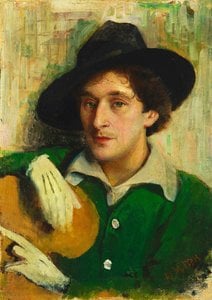
Marc Chagall
1887 - 1985 , Білорусь
Detalii rapide
- Artistic Movement Or Style: Cubism și simbolism
- Artists Or Movements Influenced By Acest Artist: ['Surrealism']
- Artists Who Influenced This Artist:
- Bakst
- Delaunay
- Date Of Birth: 6 iulie 1887
- Date Of Death: 28 martie 1985
- Full Name: Marc Chagall
- Nationality: Rusă (acum Belarus)
- Notable Artworks:
- I și Orașul
- În Vinovație
- Place Of Birth: Liozna, Belarus
Articole similare

Peisaje Romantice Iconice: 10 Capodopere Artistice pentru Decorul de Lux
Descoperă 10 capodopere romantice iconice de Caspar David Friedrich, Turner și alți maeștri. Explorează istoria artei, emoțiile din peisaje și găsește tablouri canvas perfecte pentru decorul tău pe ArtsDot.com!

Anthony Vandyke Copley Fielding: Rediscovering a Master of Romantic Landscape
Discover the captivating landscapes of Anthony Vandyke Copley Fielding, a master of Romantic watercolour painting. Explore his life, technique, and legacy with ArtsDot – your source for museum-quality art reproductions & expert appraisal.

Evocations of Place: A Historical Journey Through Landscape Art
Explore the rich history of landscape art with ArtsDot. Discover renowned artists, movements like Impressionism & Romanticism, and expert guidance for collecting timeless pieces. Find your perfect serene escape today!

John Constable: Cele Mai Frumoase 25 de Capodopere – Artă Clasică pentru Decorul Casei Tale
Descoperă cele mai frumoase 25 de picturi ale lui John Constable, maestru al peisajului englezesc! Explorează stilul romantic, Dedham Vale și capodopere precum The Hay Wain. Reproduceri artă clasică pentru decorul casei tale – ArtsDot.com.

Evocations of Place: A Historical Journey Through Landscape Art
Explore the rich history of landscape art with ArtsDot. Discover renowned artists, movements like Impressionism & tonalism, and expert guidance for collecting timeless pieces. Find your perfect serene escape today!


