


 Vezi în context
 Trimite
 Distribuie
 Detalii
 Guide
Guide

 Descarcă
 Produse similare
 Radiografie
 Diaporama
 Statistici
St Mark


 Citește mai mult
Reproducere pictată manual în ulei
Pictură în ulei pe pânză, realizată manual de artiștii noștri la dimensiunea și ramele dorite de dumneavoastră, pe comandă. ( Comută pe versiunea Print Treci la imagine digitală)




P118B $10

P118H $10

P118W $10

P438Z $10

P508JH $12

P508YH $12

P805H $10

P805Z $10

P919BZ $10

P919G $10

P919XJ $10

P959ZH $10

P968JZ $12

W106C $8

W218G $10

W218JH $8

W218Y $10

W307PJ $10

W316G $10

W316PJ $8

W316Y $10

W398PJ $8

W4111J $10

W500HY $15

W500JH $15

W692G $12

W849H $8

W940BG $15

W953PJ $8




Alegeți dintre dimensiunile noastre prestabilite, care respectă proporțiile originale ale operei de artă.

Puteți introduce propriile dimensiuni pentru a se potrivi unui anumit cadru sau spațiu. Dacă dimensiunea selectată nu corespunde proporțiilor imaginii originale, vom decupa opera de artă sau vom extinde pictura cu elemente suplimentare pictate manual. O simulare digitală vă va fi trimisă pentru aprobare înainte de începerea producției.
Vă rugăm să rețineți că previzualizarea de pe ecran nu reflectă decuparea sau extinderea reală. Doar macheta va arăta cu exactitate compoziția finală.
Deși sunt disponibile dimensiuni personalizate, vă recomandăm să selectați o dimensiune din lista predefinită pentru a păstra proporțiile originale.
După plasarea comenzii, echipa ArtsDot.com va contacta clientul prin e-mail pentru instrucțiuni și îi va furniza o previzualizare a machetei
Livrare în întreaga lume () în 3-4 săptămâni, în loc de cele 5 săptămâni standard. (21 Septembrie). Fără compromisuri în ceea ce privește calitatea.

Livrare expres gratuită la nivel mondial

Pânză de in premium

Asigurare completă pentru transport

Garanție de rambursare a taxelor vamale

Garanția fidelității culorilor

Politica de retur în 100 de zile (doar pentru defecte)

Garanție de rambursare 100%

Reducere pentru comenzi multiple
 Opțiunea cu sticlă este disponibilă doar pentru dimensiuni de sub 110 cm

St Mark
Tip de reproducere
Dimensiune reproducere
-


Preț total
$ 263
Opere similare


![Legend Of St Francis - [08] - Vision Of The Flaming Chariot — Giotto Di Bondone, Gothic And Proto-renaissance](/media/artworks/images-thumb/65/6e/656e345ff55e49ce2e4377a050b85aa1.jpg)


![Legend Of St Francis - [18] - Apparition At Arles — Giotto Di Bondone, Proto-renaissance](/media/artworks/images-thumb/79/1c/791c45725458c47701a241d551e6298f.jpg)
![Legend Of St Francis - [12] - Ecstasy Of St Francis — Giotto Di Bondone, Proto-renaissance](/media/artworks/images-thumb/04/ab/04abd6d876609c25d110143ce0fae9c5.jpg)

Biografie artist
Lorenzo di Bicci: Bridging the Gothic and Renaissance in Florence
Lorenzo di Bicci, born around 1350 in the heart of Florence, stands as a pivotal figure bridging the late Gothic traditions of his predecessors with the burgeoning naturalism that would define the early Renaissance. While often overshadowed by the towering figures of Giotto and Masaccio, Lorenzo’s contribution to Florentine painting during the mid-14th century was remarkably significant, establishing a style characterized by refined elegance, luminous colors, and a subtle shift towards greater realism – a crucial stepping stone in the evolution of Italian art. His life unfolded within a vibrant artistic milieu, shaped by the legacy of masters like Andrea Pisano and Giotto di Bondone, yet he forged his own distinct path, primarily serving the needs of Florence’s wealthy clergy and merchant families. Lorenzo's early training remains somewhat shrouded in mystery; it is believed that he learned his craft largely from his father, Jacopo di Bicci, a skilled painter who likely worked as a workshop assistant for the renowned Giotto. This apprenticeship provided Lorenzo with an invaluable foundation in technique and artistic principles, but crucially, it also exposed him to Giotto’s revolutionary approach – one that prioritized human emotion and observation over rigid adherence to Byzantine conventions. Lorenzo's style, therefore, is not simply a copy of his father’s work; rather, it represents a deliberate adaptation and refinement of those lessons, imbued with a personal sensibility. He was known for exceptional talent in drawing, an ability he put to use at the initial stages of his painting. Unlike many celebrated Florentine artists of this period, Lorenzo mostly received commissions from the country clergy and from the lower-middle class Florentine guilds.A Style Defined by Refinement and Light
Lorenzo’s paintings are immediately recognizable for their harmonious color palettes and a remarkable sense of luminosity. He eschewed the heavy, dark backgrounds favored by many of his contemporaries, opting instead for lighter, more airy compositions that allowed figures to emerge with clarity and grace. This preference for light is not merely aesthetic; it reflects a deeper philosophical shift – a move towards celebrating the beauty and dignity of human life. His figures tend to have round faces and were often expressionless, conveying an air of serene composure. He was known for exceptional talent in drawing, an ability that he put to use at the initial stages of his painting. Lorenzo’s compositions avoided complexity, focusing on clear narratives and balanced arrangements. He skillfully employed perspective, though not with the mathematically precise rigor of later Renaissance artists, creating a sense of depth and spatial awareness through subtle variations in scale and detail.Collaborations and Key Works
Lorenzo's career was marked by numerous collaborations, often working alongside other prominent artists such as Agnolo Gaddi and Niccolò di Pietro Gerini. His early work, exemplified by the panel depicting *St. Martin Enthroned* (circa 1380), showcases his developing style – a blend of Gothic elegance and nascent Renaissance realism. This piece, now housed in the Depositi Galleria d'Arte Moderna in Florence, demonstrates his mastery of color and composition, as well as his ability to imbue religious subjects with a sense of quiet dignity. He also contributed significantly to the decoration of Orsanmichele, designing medallions for the Loggia dei Lanzi that celebrated Florentine virtues. Later commissions included altarpieces and frescoes, reflecting his versatility and adaptability.Influence and Legacy
Lorenzo di Bicci’s influence extended far beyond his own lifetime. He is considered a crucial link between the late Gothic style of his predecessors and the groundbreaking innovations of artists like Masaccio and Botticelli. His emphasis on naturalism, combined with his refined aesthetic sensibilities, paved the way for the High Renaissance. His successors, Bicci di Lorenzo and Neri di Bicci, continued to serve these groups, carrying forward his artistic legacy. While he may not be as widely celebrated as some of his contemporaries, Lorenzo di Bicci’s contribution to Florentine painting is undeniable – a testament to his skill, vision, and pivotal role in shaping the course of Italian art history. His work stands as a beautiful example of how tradition could be skillfully adapted and transformed, ultimately contributing to the remarkable flowering of artistic creativity that characterized Renaissance Florence.
Lorenzo di Bicci
1350 - 1427 , Italy
Informații rapide
- Artistic Movement Or Style: Florentine School
- Artists Or Movements Influenced By This Artist:
- Bicci di Lorenzo
- Neri di Bicci
- Artists Who Influenced This Artist:
- Andrea di Cione
- Giotto di Bondone
- Date Of Birth: c. 1350
- Date Of Death: 1427
- Full Name: Lorenzo di Bicci
- Nationality: Italian
- Notable Artworks:
- St. Martin Enthroned
- Dwelling in the Fuchun Mountains
- Place Of Birth: Florence, Italy
Articole conexe

The Radiant Dusk of Medieval Vision: Exploring Late Gothic Art's Synthesis of Faith, Form & Emotionality (c. 1300-1500)
Explore the exquisite beauty & spiritual depth of Late Gothic art (c. 1300-1500). Discover key artists, symbolism, and its lasting influence on the Renaissance. Expert insights at ArtsDot.
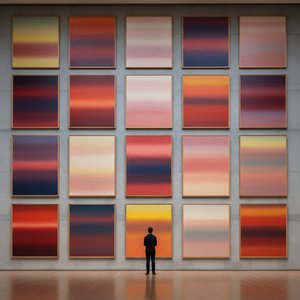
Mark Rothko: Cele Mai Iconice 25 De Capodopere – Artă Abstractă pentru Decor Rafinat
Descoperă cele mai iconice 25 de picturi abstracte ale lui Mark Rothko! Explorează istoria, culorile și emoțiile din spatele fiecărei capodopere. Reproduceri artă de calitate muzeală & inspirație decor pe ArtsDot.com.

Late Medieval Masterpieces: 10 Artworks That Defined an Era | ArtsDot
Journey through 10 defining Late Medieval masterpieces – from Giotto's frescoes to Jan van Eyck’s realism. Explore the stories, techniques & vibrant colors of Gothic art. Find museum-quality reproductions and elevate your home decor with ArtsDot.com! Discover all masterpieces on ArtsDot.com

Giotto di Bondone: Cele Mai Remarcabile 25 de Capodopere – Artă, Istorie și Decorațiuni Interioare
Descoperă cele mai frumoase 25 de opere ale lui Giotto di Bondone! Explorează frescele Renașterii timpurii, picturile iconice și poveștile din spatele capodoperelor. Găsește inspirație pentru decorul casei tale cu ArtsDot.com – artă clasică de calitate muzeală.

The Shadow of Faith: Exploring Gothic Art's Spiritual Intensity & Architectural Innovation
Explore the spiritual intensity & architectural innovation of Gothic art! Discover the symbolism behind cathedrals, stained glass & master artists like Giotto and Monet. A deep dive into medieval history & artistic expression.