


The picture follows your choices: , .
Descriere obiect de colecție
Admire Josse de Corte’s neoclassical marble bust of Medusa – a stunning example of Baroque sculpture. Explore intricate detail & timeless beauty in this captivating artwork.
Biografie artist
Discover Josse de Corte (1627-1679), a Flemish Baroque sculptor renowned for dramatic religious scenes & intricate marble carvings like the Altar of the Crucifixion.
 Vezi mai mult
Reproducere pictată manual în ulei
Pictură în ulei pe pânză, pictată manual de artiștii noștri la dimensiunea și ramele dorite de dumneavoastră, pe comandă. ( Comută pe versiunea Print Comută pe Imagine Digitală)
More about this painting
 Previzualizare
 Trimite prin felicitare
 Distribuie
 Detalii despre lucrare
 Ghid
Ghid

 Descarcă imaginea
 Produse similare
 Radiografie
 Galerie foto
 Q&A
Q&A Statistici
Order your painting in four simple steps
Take your time. You can change any answer; the price in your order card follows each choice.
1 Step one of four
Which size would you like?
These sizes keep the proportions of the original painting. The drawing shows your choice on a wall, above a two-metre sofa.
Or give your own measurements
Alegeți dintre dimensiunile noastre prestabilite, care respectă proporțiile originale ale operei de artă.

Introduceți lățimea și înălțimea necesare pentru a se potrivi ramei sau peretelui dumneavoastră. Această lucrare este pictată manual, așa că, pentru o dimensiune cu o formă diferită, artistul poate picta puțin mai mult în jurul imaginii sau poate tăia puțin din margini — dumneavoastră decideți. Vă vom trimite o simulare digitală pentru aprobare înainte de a începe pictarea. Imaginea afișată pe această pagină nu reprezintă rezultatul real — doar simularea este reprezentativă.
2 Step two of four
How should it be prepared: rolled, stretched or framed?
The prices below are for the size you chose in step one.
Choose the edges of the stretched canvas
Choose your frame

White lei1

Blurside lei1

Extended lei1

P118B lei10

P118H lei10

P118W lei10

P438Z lei10

P508JH lei12

P508YH lei12

P805H lei10

P805Z lei10

P919BZ lei10

P919G lei10

P919XJ lei10

P959ZH lei10

P968JZ lei12

W106C lei8

W218G lei10

W218JH lei8

W218Y lei10

W307PJ lei10

W316G lei10

W316PJ lei8

W316Y lei10

W398PJ lei8

W4111J lei10

W500HY lei15

W500JH lei15

W692G lei12

W849H lei8

W940BG lei15

W953PJ lei8

H24-GOLD lei30

H24-SILVER lei30

H36-GOLD lei45

H36-SILVER lei45
Înramat
Moulding: . Overall size with the frame: .
3 Step three of four
Would you like anything changed in the painting?
Most people answer no. Because each painting is made by hand, our artist can also adapt it for you.
After order, ArtsDot.com team will email client for instructions and provide a mockup preview
4 Step four of four
A few finishing options
All of them are optional. The answers already selected cost nothing extra.
Who paints it?
Livrare în întreaga lume () în 3-4 săptămâni, în loc de cele 5 săptămâni standard. (2 Noiembrie). Fără compromisuri în ceea ce privește calitatea.
A nameplate, as in a museum?
Detalii plăcuță din bronz gravat
This elegant plaque features the artist's name and the title of the artwork, finely engraved for a timeless presentation.
It is made from bronze with a refined, elegant finish. The text is precisely laser-engraved for a sharp and permanent result. Measuring 9x2 cm, the plaque is compact yet easy to read. It's built to be durable and scratch-resistant, offering a professional, museum-quality look. Mounting is simple thanks to the included adhesive backing.
Detalii plăcuță din acril transparent
The plaque includes essential engraved details such as the artist's name, the title of the artwork, the date it was created, the type of media used-like oil on canvas or watercolor-a brief description of the piece, and a QR code that links to the complete artwork information.
It is crafted from clear acrylic, offering a sleek, modern appearance. The text is UV-engraved in black to ensure strong visual contrast. With a size of 10x15 cm, it ensures optimal readability. It comes equipped with two metal hooks for secure wall mounting. The plaque is designed to be weather-resistant, making it suitable for various environments, and it includes interactive features that work seamlessly with smartphone scanning.
Detalii placă din acril negru
This elegant plaque includes engraved information such as the artist's name, the title of the artwork, the date it was created, the type of media used (like oil on canvas or watercolor), a short description of the artwork, and a QR code for quick access to more information.
The plaque itself is made from refined black acrylic with a premium finish. The text is laser-engraved in white for high contrast and readability. Its size is 10x15 cm, designed to be easy to read. It comes with two metal hooks for professional mounting. The design is sleek and fits any interior style. It is also weather-resistant and durable, with built-in digital integration for mobile compatibility.
A protective varnish?
When do you need it?
✓ Check and order
Your painting, as you ordered it

Envy
Tehnică de reproducere
Dimensiune reproducere
-

Selecție de artiști de elită
Mai multe detalii, rafinament și timp suplimentar de execuție
-

Ramă pentru reproducere artistică
-
-
Pentru opere de artă sau reproduceri care depășesc 105 cm (aproximativ 41 de inch) pe oricare dintre laturi, cadrul va fi livrat demontat, sub formă de kit. Această metodă asigură o livrare sigură și previne deteriorarea în timpul transportului.
Este necesară asamblarea profesională – acest produs nu este de tip DIY (de făcut singur).
Kitul trebuie asamblat, iar pânza întinsă, de către un legător de cadre experimentat, utilizând adeziv pentru lemn (neinclus în colet), o cheie pentru întinderea pânzei și cleme pentru a menține barele la unghi drept în timp ce adezivul se usucă. Asamblarea incorectă sau tensiunea neuniformă a pânzei pot deteriora permanent opera de artă și nu sunt acoperite de garanția noastră.
 Pentru opere de artă sau reproduceri care depășesc 105 cm (aproximativ 41 de inch) pe oricare dintre laturi, cadrul va fi livrat demontat, sub formă de kit. Această metodă asigură o livrare sigură și previne deteriorarea în timpul transportului.
Toate barele din lemn masiv sunt incluse, tăiate cu precizie la dimensiunea necesară.
Asamblat cu șuruburile incluse, plus adeziv pentru lemn pentru îmbinările de colț, care nu este furnizat și trebuie achiziționat de către tâmplarul dumneavoastră.
Sunt necesare unelte profesionale care nu sunt incluse: o șipte de întindere a pânzei (tensionator) și cleme pentru a menține barele la unghi drept în timp ce adezivul se usucă.
Important:
Îmbinările de colț necesită adeziv pentru lemn, barele trebuie fixate cu clești de strângere până când adezivul este complet uscat, iar întinderea pânzei pe cadrul asamblat necesită un clește pentru întins pânza. Niciunul dintre aceste elemente nu este inclus în kit. Vă rugăm să consultați un încadrator profesionist cu experiență înainte de a comanda această dimensiune.

Etichetă de prezentare
-
-

Lac de protecție
Lac lucios (intensifică nuanțele și oferă protecție împotriva luminii și a umidității)
-

Personalizează opera mea de artă
Exemple de elemente ce pot fi personalizate: Înlocuirea feței cu fotografia clientului; Adăugarea unui animal de companie (de exemplu, înlocuirea unei pisici cu un câine); Includerea unui mesaj ascuns în fundal; Modificarea peisajului sau a elementelor din fundal.
-

Livrare rapidă
Livrare la nivel mondial () în 3-4 săptămâni, în loc de cele 5 săptămâni standard. (2 Noiembrie). Fără compromisuri când vine vorba de calitate.
-
Livrare rapidă
Livrare la nivel mondial () în 5 săptămâni. (9 Noiembrie).
Inclus
Preț total calculat
lei 1247
Opțiunea cu sticlă este disponibilă doar pentru dimensiuni de sub 110 cm
Included with every order
- Livrare expres gratuită la nivel mondial
- Pânză de in de înaltă calitate
- Asigurare completă pentru transport
- Garanție de rambursare a taxelor vamale
- Garanția fidelității culorilor
- Politica de retur în 100 de zile (doar pentru defecte de fabricație)
- Garanție de rambursare 100%
- Ofertă pentru comenzi multiple


Opere similare


Josse De Corte
1627 - 1679, Belgium
Biografie artist
Josse de Corte: A Master of Baroque Drama
Josse de Corte (1627-1679) stands as a pivotal figure in the vibrant artistic landscape of 17th-century Flanders, a period defined by dramatic religious fervor and burgeoning classical influences. Born in Ypres, a strategically important city at the heart of the Spanish Netherlands, his early life remains somewhat shrouded in mystery, though it’s believed he received foundational training in Rome under the tutelage of François Duquesnoy, a renowned sculptor known for his elegant and refined style. This Roman education proved crucial, laying the groundwork for de Corte's own distinctive approach – one that skillfully blended the dynamism of Baroque aesthetics with a growing appreciation for classical forms.
De Corte’s career truly blossomed in Venice, a city then at the epicenter of European art and commerce. He arrived around 1657 and quickly established himself as a sought-after sculptor, commanding commissions from wealthy patrons and religious institutions throughout the Venetian Republic. This move marked a significant shift; Venice offered a radically different artistic environment than his native Flanders – one characterized by intense competition, a diverse range of influences (including Italian Mannerism and Caravaggismo), and a thriving market for sculpture intended to adorn lavish churches and palazzi.
The Sculptor’s Palette: Technique and Style
De Corte's sculptures are immediately recognizable for their dramatic intensity and meticulous detail. He possessed an extraordinary ability to convey emotion through gesture, expression, and the manipulation of light and shadow. Unlike some of his contemporaries who favored a more restrained approach, de Corte embraced theatricality, often depicting scenes of religious ecstasy or profound suffering with startling realism. His works are characterized by a powerful sense of movement – figures seem poised on the brink of action, caught in moments of intense spiritual experience.
His mastery of marble carving was particularly noteworthy. He worked primarily with white marble, skillfully exploiting its inherent luminosity and translucence to create surfaces that shimmered with an almost ethereal quality. He employed a technique known as *schiacciato*, or “flattening,” which involved subtly manipulating the surface of the stone to create the illusion of depth and volume. This technique, combined with his precise modeling skills, allowed him to achieve remarkable anatomical accuracy while maintaining a sense of dynamism and movement.
Key Works: A Testament to His Vision
Among de Corte’s most celebrated achievements is undoubtedly the ‘Altar of the Crucifixion’ (1672), currently housed in ArtsDot's collection. This monumental work exemplifies his signature style – a dramatic depiction of Christ’s sacrifice rendered with breathtaking realism and emotional intensity. The intricate marble carvings, showcasing the agony and compassion of the figures involved, are a testament to his technical skill and artistic vision.
Another significant piece is “Envy” (1660), a neoclassical marble bust of Medusa, demonstrating his growing interest in classical forms. The sculpture captures the terrifying beauty of the Gorgon’s visage with remarkable detail, reflecting a shift towards greater restraint and elegance in his style as he matured.
Furthermore, de Corte's contribution to the High Altar for Santa Maria della Salute in Venice remains a cornerstone of Baroque art. This colossal sculptural complex, depicting the Virgin Mary expelling the plague, is considered one of his masterpieces, showcasing his ability to create monumental works that powerfully conveyed religious themes and emotions.
Legacy and Influence
Josse de Corte’s impact on 17th-century sculpture extends beyond his individual creations. He played a crucial role in shaping the artistic landscape of Venice, fostering a vibrant community of sculptors and influencing the work of subsequent generations. His dynamic style, combined with his technical mastery, helped to establish Baroque sculpture as a dominant force in Europe.
His association with the Somascan Fathers at Santa Maria della Salute further cemented his legacy, contributing significantly to the elaborate sculptural decoration of one of Venice’s most iconic churches. De Corte's work continues to be studied and admired for its dramatic intensity, technical skill, and profound emotional resonance – a testament to the enduring power of his artistic vision.
Articole similare
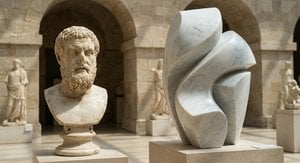
The Enduring Allure of Marble in Art History: From Classical Sculpture to Modern Abstraction
Explore the captivating history of marble sculpture from ancient Greece to modern art. Discover renowned artists like Canova & Michelangelo, carving techniques, and investment insights at ArtsDot.

Top 10 Capodopere din Bronz care au Revoluționat Arta – Inspirație pentru Decor
Descoperă Top 10 sculpturi din bronz care au schimbat istoria artei! Explorează operele lui Rodin, Michelangelo și alți maeștri, tehnicile lor unice și inspirația pentru decorul casei tale. Replici de calitate muzeală pe ArtsDot.com.

Goya: Cele Mai Iconice Capodopere – Artă Spaniolă pentru Decor Rafinat | ArtsDot.ro
Descoperă cele mai frumoase 25 de picturi ale lui Francisco Goya! Explorează capodoperele romantice, portretele impresionante și gravurile puternice. Reproduceri artă spaniolă de calitate muzeală pentru un decor rafinat. Explorează colecția completă online pe ArtsDot.com