


 Previzualizare
 Trimite
 Distribuie
 Detalii despre lucrare

 Descarcă
 Produse similare
 Radiografie
 Diapozitive automate
 Statistici
Treize Huia


 Vezi mai mult
Reproducere pictată manual în ulei
Pictură în ulei pe pânză, realizată manual de artiștii noștri la dimensiunea și ramele dorite de dumneavoastră, pe comandă. ( Comută pe Print Comută pe Imagine Digitală)




P118B $10

P118H $10

P118W $10

P438Z $10

P508JH $12

P508YH $12

P805H $10

P805Z $10

P919BZ $10

P919G $10

P919XJ $10

P959ZH $10

P968JZ $12

W106C $8

W218G $10

W218JH $8

W218Y $10

W307PJ $10

W316G $10

W316PJ $8

W316Y $10

W398PJ $8

W4111J $10

W500HY $15

W500JH $15

W692G $12

W849H $8

W940BG $15

W953PJ $8




Alegeți dintre dimensiunile noastre prestabilite, care respectă proporțiile originale ale operei de artă.

Puteți introduce propriile dimensiuni pentru a se potrivi unui anumit cadru sau spațiu. Dacă dimensiunea selectată nu corespunde proporțiilor imaginii originale, vom decupa opera de artă sau vom extinde pictura cu elemente suplimentare pictate manual. O simulare digitală vă va fi trimisă pentru aprobare înainte de începerea producției.
Vă rugăm să rețineți că previzualizarea de pe ecran nu reflectă decuparea sau extinderea reală. Doar macheta va arăta cu exactitate compoziția finală.
Deși sunt disponibile dimensiuni personalizate, vă recomandăm să selectați o dimensiune din lista predefinită pentru a păstra proporțiile originale.
După plasarea comenzii, echipa ArtsDot.com va contacta clientul prin e-mail pentru instrucțiuni și îi va furniza o previzualizare a machetei
Livrare în întreaga lume () în 3-4 săptămâni, în loc de cele 5 săptămâni standard. (12 Septembrie). Fără compromisuri în ceea ce privește calitatea.

Livrare expres gratuită la nivel mondial

Pânză de in de înaltă calitate

Asigurare completă pentru transport

Garanție de rambursare a taxelor vamale

Garanția fidelității culorilor

Politica de retur de 100 de zile (doar pentru defecte)

Garanție de rambursare 100%

Ofertă pentru comenzi multiple
 Opțiunea cu sticlă este disponibilă doar pentru dimensiuni de sub 110 cm

Treize Huia
Tehnică de reproducere
Dimensiune reproducere
-


Preț total calculat
$ 263
Johannes Gerardus Keulemans: A Life Dedicated to Feather and Brush
Johannes Gerardus Keulemans (1842-1912) stands as an enigmatic figure in the annals of ornithological illustration, a Dutch artist whose meticulous dedication transformed scientific observation into breathtaking artistic achievement. Born in Rotterdam in 1842, Keulemans’s formative years were marked by a profound fascination with the natural world—a passion nurtured by early encounters with animal specimens and crucially fostered by Hermann Schlegel, director of Leiden University's Natural History Museum. Schlegel recognized Keulemans’s innate talent and championed his artistic pursuits, orchestrating an expedition to West Africa in 1864 that provided invaluable experience and broadened his understanding of avian diversity. This pivotal moment solidified his commitment to capturing the beauty and complexity of birds through art.- The Turning Point: Sharpe’s Influence
- Establishing a Reputation: Illustrating Alcedinidae
- London Calling: A Career Defined by Collaboration
- A Unique Artistic Vision
- Beyond Accuracy: The Poetic Touch of Watercolor
The Turning Point: Sharpe’s Influence
Richard Bowdler Sharpe, a visionary ornithologist and publisher, played an instrumental role in shaping Keulemans's trajectory. Recognizing his exceptional artistic abilities, Sharpe persuaded him to relocate to England in 1869—a decision that would propel him into the heart of Britain’s burgeoning ornithological community. This move cemented his partnership with Sharpe, resulting in the ambitious undertaking of illustrating *Monograph of the Alcedinidae*, a monumental work dedicated to documenting the family of kingfishers (1868-1871). The project demanded unparalleled precision and artistic skill—challenges Keulemans embraced wholeheartedly.Establishing a Reputation: Illustrating Alcedinidae
Sharpe’s patronage fostered Keulemans's burgeoning reputation, securing him commissions for numerous prestigious publications that would solidify his place as one of the era’s foremost bird illustrators. His meticulous attention to detail and unwavering commitment to artistic integrity earned him admiration from fellow scientists and collectors alike—a testament to his mastery of technique and dedication to conveying the essence of avian life.London Calling: A Career Defined by Collaboration
Keulemans’s subsequent years in London witnessed a prolific artistic output, fueled by collaborations with prominent publishers and driven by an unwavering desire to push the boundaries of ornithological illustration. He honed his craft through painstaking observation and skillful rendering—a process that yielded images of extraordinary beauty and scientific accuracy. His work became synonymous with elegance and precision, reflecting the highest standards of Victorian art.A Unique Artistic Vision
Keulemans possessed a singular artistic perspective—one acutely aware of the inherent paradox faced by illustrators striving to capture the sublime truthfulness of nature while adhering to the aesthetic conventions of painting. He famously remarked that “you cannot draw them true to life and at the same time perfectly in harmony with the rules of the art of painting,” acknowledging the delicate balance between scientific representation and artistic expression. Yet, this watercolor—a captivating depiction of three black birds perched on branches within a dense foliage setting—demonstrates his remarkable ability to synthesize these seemingly opposing forces.Beyond Accuracy: The Poetic Touch of Watercolor
The resulting painting transcends mere documentation; it embodies Keulemans’s artistic sensitivity and conveys a profound appreciation for the natural world. Employing glazing techniques and subtle textural nuances, he achieved an ethereal quality that elevates the image beyond the confines of scientific observation—a testament to his mastery of watercolor and his unwavering commitment to capturing not only form but also feeling. The soft blending of colors and organic lines evoke a sense of tranquility and contemplation—inviting viewers to immerse themselves in the beauty of this exquisite specimen of Victorian wildlife art.Opere similare


Biografie artist
Johannes Gerardus Keulemans: A Life in Feather and Brush
Early Life and Education
- Born: June 8, 1842, Rotterdam, Netherlands.
- From a young age, Keulemans demonstrated an interest in the natural world, collecting animal specimens.
- This early passion led him to connect with Hermann Schlegel, director of the Natural History Museum in Leiden, who became a crucial mentor.
- Schlegel encouraged Keulemans’s artistic talent and sent him on an expedition to West Africa in 1864, providing invaluable field experience.
Move to England and Artistic Development
- In 1869, Richard Bowdler Sharpe persuaded Keulemans to move to England to illustrate his monumental work, *Monograph of the Alcedinidae*, or Family of Kingfishers.
- This marked a turning point in Keulemans’s career, establishing him within the British ornithological community.
- He remained in England for the rest of his life, becoming a highly sought-after illustrator.
- Keulemans developed a distinctive style characterized by meticulous detail and accuracy, essential qualities for scientific illustration.
Major Works and Collaborations
- Keulemans illustrated numerous significant ornithological publications throughout his career.
- Notable works include:
- Buller’s *A History of the Birds of New Zealand* (1873, 1888): Showcasing the unique avian fauna of New Zealand.
- Legge’s *History of the Birds of Ceylon* (1880): A comprehensive study of Sri Lankan birds.
- Elliot’s *Monograph of the Bucerotidae* (Hornbills) (1887–1892): Detailed illustrations of hornbill species.
- Seebohm’s *Monograph of the Turdidae* (Thrushes) (1902): A thorough examination of thrush varieties.
- Godman’s *Monograph of the Petrels* (1907–1910): Featuring over one hundred plates contributed by Keulemans.
- He regularly provided illustrations for journals like The Ibis and Proceedings of the Zoological Society.
Artistic Style and Techniques
- Keulemans’s work is renowned for its consistency, maintaining a high level of detail throughout his career.
- He primarily employed lithography, allowing for the creation of vivid and lifelike depictions through depth and tone.
- The finished prints were often hand-colored by skilled artisans, though the accuracy of these colorations sometimes faced criticism.
- His ability to capture accurate representations of birds earned him prominence in the field of scientific illustration.
Personal Life and Later Years
- Keulemans married twice and had fifteen children, though only nine reached adulthood.
- He also pursued interests beyond ornithology, writing on topics related to spirituality and claiming to experience premonitions.
- Death: March 29, 1912, Ilford, Essex (now Greater London). He is buried in Buckingham Road Cemetery, Ilford, in an unmarked grave.
Legacy and Historical Significance
- Keulemans produced an estimated 4,000-5,000 published illustrations throughout his career.
- His work remains highly valued for its scientific accuracy and artistic merit.
- He is credited with describing the Cape Verde swamp-warbler (*Calamodyta brevipennis*).
- Keulemans’s illustrations continue to be studied and admired by ornithologists, artists, and collectors alike, solidifying his place as a significant figure in 19th-century natural history art.

John Gerrard Keulemans
1842 - 1912
Detalii rapide
- Birth Date: 1842-06-08
- Birth Place: Rotterdam, Netherlands
- Death Date: 1912-03-29
- Influenced: None, 'influenced by': 'Hermann Schlegel, Richard Bowdler Sharpe', 'movement': 'Scientific Illustration, Ornithological Art', 'name': 'John Gerrard Keulemans', 'nationality': 'Dutch', 'notable works': [
Articole similare

Feathered Visions: A Historical & Artistic Exploration of Birds in Painting
Explore the rich history of birds in painting! Discover symbolism, artistic movements & master artists like Audubon. High-quality reproductions available at ArtsDot.

Angelo Chiacchio: A Mid-Century American Illustration Master & the Rise of Commercial Art
Explore the captivating world of Angelo Chiacchio, a master of mid-century American illustration. Discover his evolution, signature style, and lasting impact on commercial art & design. Learn about his legacy at the Museum of American Illustration.

Kay Rasmus Nielsen: A Golden Age Illustrator's Enchanting Legacy of Symbolism & Narrative
Explore the captivating world of Kay Rasmus Nielsen, a celebrated Golden Age illustrator renowned for his Art Nouveau fairy tale art & Disney contributions. Discover his unique style, enduring legacy, and how to collect his enchanting works.

The Refined Aesthetic of Victorian Illustration: A Study in Narrative & Technique
Explore the captivating world of Victorian illustration! Discover Pre-Raphaelite influences, key artists like Rossetti & Stephens, and the era's rich narrative detail. A deep dive for art enthusiasts.
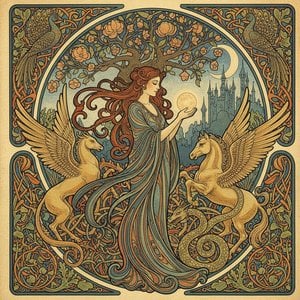
Edmund Dulac: A Master of Golden Age Illustration – Exploring Myth, Symbolism & Art Nouveau Legacy
Explore the captivating world of Edmund Dulac, a master of Golden Age illustration! Discover his enchanting fairy tales, Art Nouveau style, and lasting influence on art & design. Learn about *The Rubaiyat* and more.
