


 Trimite
 Distribuie
 Detalii
 Ghidul

 Descarcă
 Produse similare
 Diaporama
 Statistici
Sabina Houdon


 Citește mai mult
Reproducere pictată manual în ulei
Pictură în ulei pe pânză, realizată manual de artiștii noștri la dimensiunea și ramele dorite de dumneavoastră, pe comandă. ( Comută pe versiunea Print Treci la imagine digitală)




































Alegeți dintre dimensiunile noastre prestabilite, care respectă proporțiile originale ale operei de artă.

Introduceți lățimea și înălțimea de care aveți nevoie, pentru a se potrivi ramei sau peretelui dumneavoastră. Această lucrare este pictată manual, așa că pentru o dimensiune cu o formă diferită, artistul poate picta puțin mai mult în jurul imaginii sau poate tăia puțin din margini — dumneavoastră decideți. Vă vom trimite o simulare digitală pentru aprobare înainte de a începe pictarea. Imaginea afișată pe această pagină nu reprezintă rezultatul real — doar simularea este reprezentativă.
După plasarea comenzii, echipa ArtsDot.com va contacta clientul prin e-mail pentru instrucțiuni și îi va furniza o previzualizare a machetei
Livrare în întreaga lume () în 3-4 săptămâni, în loc de cele 5 săptămâni standard. (23 Octombrie). Fără compromisuri în ceea ce privește calitatea.

Livrare expres gratuită la nivel mondial

Pânză de in premium

Asigurare completă pentru transport

Garanție de rambursare a taxelor vamale

Garanția fidelității culorilor

Politica de retur în 100 de zile (doar pentru defecte)

Garanție de rambursare 100%

Reducere pentru comenzi multiple
 Opțiunea cu sticlă este disponibilă doar pentru dimensiuni de sub 110 cm

Sabina Houdon
Tip de reproducere
Dimensiune reproducere
-


Preț total
lei 1220
Sabine Houdon: A Glimpse of Innocence in Marble
Jean-Antoine Houdon’s “Sabine,” sculpted between 1787 and 1791, is more than just a portrait; it's a poignant distillation of childhood captured with an unparalleled sensitivity. This exquisite marble bust, currently housed within the Louvre Museum, offers a rare window into the artistic vision of one of France’s most significant Neoclassical sculptors. Houdon, a pivotal figure bridging the Rococo and Neoclassical eras, sought not merely to replicate likenesses but to imbue his subjects with their very essence – intellect, character, and inner life. “Sabine” exemplifies this ambition, presenting a remarkably lifelike representation of the sculptor’s eldest daughter at just ten months old.
The sculpture immediately draws the eye with its monochromatic palette—a symphony of whites and grays that allows the subtle nuances of the marble to sing. Houdon masterfully employed light and shadow to sculpt the delicate contours of the infant's face, highlighting the soft curves of her cheeks, the gentle slope of her forehead, and the slightly puckered expression of her mouth. The artist’s meticulous attention to detail is breathtaking; observe how he captures the subtle folds of skin around her ears, a testament to his profound understanding of human anatomy and texture. The pedestal, crafted from dark granite, provides a striking contrast, grounding the ethereal beauty of the bust and emphasizing its delicate form.
Neoclassical Realism and the Enlightenment
“Sabine” firmly establishes Houdon within the Neoclassical movement, a style characterized by an unwavering commitment to realism, idealized forms, and a deep reverence for classical antiquity. Houdon’s work reflects the intellectual fervor of the Enlightenment—a period marked by reason, scientific inquiry, and a renewed interest in the art and philosophy of ancient Greece and Rome. Unlike the ornate excesses of the Rococo style that preceded it, Neoclassicism prioritized clarity, restraint, and a focus on moral virtue. Houdon’s portraits, particularly those of philosophers and statesmen, sought to embody these ideals, portraying his subjects with dignified composure and intellectual depth.
The sculpture's creation coincided with a period of significant social and political upheaval in France – the waning days of the monarchy and the burgeoning revolutionary fervor. Houdon’s decision to depict a young child, so vulnerable and innocent, carries a subtle yet powerful symbolic weight. It speaks to a yearning for a return to simpler times, a rejection of the extravagance and corruption of the aristocracy, and perhaps even an expression of hope for a brighter future. The fact that he presented it at the Salon of 1789, just before the revolution erupted, adds another layer of intrigue to its interpretation.
Technique and Materials: A Master’s Craft
Houdon's skill as a sculptor is immediately apparent in the flawless execution of “Sabine.” He was renowned for his painstaking carving techniques, meticulously shaping marble with an almost obsessive attention to detail. The smooth, polished surface of the bust suggests countless hours spent refining every curve and contour. The subtle variations in tone within the marble—the delicate highlights on her cheekbones, the soft shadows beneath her chin—are a testament to his mastery of light and shadow.
The sculpture is primarily composed of white marble, chosen for its ability to capture fine details and create a luminous effect. The dark granite pedestal provides a strong visual anchor and contrasts beautifully with the lightness of the bust. Houdon’s choice of materials—marble and granite—reflects his commitment to both beauty and durability, ensuring that “Sabine” would endure as a timeless masterpiece for generations to come.
Symbolism and Emotional Resonance
Beyond its technical brilliance, “Sabine” possesses a profound emotional resonance. The sculpture evokes feelings of innocence, youthfulness, and perhaps even nostalgia. The artist’s tender portrayal of the child captures her vulnerability and inherent beauty, inviting viewers to contemplate the fleeting nature of childhood and the preciousness of human life. It's not simply a portrait; it’s an intimate glimpse into the heart of a family.
The sculpture’s enduring appeal lies in its ability to connect with us on a deeply personal level. It reminds us of our own childhoods, of the simple joys and innocent wonder that often get lost in the complexities of adult life. “Sabine” is a testament to Houdon's extraordinary talent—a timeless masterpiece that continues to captivate and inspire art lovers around the world.
Întrebări și răspunsuri
Cine este artistul din spatele "Sabina Houdon"?
„Sabina Houdon” a fost creat de Jean-Antoine Houdon. Informațiile de pe această pagină descriu opera originală a lui Jean-Antoine Houdon.
Ce fel de piesă este "Sabina Houdon"?
În catalog, "Sabina Houdon" de Jean-Antoine Houdon este clasificat ca Sculptură. Această categorie ajută la găsirea unor lucrări similare.
Pot vedea o imagine cu raze X a lucrării "Sabina Houdon" de Jean-Antoine Houdon?
Pagina Raze X a operei "Sabina Houdon" de Jean-Antoine Houdon este un vizualizator interactiv care vă permite să parcurgeți onze straturi optice ale imaginii lucrării, inclusiv o perspectivă de tip radiografie.
Opere similare


Biografie artist
A Sculptor of the Enlightenment
Jean-Antoine Houdon, born in Versailles in 1741, stands as a pivotal figure bridging the Rococo and Neoclassical eras—a sculptor whose work embodies the intellectual fervor and evolving aesthetic sensibilities of the eighteenth century. His life unfolded amidst dramatic shifts in French society, from the waning opulence of the monarchy through the revolutionary upheaval and Napoleonic ascendance. Yet, Houdon remained remarkably consistent in his artistic vision: to capture not merely a likeness, but the very essence of his subjects—their intellect, character, and inner lives—in enduring marble and bronze. This dedication stemmed from an early aptitude for sculpture, nurtured by formal training at the Académie Royale de Peinture et de Sculpture beginning in 1752 under esteemed sculptors like René-Michel Slodtz, Jean-Baptiste Lemoyne, and Jean-Baptiste Pigalle. His subsequent enrollment at the École Royale des Élèves Protégés from 1761 to 1764 solidified his foundation, culminating in a triumphant win of the Prix de Rome competition in 1761—an award that granted him invaluable study time with classical art firsthand in Italy, an experience profoundly shaping his aesthetic sensibilities.The Art of Verisimilitude and Psychological Insight
Houdon’s sculptures are immediately recognizable for their breathtaking realism and meticulous attention to detail. He wasn't content with simply replicating physical features; he sought to penetrate the surface, revealing the personality and intellect within. This commitment to verisimilitude arose from a deep fascination with anatomy—evident in his celebrated *Muscleman Sideview* bronze sculpture—and an unwavering dedication to observation. Unlike many contemporaries who idealized their subjects, Houdon embraced imperfections, believing they contributed to a more truthful and compelling portrayal. He employed innovative techniques, including taking casts directly from life, allowing him to capture minute details with unparalleled accuracy. This approach was particularly evident in his portrait busts, which became his signature achievement. These weren’t merely static representations; they were dynamic studies of character, imbued with psychological depth and emotional resonance. Houdon's ability to convey not just *how* someone looked, but *who* they were, set him apart. He achieved this through subtle nuances in expression, posture, and the rendering of details like the eyes—often carved with a slight concavity to capture the play of light and suggest inner thought. His meticulous attention to detail extended beyond mere physical representation; he painstakingly studied musculature, bone structure, and facial expressions to convey not only appearance but also temperament and intellect.Immortalizing an Era: A Pantheon of Enlightenment Figures
The breadth of Houdon’s clientele reads as a veritable who's who of the Enlightenment. He immortalized some of the most influential thinkers, writers, politicians, and leaders of his time. His terracotta portrait of Denis Diderot captures the philosopher’s intellectual intensity and unconventional spirit with remarkable sensitivity. Benjamin Franklin, portrayed during his diplomatic mission to France, appears as a man of wisdom and pragmatism, his gaze both shrewd and benevolent. Jean-Jacques Rousseau, sculpted with characteristic empathy, embodies both the passion and melancholy that defined his philosophy. Perhaps most famously, Houdon sculpted Voltaire—creating multiple versions of the celebrated writer, including a dynamic seated figure for the Comédie-Française that captures his wit and intellectual energy. Beyond these intellectual giants, Houdon also received commissions from royalty, notably Louis XVI, and rising political figures like Napoleon Bonaparte. However, it was his sculpture of George Washington, commissioned by the Virginia General Assembly, that secured his place in American iconography. This life-size marble statue—based on meticulous measurements and a life mask taken during Washington’s presidency—became the definitive image of the nation's first president, serving as the model for countless engravings and reproductions, even appearing on U.S. postage stamps for decades. He also sculpted Thomas Jefferson, furthering cementing his legacy across the Atlantic.Technique and Innovation: Mastering Marble and Bronze
Houdon’s sculptural technique was revolutionary for its time. Rejecting traditional methods of idealized representation, he pioneered a new approach rooted in observation and anatomical accuracy. His method involved painstakingly studying cadavers—a controversial practice at the time—to gain an understanding of human musculature and bone structure. He utilized a process known as *L'Écorché*, which involved stripping away layers of flesh to reveal underlying muscle tissue, achieving unprecedented realism. This technique demanded immense patience and skill, but it allowed Houdon to capture not only physical form but also the subtle nuances of expression and emotion. Furthermore, he mastered bronze casting—a challenging medium that required precise calculations and meticulous craftsmanship. His bronzes are renowned for their fluidity and dynamism, capturing movement and conveying a sense of vitality rarely achieved in marble sculpture. He skillfully employed techniques like *lost wax casting*, ensuring exceptional detail and tonal variation.Legacy and Enduring Influence
Jean-Antoine Houdon’s impact on the world of sculpture is undeniable. He elevated portraiture to an art form capable of profound psychological insight and historical documentation. His dedication to realism, combined with his ability to capture the essence of his subjects, set a new standard for sculptural representation. Throughout his life, he received widespread recognition, being named a Chevalier de la Légion d'Honneur in 1804 and a Chevalier de l’Empire in 1809—testaments to his esteemed status within French society. Even in his later years, Houdon continued to create significant works, demonstrating an unwavering commitment to his craft until his death in Paris on July 15, 1828. His sculptures remain highly valued today, not only for their artistic merit but also for the invaluable glimpses they provide into the lives and times of the Enlightenment era. Houdon’s work serves as a powerful reminder of the enduring power of art to capture the human spirit and preserve it for generations to come. His influence can be seen in the works of countless artists who followed, solidifying his position as a master sculptor whose legacy continues to inspire awe and admiration.
Jean-Antoine Houdon
1741 - 1828 , Franța
Informații rapide
- Artistic Movement Or Style: Neoclassical Realism
- Artists Or Movements Influenced By This Artist: ['Canova']
- Artists Who Influenced This Artist:
- Slodtz
- Lemoyne
- Pigalle
- Date Of Birth: 1741
- Date Of Death: 1828
- Full Name: Jean-Antoine Houdon
- Nationality: France
- Notable Artworks:
- George Washington statue
- Voltaire
- Benjamin Franklin
- Place Of Birth: Versailles, France
Articole conexe

Top 10 Capodopere din Bronz care au Revoluționat Arta – Inspirație pentru Decor
Descoperă Top 10 sculpturi din bronz care au schimbat istoria artei! Explorează operele lui Rodin, Michelangelo și alți maeștri, tehnicile lor unice și inspirația pentru decorul casei tale. Replici de calitate muzeală pe ArtsDot.com.

The Enduring Form: Sculpture Across History, Technique & Emotional Resonance
Explore the rich history of sculpture with ArtsDot. Discover key techniques, influential artists & investment potential for discerning collectors. Expert insights into valuing and collecting timeless masterpieces.
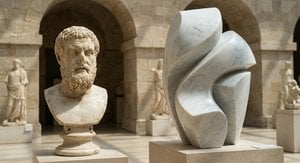
The Enduring Allure of Marble in Art History: From Classical Sculpture to Modern Abstraction
Explore the captivating history of marble sculpture from ancient Greece to modern art. Discover renowned artists like Canova & Michelangelo, carving techniques, and investment insights at ArtsDot.

Top 10 Capodopere din Bronz care au Revoluționat Arta | ArtsDot.ro
Descoperiți Top 10 capodopere din bronz care au revoluționat arta! Rodin, Michelangelo și alții. Aflați istoria sculpturilor clasice și inspirație pentru decorul casei dvs. Reproduceri de artă de calitate muzeală pe ArtsDot.com

The Enduring Form: Exploring Themes & Techniques in Sculpture Across Historical Periods
Explore the rich history of sculpture from ancient masterpieces to contemporary innovations. Discover key techniques, influential artists & investment potential for discerning art collectors.


