

 Previzualizare
 Trimite prin felicitare
 Distribuie
 Detalii despre lucrare
 Ghid
Ghid

 Descarcă imaginea
 Produse similare
 Radiografie
 Galerie foto
 Întrebări și răspunsuri
 Statistici
Pol

- 55.0 x 76.0 cm


 Vezi mai mult
Obțineți un fișier gata de imprimare care depășește cu mult calitatea previzualizării web. Fiecare imagine digitală pe care o vindem provine dintr-un master de înaltă rezoluție din baza noastră de date — având, de regulă, o lățime între 5.000 și 15.000 de pixeli — astfel încât să puteți printa în format mare, să decupați strâns sau să reproduceți detalii fine cu încredere.
Niciun fișier nu părăsește studioul nostru fără să fie tratat. Un expert digital verifică nuanțele de culoare în raport cu pictura originală și le corectează acolo unde este necesar, apoi îmbunătățește claritatea și detaliile folosind instrumente profesionale de retușare — rămânând întotdeauna fidel gestului pictural și stilului artistului. Rezultatul este o imagine care seamănă cu tabloul propriu-zis, nu cu o scanare filtrată.
Aprobați înainte de finalizare: expertul nostru vă va trimite imaginea prin e-mail în termen de 72 de ore pentru revizuire. Nu sunteți mulțumit? Solicitați îmbunătățiri sau corecturi, ori cereți o restituire a plății dacă calitatea nu este pe măsura așteptărilor.
Aceasta este calitatea pe care se bazează editorii, studiourile de design, galeriile și tipăriturile.
Imagine Digitală
Descărcați un fișier la rezoluție înaltă pentru afișare personală, imprimare și proiecte creative. ( Comută pe versiunea Print Comandă pictură realizată manual)
Inclus în fiecare comandă de imagini digitale
Livrare digitală de expertiză, garantată
Când alegeți ArtsDot.com, nu primiți doar o simplă imagine – primiți o operă de artă digitală îmbunătățită profesional, creată cu precizie și susținută de o garanție de satisfacție. Iată tot ceea ce primești odată cu comanda ta, în mod automat:

Livrare rapidă prin e-mail
Fișierul imaginii digitale la rezoluție înaltă vă va fi trimis prin e-mail în termen de 72 de ore de la finalizarea comenzii – gata pentru utilizare imediată.

Fișier digital optimizat prin IA
Opera ta de artă este optimizată profesional prin intermediul unor instrumente AI avansate și al editării manuale, asigurând un nivel maxim de detalii, claritate și acuratețe a culorilor.

Retransmitere gratuită pe viață
Ai șters sau ai pierdut din greșeală fișierul? Nu îți face griji – ți-l vom retrimite oricând, gratuit.

Fără taxe de import – Întotdeauna
Bucură-te instant de noua ta operă de artă, fără taxe vamale, taxe de import sau costuri de livrare – descărcările digitale sunt întotdeauna fără taxe.

Garanția acurateții culorilor
Asigurăm o reflectare cât mai fidelă a culorilor originale în imaginea ta digitală, prin utilizarea unor instrumente profesionale și a proceselor de gestionare a culorii.

Garanție de satisfacție de 100 de zile
Dacă nu sunteți mulțumit de imaginea digitală achiziționată, o vom revizui sau vă vom returna 100% în termen de 100 de zile – fără nicio întrebare.

Garanție de returnare 100% a banilor
Nu ești mulțumit? Primești rambursarea integrală în termen de 100 de zile de la primirea fișierului digital – fără nicio întrebare.

Reduceri pentru comenzi în volum
Cumpără 3 imagini, economisește 10% - Cumpără 5, economisește 15% - Cumpără 10+, economisește 20%. Ideal pentru proiecte creative, galerii și agenții.
A Dance of Form and Fluidity
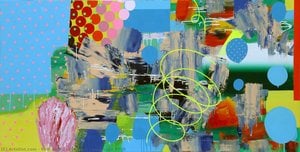
In the mesmerizing realm of Janaina Tschäpe’s "Pol," viewers are invited into a dreamscape where the boundaries between the organic and the abstract dissolve into a rhythmic dance of color. Created in 2012, this piece serves as a profound exploration of movement and metamorphosis, characteristic of Tschäpe’s unique ability to blend aquatic imagery with botanical whispers. The composition is anchored by a striking blue and yellow color scheme, a duality that evokes both the deep, tranquil mysteries of an underwater world and the vibrant, sun-drenched energy of life in bloom. At its heart lies a central, commanding circle, surrounded by a constellation of smaller celestial or cellular forms that seem to drift across the canvas like organisms suspended in a liquid medium.
The painting’s visual language is one of delightful surprise and whimsical complexity. Amidst the swirling geometric shapes and circular motifs, the unexpected presence of two bananas—one nestled near the top left and another drifting toward the bottom right—injects a playful, surrealist element into the work. These organic fragments act as anchors of reality within an otherwise ethereal abstraction, challenging the viewer to find meaning in the intersection of the mundane and the magnificent. This juxtaposition is a hallmark of Tschä-pe’s practice, where she utilizes gestural movement to replicate the mutation and flux found in nature's most hidden corners.
Technique and the Essence of Nature
Tschäpe’s technique in "Pol" reflects her deep-seated fascination with the relationship between the human body and the material world. The application of color suggests a liquid appearance, where edges are not rigid but rather fluid, mimicking the contours of minerals, plants, or even the undulating movement of sea creatures. This sense of "shaping fluid" allows the artwork to breathe, creating an atmosphere that feels less like a static image and more like a captured moment of biological transformation. The interplay between the bold yellows and the deep, immersive blues creates a visual tension that is both soothing and stimulating, making it a centerpiece capable of commanding attention in any sophisticated interior.
For the discerning collector or interior designer, this piece offers much more than mere decoration; it provides an emotional gateway. The artwork resonates with themes of harmony, growth, and the cyclical nature of life. Whether placed in a contemporary gallery setting or used to add a layer of intellectual depth to a residential living space, "Pol" acts as a window into a world of endless possibility. It is a work that rewards prolonged contemplation, inviting one to lose themselves in its circular rhythms and discover the quiet beauty of the abstract metamorphosis occurring right before their eyes.
Întrebări și răspunsuri
Ce stare și ce emoție transmite "Pol" de Janaina Tschäpe?
"Pol" de Janaina Tschäpe transmite un sentiment Playful, într-o atmosferă generală Playful.
Ce intensitate de culoare are "Pol" de Janaina Tschäpe?
"Pol" de Janaina Tschäpe prezintă o intensitate a culorii Balanced.
Ce dimensiuni are originalul "Pol"?
„Pol” măsoară 55 x 76 cm în formatul său original. Dimensiunile originale reprezintă o referință utilă atunci când alegeți dimensiunea unei reproduceri.
Opere similare




Biografie artist
A Universe of Metamorphosis
Janaina Tschäpe exists within a realm where the boundaries between the organic and the abstract dissolve into a rhythmic dance of color and form. Born in Munich, Germany, and raised in São Paulo, Brazil, her identity as a Brazilian/German artist informs a practice that is profoundly interdisciplinary. Her work does not merely sit upon a surface; it breathes, shifting between representation, fantasy, and abstraction to create what can be described as a holistic cosmology. Through painting, drawing, photography, video, and sculpture, Tschäpe invites viewers into dreamscapes where the distinction between the human body, botanical whispers, and aquatic mysteries becomes beautifully blurred.
Her artistic journey is marked by a deep fascination with the concept of metamorphosis. In her early photographic and video works, such as One Hundred Little Deaths, she explored themes of mortality and transformation, often staging herself or models as nebulous, mysterious beings. These creatures, adorned with appendages made from fabric, water-filled latex, or inflatables, inhabit landscapes that serve as narrative sources where the whimsical and the actual coexist. This exploration of the body—often reflecting a feminist resistance to the policing of the female form—allows her to excavate the nature of landscape and the complex interactions between humanity and the natural world.
Technique and the Fluidity of Nature
The visual language of Tschäpe is one of delightful surprise and whimsical complexity. In her paintings, particularly her vibrant watercolors, she captures the transformative properties of water through a meticulous application of media including watercolor, casein, colored pencil, and pastel. Her canvases often possess a liquid appearance, where edges are not rigid but fluid, mimicking the undulating movement of sea creatures or the contours of minerals. This sense of shaping fluid allows her work to evoke both the deep, tranquil mysteries of an underwater world and the sun-drenched energy of life in bloom.
There is a dynamic tension inherent in her compositions: a struggle between loose, luscious forms that pervade the canvas and precise systems of markings that overlay and unify the piece. This technique creates a sensation of movement, where biomorphic shapes function as emotive signifiers of her interior thoughts. Whether she is utilizing saturated colors to suggest growth or incorporating unexpected elements—like the surrealist presence of fruit within an abstract field—her work remains anchored in the exploration of how life transitions and mutates.
Legacy and Global Presence
Since moving to New York in 1997, Tschäpe has established a significant presence in the international art world. Her multidisciplinary oeuvre is not merely a collection of individual pieces but a gesamtkunstwerk—a total work of art—where each creation plays a supporting role in a grand evolutionary opera. Her ability to collapse scale, making the grand cosmos feel as intimate as the infinitesimal cellular level, has earned her recognition in some of the most prestigious institutions globally.
Her profound contributions to contemporary art are reflected in the permanent collections of numerous world-renowned museums, including:
- Centre Pompidou, Paris, France
- Solomon R. Guggenheim Museum, New York
- National Gallery of Art, Washington, D.C.
- Museo Nacional Centro de Arte Reina Sofía, Madrid, Spain
- Harvard Art Museum, Cambridge, Massachusetts
- Moderna Museet, Stockholm, Sweden
- Thyssen-Bornemisza Art Contemporary, Vienna, Austria

Janaina Tschäpe
1973 -