

 Previzualizare
 Trimite prin felicitare
 Distribuie
 Detalii despre lucrare
 Ghid
Ghid

 Descarcă imaginea
 Produse similare
 Radiografie
 Galerie foto
 Întrebări și răspunsuri
 Statistici
Ceiling decoration


 Vezi mai mult
Giclée / Imprimare artistică
Printuri giclée sau pe canvas de calitate muzeală, cu proces de producție rapid și opțiuni flexibile de finisare. ( Comandă pictură realizată manual Comută pe Imagine Digitală)




































Alegeți dintre dimensiunile noastre prestabilite, care respectă proporțiile originale ale operei de artă.

Introduceți lățimea și înălțimea necesare pentru a se potrivi ramei sau peretelui dumneavoastră. O printare poate fi doar tăiată, niciodată extinsă dincolo de dimensiunea imaginii originale, astfel încât o dimensiune cu o formă diferită va pierde o parte din imagine. Vă trimitem o simulare digitală pentru aprobare înainte de a imprima orice. Imaginea afișată pe această pagină nu prezintă tăierea reală — doar simularea arată acest lucru.
Livrare în întreaga lume () în 2 săptămâni, în loc de cele 4/5 săptămâni standard. (14 Noiembrie)

Livrare expres gratuită la nivel mondial

Pânză de in de înaltă calitate

Asigurare completă pentru transport

Garanție de rambursare a taxelor vamale

Garanția fidelității culorilor

Politica de retur în 100 de zile (doar pentru defecte de fabricație)

Garanție de rambursare 100%

Ofertă pentru comenzi multiple
 Opțiunea cu sticlă este disponibilă doar pentru dimensiuni de sub 110 cm

Ceiling decoration
Giclée / Imprimare artistică
Dimensiune reproducere
-


Preț total calculat
lei 299
Opere similare


Biografie artist
Bernardino Poccetti: Life and Legacy
Early Life and Training
Bernardino Poccetti (Florence, 1548 – 1612) was an Italian Mannerist painter and printmaker who flourished during the late Renaissance. Details regarding his early training remain somewhat scarce; however, it is known he began his artistic journey in Florence, a city brimming with artistic innovation at the time.
Major Works and Artistic Development
Poccetti’s career was marked by significant commissions, particularly in fresco painting. He secured important projects for religious institutions and aristocratic patrons throughout Tuscany. One of his most notable early achievements was frescoing scenes from the life of Cosimo I de' Medici as decoration within the Great Salon of the Pitti Palace. This commission established his reputation and demonstrated his skill in large-scale decorative work.
He also labored extensively for various charterhouses in Pisa and Siena, further solidifying his position as a sought-after artist. However, it is widely considered that his masterpiece lies within the Cappella del Giglio (also known as the Cappella Neri) in Santa Maria Maddalena dei Pazzi, Florence (1599). This chapel showcases his mature style and mastery of fresco technique.
The Counter-Maniera Movement
In his later career, Poccetti became a prominent figure within the so-called Counter-Maniera movement. This artistic trend represented a reaction against the highly stylized and often artificial qualities of late Mannerism. Artists associated with this movement – including Santi di Tito, Domenico Cresti (Il Passignano), Lodovico Cigoli, Jacopo Chimenti da Empoli, Andrea Boscoli, and Gregorio Pagani – sought to restore clarity, naturalism, and emotional resonance to their work.
Poccetti’s contribution to the Counter-Maniera was characterized by a simplification of forms, a greater emphasis on realistic depiction, and a renewed focus on narrative clarity. His frescoes in Santa Maria Maddalena dei Pazzi exemplify these characteristics.
Influences and Legacy
While specific influences are difficult to pinpoint definitively, Poccetti’s work demonstrates an awareness of the artistic trends prevalent in Florence during his lifetime. He likely studied the works of earlier masters such as Michelangelo and Pontormo, adapting their innovations to his own unique style.
Poccetti also trained or influenced a number of younger artists, most notably Michelangelo Cinganelli, ensuring that his artistic principles continued to be disseminated within Florentine art circles. His work represents an important transition between the Mannerist and Baroque periods, paving the way for the stylistic developments of the 17th century.
Notable Works
- Frescoes in the Great Salon, Palazzo Pitti
- Frescoes at various Charterhouses in Pisa & Siena
- Cappella del Giglio (Cappella Neri) – Santa Maria Maddalena dei Pazzi
- Capella Strozzi, Santa Trinità
- Villa di Artimino
- Foundation of Monastery of Monte Senario
Historical Significance
Bernardino Poccetti’s significance lies in his role as a key figure within the Counter-Maniera movement and his contribution to the evolution of Florentine painting. His frescoes remain important examples of late Renaissance art, showcasing both technical skill and artistic innovation.

Bernardino Poccetti
1548 - 1612 , Italy
Detalii rapide
- Name: Bernardino Poccetti
- Movement: Mannerism, Counter-Maniera
- Birth Date: 1548
- Death Date: 1612
- Influenced: Michelangelo Cinganelli
- Birth Place: Florence, Italy
- Nationality: Italian
- Date Of Birth: 1548
- Date Of Death: 1612
- Notable Works: Frescoes at Palazzo Pitti & Santa Maria Maddalena dei Pazzi
- Place Of Birth: Florence, Italy
Articole similare

Proto-Renaissance: 10 Capodopere Esențiale pentru Decorul Cult și Inspirație Artistică
Descoperă 10 capodopere Proto-Renaștere de la Giotto la Duccio! Explorează istoria artei, tehnicile picturii italiene și inspirația din frescele medievale. Reproduceri tablouri de calitate muzeală pe ArtsDot.com – pentru un decor artistic unic.
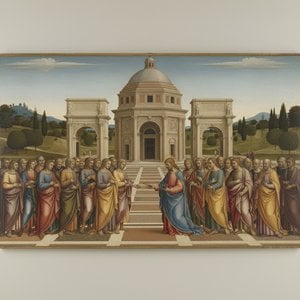
Pietro Perugino: Umbrian Master of Serenity & Precursor to Raphael's High Renaissance
Explore the life & art of Pietro Perugino, a pivotal Renaissance master and Raphael’s influential teacher. Discover his serene compositions, Sistine Chapel frescoes, and lasting legacy with ArtsDot.
Renașterea Înaltă: 10 Capodopere Iconice pentru Decorul Casei Tale
Descoperă 10 capodopere ale Renașterii Înalte – Leonardo da Vinci, Michelangelo, Rafael și alții. Află poveștile din spatele picturilor celebre și inspiră-ți decorul cu artă renascentistă de calitate muzeală pe ArtsDot.com! Explorează colecția online.

Fresca Modernă de Tavan: Aducerea Cerului în Interior – Reinterpretarea Artei Renascentiste Clasice cu Tematici Contemporane – Orizonturi Urbane, Galaxii, Nori, Adăugând Înălțime și Grandiozitate Chiar și Spațiilor Compacte
Descoperă fresce moderne de tavan spectaculoase! Design personalizat, calitate superioară și consultanță expertă pentru un interior unic. Transformă-ți spațiul cu !

The Renaissance Reimagined: Art, Humanism & Cultural Transformation (14th–16th Centuries)
Explore the Renaissance! Discover key artists like Leonardo & Michelangelo, the rise of Humanism, and groundbreaking techniques such as chiaroscuro. A comprehensive guide for art enthusiasts.