


 Vezi în context
 Trimite
 Distribuie
 Detalii
 Ghidul

 Descarcă
 Produse similare
 Radiografie
 Diaporama
 Statistici
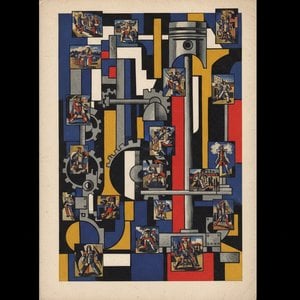
Untitled
 Oil On Canvas
- WallArt
- Geometric Abstraction
 1938
1938- Early Modern
 36.0 x 25.0 cm
 Whitney Museum of American Art
 Citește mai mult
Lucrarea de artă afișată pe această pagină este protejată de legile privind drepturile de autor, ceea ce înseamnă că nu putem crea sau vinde în mod legal o reproducere identică. Această protecție este garantată prin acorduri internaționale, precum Convenția de la Berna și de legile naționale, inclusiv cele prevăzute de Legea dreptului de autor din S.U.A. – Titlul 17. Toate drepturile rezervate. Orice reproducere neautorizată este interzisă.
Ca alternativă respectuoasă și legală, oferim tablouri pictate manual, personalizate, inspirate de original. Artistii noștri experimentați și profesioniști studiază cu atenție stilul, starea de spirit și esența artistică a originalului pentru a crea o piesă nouă și unică, care evocă aceeași emoție – rămânând, în același timp, o creație originală în sine.
Această metodă respectă pe deplin reglementările privind drepturile de autor, deoarece nu implică copierea sau duplicarea operei protejate. În schimb, este o reinterpretare creativă – o pictură nouă, influențată de original, dar care nu este identică cu acesta.
Reproducere pictată manual în ulei
Pictură în ulei pe pânză, realizată manual de artiștii noștri la dimensiunea și ramele dorite de dumneavoastră, pe comandă. ( Comută pe versiunea Print Treci la imagine digitală)




P118B lei10

P118H lei10

P118W lei10

P438Z lei10

P508JH lei12

P508YH lei12

P805H lei10

P805Z lei10

P919BZ lei10

P919G lei10

P919XJ lei10

P959ZH lei10

P968JZ lei12

W106C lei8

W218G lei10

W218JH lei8

W218Y lei10

W307PJ lei10

W316G lei10

W316PJ lei8

W316Y lei10

W398PJ lei8

W4111J lei10

W500HY lei15

W500JH lei15

W692G lei12

W849H lei8

W940BG lei15

W953PJ lei8




Alegeți dintre dimensiunile noastre prestabilite, care respectă proporțiile originale ale operei de artă.

Introduceți lățimea și înălțimea de care aveți nevoie, pentru a se potrivi ramei sau peretelui dumneavoastră. Această lucrare este pictată manual, așa că pentru o dimensiune cu o formă diferită, artistul poate picta puțin mai mult în jurul imaginii sau poate tăia puțin din margini — dumneavoastră decideți. Vă vom trimite o simulare digitală pentru aprobare înainte de a începe pictarea. Imaginea afișată pe această pagină nu reprezintă rezultatul real — doar simularea este reprezentativă.
După plasarea comenzii, echipa ArtsDot.com va contacta clientul prin e-mail pentru instrucțiuni și îi va furniza o previzualizare a machetei
Livrare în întreaga lume () în 3-4 săptămâni, în loc de cele 5 săptămâni standard. (21 Octombrie). Fără compromisuri în ceea ce privește calitatea.

Livrare expres gratuită la nivel mondial

Pânză de in premium

Asigurare completă pentru transport

Garanție de rambursare a taxelor vamale

Garanția fidelității culorilor

Politica de retur în 100 de zile (doar pentru defecte)

Garanție de rambursare 100%

Reducere pentru comenzi multiple
 Opțiunea cu sticlă este disponibilă doar pentru dimensiuni de sub 110 cm

Untitled
Tip de reproducere
Dimensiune reproducere
-


Preț total
lei 1206
A Meditation on Minimalism: Exploring Ad Reinhardt’s “Untitled”
The artwork known simply as "Untitled" by Ad Reinhardt stands as a cornerstone of Abstract Expressionism and a testament to the profound power of reductive artistic vision. Painted in 1938, during a period marked by burgeoning anxieties surrounding impending war and societal upheaval—a context that profoundly influenced European art—this deceptively simple canvas embodies Reinhardt’s unwavering commitment to stripping away extraneous ornamentation and confronting viewers with the purest essence of visual experience. It's not merely a painting; it’s an exercise in intellectual rigor, a deliberate rejection of representational illusionism in favor of pure color and form.- Historical Context: Reinhardt’s artistic trajectory emerged from the crucible of Weimar Germany, where he witnessed firsthand the disintegration of traditional values and the rise of extremist ideologies. Influenced by thinkers like Heidegger and Gödel, Reinhardt sought to liberate art from the constraints of narrative storytelling and psychological introspection—a reaction against the dominant trends of Surrealism and Psychoanalytic Art that dominated the decade preceding its creation.
- Style & Technique: Reinhardt’s approach was revolutionary in its simplicity. Rejecting brushstrokes and textural variation, he meticulously applied thin layers of matte black paint to a rectangular canvas—a technique he termed “Black Painting.” This method aimed to eliminate any perceptible surface irregularities, creating an almost impenetrable barrier between the viewer and the underlying pigment. The resulting monochrome surface is deliberately devoid of visual stimulation, forcing contemplation rather than passive observation.
- Composition & Color Palette: Despite its apparent austerity, "Untitled" possesses a carefully considered compositional balance. Reinhardt employed geometric shapes—primarily squares and rectangles—arranged in overlapping planes to generate depth without resorting to conventional perspective. The stark palette of black, white, and gray serves as a deliberate provocation, challenging viewers to confront the fundamental questions of perception and representation.
- Symbolism & Emotional Impact: Reinhardt’s intention wasn't to convey explicit emotion or narrative content; rather, he sought to evoke a state of meditative stillness. The monochrome surface symbolizes purity and negation—a deliberate erasure of illusion—while simultaneously prompting reflection on the nature of consciousness itself. Critics have interpreted the work as an emblem of existential contemplation, mirroring Reinhardt’s own philosophical convictions.
- Medium & Materials: Executed in oil paint on canvas, “Untitled” exemplifies Reinhardt's unwavering dedication to precision and control. Masking tape was employed to ensure perfectly straight edges, reinforcing the artwork’s geometric rigor. The resulting surface is remarkably smooth—a testament to Reinhardt’s meticulous technique—and embodies his belief that art should transcend mere decoration to achieve a state of profound intellectual clarity.
Întrebări și răspunsuri
La ce artist este atribuită opera „Untitled”?
Artistul din spatele operei „Untitled” este Ad Reinhardt. Lucrarea este catalogată sub numele lui Ad Reinhardt.
Cum echilibrează "Untitled" lumina și întunericul?
Valorile înregistrate pentru "Untitled" de Ad Reinhardt sunt: luminozitate de bright, luminanță de Bright Balance.
Ce sentiment transmite "Untitled" de Ad Reinhardt?
Starea de spirit surprinsă în "Untitled" de Ad Reinhardt este Minimalist, iar tonul său emoțional este Reflective.
Opere similare


Biografie artist
A Life Dedicated to the Essence of Art
Ad Reinhardt, born Adolph Friedrich Reinhardt in Buffalo, New York, on December 24, 1913, was a figure who dedicated his life not merely to creating art, but to defining what art *could* be. His early years were marked by a familial mobility—his father’s work led the family to New York City—and a close bond with his cousin Otto. Even as a child, Reinhardt displayed an exceptional talent for drawing and painting, winning accolades in school that hinted at the rigorous artistic journey ahead. He wasn't simply interested in *making* images; he was driven by a need to understand the very foundations of visual expression. This intellectual curiosity led him to Columbia University where he studied art history under the influential Meyer Schapiro, an experience that profoundly shaped his thinking about aesthetics and the role of the artist. Further training at Columbia’s Teachers College, the American Artists School with Carl Holty and Francis Criss, and portraiture studies at the National Academy of Design under Karl Anderson solidified his technical skills—skills he would later deliberately attempt to transcend. Reinhardt believed he had mastered traditional techniques early on, freeing him to pursue a more conceptual path.From Geometric Beginnings to the “Ultimate” Black
Reinhardt’s artistic evolution was far from linear. He began with works rooted in geometric abstraction, exploring form and color with a precision that demonstrated his technical mastery. However, this early work served as a stepping stone toward something more radical. His involvement with the WPA Federal Art Project during the 1930s provided him with crucial support and exposure, allowing him to hone his craft while contributing to public art initiatives. The 1940s saw Reinhardt become an active member of American Abstract Artists (AAA), a group he considered pivotal to his development. He found kinship with fellow artists who shared a commitment to non-representational art, exhibiting regularly alongside them and engaging in lively debates about the future of painting. His association with Betty Parsons Gallery further cemented his place within the burgeoning New York art scene. Throughout the 1950s, Reinhardt embarked on a series of paintings exploring subtle variations within single hues—all red, all blue, all white—a deliberate reduction that foreshadowed his most iconic works. It was in the 1960s, however, that he achieved what many consider his defining achievement: the “black” paintings. These weren’t simply black canvases; they were meticulously crafted explorations of near-black shades, subtle gradations and textures designed to challenge perception and push the boundaries of painting itself. He referred to them as his "ultimate" paintings, suggesting a culmination of artistic endeavor—a point beyond which further progress was impossible. The process involved layering countless thin washes of gray, creating an illusion of depth and texture that defied simple categorization.Art-as-Art: A Philosophy of Pure Aestheticism
Central to understanding Reinhardt’s work is his philosophy of *Art-as-Art*. He vehemently believed in the autonomy of art, rejecting any notion that it should serve political, social, or narrative purposes. For Reinhardt, the value of a painting lay solely in its aesthetic qualities—its form, color, composition, and the way it engaged with the viewer on a purely visual level. This conviction led him to critique what he saw as problematic tendencies within the art world, particularly artists who prioritized messaging over aesthetics. He expressed these critiques through satirical cartoons and writings, often challenging prevailing artistic norms with wit and intellectual rigor. His friendships with Robert Lax and Thomas Merton, both of whom explored themes of simplicity in their respective fields, further informed his aesthetic principles. Reinhardt’s work resonated with a growing interest in minimalism and conceptual art, influencing artists who sought to strip away extraneous elements and focus on the essential qualities of their medium. He wasn't merely creating paintings; he was articulating a theoretical position about the nature of art itself. His famous cartoon “How to Look at Modern Art in America” perfectly encapsulated this stance, highlighting the distinction between genuine artistic expression and works driven by social or political agendas.The Black Paintings and Their Significance
Reinhardt’s “black” paintings represent the culmination of his artistic explorations. These large-scale canvases, typically five feet square, were not intended to depict anything specific but rather to explore the very nature of painting itself. The subtle variations in tone and texture created an illusion of depth and movement, inviting viewers to contemplate the act of seeing. He famously stated that these paintings were “the ultimate,” suggesting they represented a final stage of artistic development—a point beyond which further progress was impossible. Critics debated the meaning behind these works, with some interpreting them as meditations on darkness, silence, or the void, while others saw them simply as exercises in pure color and form. Regardless of interpretation, the black paintings stand as a testament to Reinhardt’s commitment to aesthetic autonomy and his willingness to challenge conventional notions of artistic representation.A Lasting Legacy: Minimalism, Conceptualism, and Beyond
Ad Reinhardt’s influence extends far beyond his own body of work. His “black” paintings are now recognized as seminal contributions to minimalist and monochrome painting, challenging conventional notions of representation and pushing the boundaries of visual perception. His writings on *Art-as-Art* continue to be studied by artists and critics alike, sparking debate about the role of art in society and the relationship between form and content. Though he was a key figure within Abstract Expressionism through his association with AAA and Betty Parsons Gallery, Reinhardt ultimately transcended categorization, paving the way for subsequent generations of conceptual and minimalist artists. He taught at numerous institutions—Brooklyn College, California School of Fine Arts, University of Wyoming, Yale University, and Hunter College—imparting his rigorous intellectual approach to aspiring artists. Even his involvement in protests – against MoMA in the 1940s, with “The Irascibles” against the Metropolitan Museum of Art in the 1950s, and through a lithograph for Artists and Writers Protest Against the Vietnam War in 1967—demonstrated a commitment to artistic freedom and social responsibility. Ad Reinhardt died on August 30, 1967, in New York City, leaving behind a legacy that continues to inspire and provoke. His work remains a powerful testament to the enduring power of abstract art and the importance of questioning fundamental assumptions about the nature of creativity itself. The Ad Reinhardt Estate is currently represented by David Zwirner Gallery, ensuring his continued presence within the contemporary art world.
Ad Reinhardt
1913 - 1967 , Statele Unite ale Americii
Informații rapide
- Artistic Movement Or Style: Abstract Expressionism, Minimalism
- Artists Or Movements Influenced By This Artist:
- Artă ca Artă
- Minimalism
- Artists Who Influenced This Artist:
- Meyer Schapiro
- Robert Lax
- Thomas Merton
- Date Of Birth: 24 Decembrie 1913
- Date Of Death: 30 August 1967
- Full Name: Adolf Friedrich Reinhardt
- Nationality: American
- Notable Artworks:
- Untitled
- Roșu și Gri
- Numărul - (107)
- Place Of Birth: Buffalo, Statele Unite
Articole conexe

Cele mai importante 10 capodopere ale abstracției geometrice | Artă & Decor de lux pe ArtsDot.com
Descoperă cele mai importante 10 capodopere ale abstracției geometrice! Explorează istoria, artiștii (Mondrian, Kandinsky) și culorile vibrante care au definit arta modernă. Reproduceri de tablouri de lux pe ArtsDot.com pentru un decor interior rafinat. Explorează colecția online!

Wassily Kandinsky: Cele Mai Iconice 25 De Opere – Artă Abstractă pentru Decor Rafinat
Descoperă cele mai emblematice 25 de opere ale lui Wassily Kandinsky, pionierul artei abstracte! Explorează culorile vibrante, compozițiile unice și istoria fascinantă din spatele fiecărei picturi. Reproduceri de calitate muzeală pe ArtsDot.com – inspiră-ți decorul cu artă modernă!

Top 10 Capodopere ale Expresionismului Abstract: Artă, Artiști și Decorațiuni de Lux | ArtsDot.ro
Descoperă Top 10 capodopere ale Expresionismului Abstract! Explorează poveștile lui Pollock, Rothko și De Kooning. Reproduceri de artă de lux & inspirație decor pe ArtsDot.ro. Găsește pictura perfectă pentru spațiul tău!

Kazimir Malevich: Cele Mai Iconice 25 De Opere – Artă Abstractă pentru Decor Rafinat
Descoperă cele mai importante 25 de opere ale lui Kazimir Malevich, pionierul Suprematismului! Explorează istoria picturilor abstracte iconice precum 'Black Square' și 'White on White'. Găsește reproduceri artă de calitate muzeală pentru un decor rafinat pe ArtsDot.com.
Fernand Léger: Cele Mai Iconice 25 de Opere – Artă Modernă pentru Decorul Tău
Descoperă cele mai importante 25 de opere ale lui Fernand Léger – pionier al cubismului și tubismului! Explorează istoria, tehnicile și semnificația fiecărei pânze. Reproduceri artă de calitate muzeală pentru un decor modern și sofisticat pe ArtsDot.com.