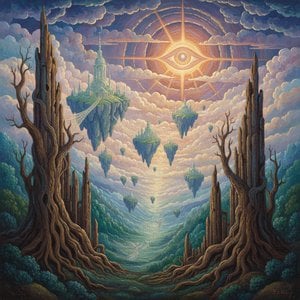
The Quiet Language of Ink and Spirit
Yu He was born on August 26, 1996, in China, growing up in an environment where the subtle movements of a brush and the flow of ink were part of the daily rhythm. His early years were shaped by the presence of traditional calligraphy and landscape artistry, disciplines that taught him how to find meaning in the way a single line meets a blank surface. He found inspiration in the works of masters like Qi Baishi and Zhang Daqian, learning how they used small visual cues to speak of deep human emotions. This foundation allowed him to develop a way of seeing that honors the past while looking toward a new era of Chinese painting.
His approach to the canvas is a careful balance of old and new. Using the ink wash technique, he builds layers of pigment on silk or paper to create a sense of depth and light. His landscapes often feature expansive vistas in muted tones of grey and ochre, creating a feeling of stillness. These works are not merely pictures of nature; they are infused with Buddhist philosophy, where mountains and rivers act as metaphors for resilience and the cycles of life.
A Study in Symbolism and Form
The way Yu He handles his subjects reveals a deep connection to the spiritual and the natural. He uses specific motifs to communicate ideas that might otherwise remain unspoken. His work often explores the following elements:
- The use of muted color palettes to establish a contemplative atmosphere.
- The application of meticulous brushwork to achieve textural depth on silk.
- The integration of symbolic imagery rooted in Chinese cosmology.
- The balance of negative space to emphasize the essence of the subject.
In pieces like “A Poem to a Friend,” he demonstrates how to distill complex feelings into a simple composition. Through subtle color changes and the placement of a few careful strokes, he conveys warmth and compassion. This ability to turn a visual scene into a poetic expression is a hallmark of his development as an artist.
A Bridge Between Eras
Yu He occupies a unique space in the contemporary art landscape. He does not simply repeat the styles of the past; instead, he uses those traditional methods to address modern sensibilities. By doing so, he helps keep the dialogue of Chinese painting alive for a new generation. His work suggests that tradition is not a static thing to be preserved in a museum, but a living language that can be used to express the complexities of modern existence. As he continues to develop his vision, his presence in the art world marks a significant moment for the evolution of modern Chinese art.
Perguntas e Respostas
Posso explorar as obras de Yu He por espectro de cores?
As obras de Yu He podem ser exploradas por cor na página Índice de Cores do artista.
De onde é Yu He?
Yu He nasceu em China.
Onde posso ver as obras de Yu He organizadas por atmosfera?
A página de Coleção por Humor do artista apresenta as obras de Yu He organizadas por sua atmosfera.
Quantas obras de Yu He estão disponíveis para explorar?
Você pode explorar 1 obras de arte obras de Yu He na página Todas as obras.