The Brush of Jiaxing
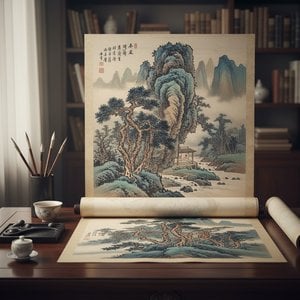
The landscape of the Qing Dynasty shifts through the ink of Pu Hua. Born in Jiaxing, within the Zhejiang province, he moves through the world as a painter and calligrapher. His style name, Zuoying, marks a man defined by the movement of the brush. He does not adhere to the rigid constraints of tradition, opting instead for a method of free and easy brush strokes. This approach allows the ink to breathe, capturing the essence of the natural world through a sense of spontaneous motion.
His focus remains split between the vastness of the terrain and the delicate precision of botanical life. He navigates the space between the grand and the minute, applying ink and color to paper to manifest the spirit of the mountains and the quiet strength of bamboo.
Technical Nuance and Subject Matter
The work of Pu Hua is characterized by a specific tension between control and release. His compositions often reflect a deep engagement with the natural environment, rendered through a technique that prioritizes the rhythm of the stroke over photographic accuracy. His repertoire is defined by several key focuses:
- Landscape painting, often exploring the interplay of mountains and rivers.
- Ink bamboo, executed with a focus on the vitality of the plant.
- Calligraphy, where the written word meets the visual weight of the ink.
In works such as Reading Books in a Cave: after Wu Zhen, the influence of earlier masters is felt, yet the execution remains distinctly his own. He utilizes the ink to suggest depth and atmosphere, creating scenes that feel lived-in rather than merely observed.
Historical Presence
Pu Hua lived through the final decades of the Qing Dynasty, a period of profound transition. His art remains a part of the historical record, held in collections such as the Yale University Art Gallery in New Haven. His ability to maintain an unconventional style amidst the established norms of his era ensures his place in the study of Chinese ink painting. He remains a figure of the late imperial period, a painter whose hand captured the shifting light of the 19th century.
Perguntas e Respostas
Posso navegar pelas obras de Pu Hua por movimento?
Os movimentos em que Pu Hua atuou podem ser conferidos na página de Todos os Movimentos do artista, que agrupa as obras por movimento.
Por quais outros nomes ou pseudônimos Pu Hua é conhecido?
Pu Hua também é conhecido como Xushan waishi, Zuoying, 蒲华.
Onde posso ver todas as obras de Pu Hua?
Todas as obras de Pu Hua no este site podem ser exploradas na página de Todas as obras do artista.
Posso navegar pelas obras de Pu Hua por paleta de cores?
A página Por paleta de cores agrupa as obras de Pu Hua por suas paletas de cores.