The Modernist Vision of Karl Hagedorn
In the tapestry of early twentieth-century modernism, few threads are as intricately woven as those left by Karl Hagedorn. Born in Berlin in 1889, Hagedorn’s life was a journey of geographical and stylistic migration, eventually anchoring him within the vibrant, industrial heart of Manchester. While his origins were German, his artistic soul became deeply entwined with the British art scene, where he emerged as a pivotal figure of the Manchester modernist movement. His work, often signed simply as Hagedorn, serves as a profound bridge between the rigorous academic traditions of the late nineteenth century and the fractured, energetic experimentation of the avant-garde.
Hagedorn’s artistic evolution was shaped by an extraordinary breadth of education and mentorship. His formative years saw him absorbing the technical precision of Berlin University and the Manchester School of Technology, yet it was his time at the Slade School of Fine Art in London and his studies in Paris under the renowned Maurice Denis that truly ignited his creative spirit. From Denis, Hagedorn inherited a sense of spiritual contemplation and a belief that art should transcend mere representation to touch upon deeper, more essential truths. This influence is palpable in his ability to infuse even the most geometric or structured compositions with a lingering, humanistic warmth.
A Synthesis of Form and Feeling
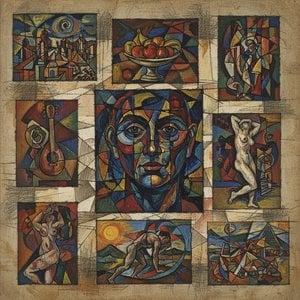
The stylistic hallmarks of Hagedorn’s oeuvre are defined by a captivating tension between Cubist experimentation and a deeply felt humanist sensibility. During the height of the modernist era, he embraced the fragmented planes and rhythmic geometries of Cubism and Futurism, utilizing them not to obscure reality, but to dissect and reassemble it in ways that captured the dynamism of modern life. In masterpieces such as “Winter Sunshine”, one can observe how he employs muted grays, earthy browns, and evocative textures to create a melancholic yet luminous urban atmosphere. His brushwork often oscillates between realistic precision and impressionistic fluidity, allowing light and shadow to dance across textured surfaces.
Beyond the purely aesthetic, Hagedorn’s work was profoundly shaped by the historical upheavals of his era. His service in the British Army during World War I left an indelible mark on his psyche, manifesting in powerful, somber depictions of conflict. These works moved beyond simple reportage, instead utilizing his developing modernist vocabulary to explore the psychological weight of war and the resilience of the human spirit. This period solidified his reputation as an artist capable of translating the chaos of global upheaval into a structured, meaningful visual language.
Legacy and Artistic Contribution
Throughout his prolific career, Hagedorn remained a steadfast presence in the prestigious corridors of the art world. He was a regular contributor to the Society of Modern Painters and earned significant acclaim through frequent exhibitions at the Royal Academy and the New English Art Club. His versatility extended beyond the canvas; he was also a skilled illustrator, a designer of fabrics, and a dedicated educator who nurtured future generations of artists at institutions such as the Epsom School of Art.
The historical significance of Karl Hagedorn lies in his role as a cultural conduit. He successfully synthesized the intellectual rigor of Continental European modernism with the burgeoning artistic identity of Northern England. His legacy is found in:
- Stylistic Innovation: The seamless integration of Cubist and Futurist techniques into a more contemplative, humanist aesthetic.
- Educational Impact: His commitment to teaching, which helped sustain the momentum of modernist thought in British art schools.
- Cultural Synthesis: His ability to bridge German academic roots with British modernist movements, creating a unique, transnational artistic voice.
Today, Hagedorn’s work continues to resonate, offering a window into an era of profound transition. His paintings remain much more than mere artifacts of the early twentieth century; they are enduring meditations on the interplay between structure and emotion, light and shadow, and the eternal human struggle to find beauty within the fractured modern world.