

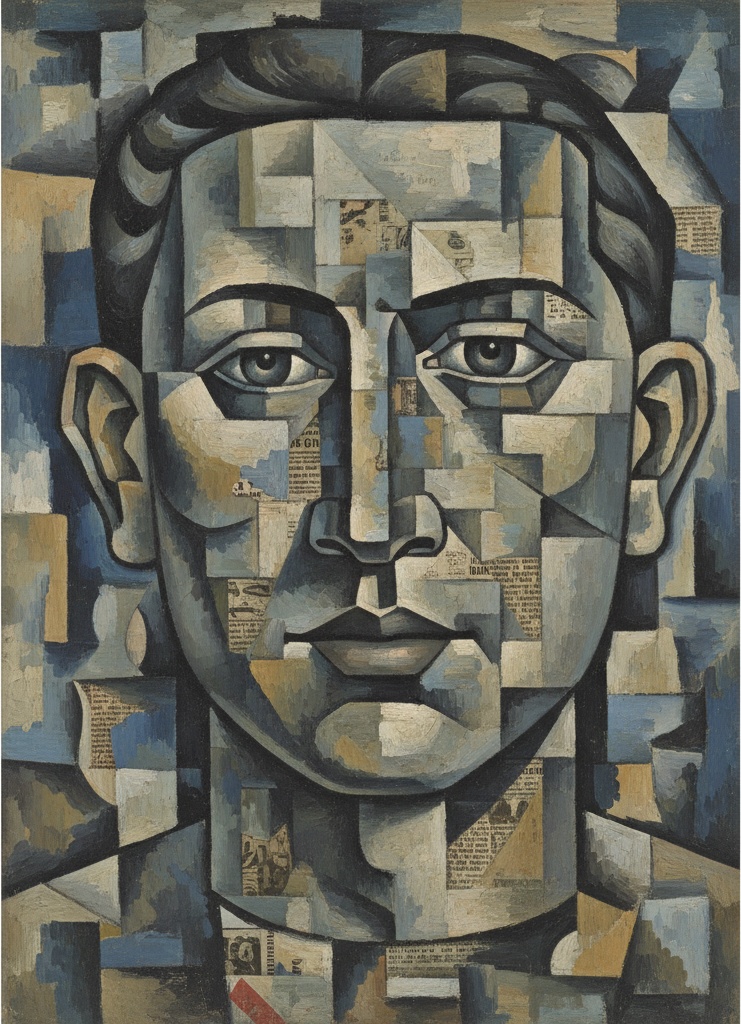


The Genesis of Cubism: From Cézanne to Picasso and Braque
Cubism is an early-20th-century avant-garde art movement which began in Paris. It revolutionized painting and the visual arts, and sparked artistic innovations in music, ballet, literature, and architecture. Cubist subjects are analyzed, broken up, a...
The early 20th century witnessed a seismic shift in the artistic landscape, a dismantling of traditional representation that would come to be known as Cubism. While often attributed solely to Pablo Picasso and Georges Braque, its roots lie deeper, entwined with the groundbreaking work of Paul Cézanne. Cézanne’s late paintings—his still lifes and landscapes—were not merely depictions of reality but investigations into its underlying structure. He fractured forms, presenting multiple viewpoints simultaneously, a deliberate rejection of single-point perspective that had dominated Western art for centuries. This wasn't about optical illusion; it was about conveying the totality of an object’s presence, its weight, volume, and spatial relationships. Picasso’s encounter with Cézanne’s retrospective in 1904 proved pivotal, igniting a desire to push beyond Impressionism’s fleeting moments and explore the very foundations of pictorial space. The subsequent collaboration between Picasso and Braque, beginning around 1907, marked the true birth of Cubism—a radical departure that would redefine how artists perceived and represented the world.
The initial phase, often referred to as Proto-Cubism, saw a simplification of forms and a move towards geometric shapes. Picasso’s Les Demoiselles d'Avignon (1907) stands as a watershed moment—a jarring composition featuring fragmented figures influenced by Iberian sculpture and African masks. This work wasn’t simply about depicting nude women; it was an assault on conventional beauty standards, a deliberate distortion of the human form that signaled a new artistic language. Braque, meanwhile, explored similar themes in his early Cubist works, focusing on still lifes and interiors. These initial experiments laid the groundwork for the more systematic deconstruction that would characterize Analytic Cubism.
Analytic Cubism: Fragmentation, Multiple Perspectives & The Dissolution of Form
Between 1908 and 1912, Picasso and Braque embarked on a period of intense experimentation known as Analytic Cubism. This phase was characterized by the fracturing of objects into geometric facets, presented from multiple viewpoints simultaneously. The palette became deliberately muted—primarily browns, grays, and blacks—a conscious effort to minimize distraction and focus attention on the formal elements of the composition. Head of a Man (Picasso) exemplifies this approach; the subject is barely discernible as a human head, broken down into angular planes that seem to float on the canvas. The goal wasn’t to replicate reality but to analyze it—to dissect its constituent parts and reconstruct them in a new, abstract form.
This process of deconstruction was not arbitrary; it reflected a desire to represent the subject in its entirety, capturing all possible perspectives at once. Smarthistory highlights this technique as a key innovation, noting that Cubist artists sought to depict objects from multiple angles, offering a more comprehensive understanding of their form. The use of multiple perspectives challenged traditional notions of space and representation, forcing viewers to actively engage with the artwork and reconstruct the image in their own minds. The paintings became intellectual puzzles, demanding careful scrutiny and interpretation. This period also saw the introduction of “attributes”—fragments of recognizable objects—to anchor the compositions in reality, preventing them from dissolving into pure abstraction.
Synthetic Cubism: Reassembling Reality Through Collage and Color
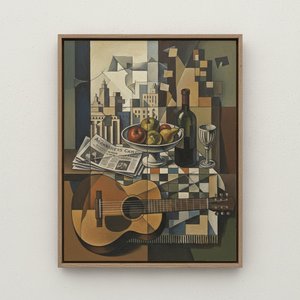 Juan Gris: Cubist Deconstruction & Synthesis – A Comprehensive Exploration
Explore the revolutionary art of Juan Gris – a master of Cubism. Discover his unique approach to deconstruction, vibrant Synthetic Cubist works, and lasting influence on modern art. Expert analysis for collectors.
Around 1912, Analytic Cubism began to evolve into Synthetic Cubism. While still employing geometric forms and fragmented perspectives, this phase marked a shift towards greater simplification and the introduction of brighter colors. Crucially, it also saw the incorporation of collage—the pasting of real-world materials, such as newspaper clippings and patterned paper, onto the canvas. This was a revolutionary technique that blurred the boundaries between painting and sculpture, challenging traditional notions of artistic medium.
Juan Gris emerged as a key figure during this period, bringing a unique sensibility to Synthetic Cubism. His works are characterized by vibrant colors, bold compositions, and a meticulous attention to detail. Unlike Picasso and Braque’s more subdued palettes, Gris embraced a brighter range of hues, creating visually striking images that were both abstract and accessible. The use of collage allowed artists to introduce new textures and patterns into their work, further disrupting the illusion of reality. Synthetic Cubism wasn't simply about breaking down objects; it was about reassembling them—creating new forms from fragments of the existing world.
Beyond Picasso & Braque: Key Figures in the Cubist Movement – Juan Gris and Others
 pablo diego josé francisco de paula juan nepomuceno maría de los remedios cipriano de la santísima trinidad ruiz y picasso
Explore the revolutionary art of Pablo Picasso (1881-1973), a Spanish painter & sculptor, co-founder of Cubism. Discover his iconic paintings, sculptures, and prints that redefined modern art with themes of abstraction, portraiture, and social commen
While Picasso and Braque are rightfully considered the pioneers of Cubism, their influence extended to a wider circle of artists. Jean Metzinger and Albert Gleizes played a crucial role in disseminating Cubist ideas through their writings and exhibitions. Robert Delaunay explored Orphism, a related style that emphasized color and abstraction. Fernand Léger developed his own unique brand of Cubism, incorporating machine-like forms and industrial motifs.
However, Juan Gris stands out as a particularly significant figure. He brought a rigorous intellectual approach to Cubism, analyzing the movement’s principles and developing his own distinct style. His work is characterized by its clarity, precision, and vibrant color palette. As Daniel-Henry Kahnweiler noted, Gris was instrumental in articulating the theoretical foundations of Cubism, providing a framework for understanding its complex ideas. His contributions helped to solidify Cubism's place as one of the most influential art movements of the 20th century.
The Psychological Dimension: Exploring Identity and Representation in Cubist Portraits
Cubist portraits, while often fragmented and abstract, were not simply formal exercises; they also explored deeper psychological themes. By breaking down the human face into geometric planes, artists challenged conventional notions of identity and representation. Head of a Woman 6 (Picasso) exemplifies this approach—the subject is barely recognizable as a woman, her features distorted and reassembled in a new, unsettling way.
This fragmentation can be interpreted as a reflection of the complexities of human personality—the multiple facets that make up an individual’s identity. The use of multiple perspectives suggests that there is no single “true” representation of a person; rather, identity is fluid and multifaceted. The muted colors and angular forms often convey a sense of alienation and anxiety, reflecting the psychological turmoil of the modern era. These portraits weren't about capturing likeness; they were about exploring the inner life of the subject—their emotions, thoughts, and experiences.
Cubism’s Enduring Legacy: Influence on Modern Art and Beyond
The impact of Cubism extended far beyond painting, influencing sculpture, architecture, music, and literature. Its revolutionary ideas challenged traditional notions of space, form, and representation, paving the way for a new era of artistic experimentation. Movements such as Futurism, Suprematism, and Constructivism all drew inspiration from Cubism’s principles.
Even today, Cubism continues to resonate with artists and audiences alike. Its emphasis on abstraction, fragmentation, and multiple perspectives remains relevant in a world increasingly characterized by complexity and uncertainty. The movement's legacy can be seen in countless works of modern art—from the abstract sculptures of David Smith to the deconstructed paintings of Gerhard Richter. At ArtsDot.com, we offer a curated selection of museum-quality Cubist reproductions, allowing you to experience the power and beauty of this revolutionary movement firsthand. Explore our collection today and discover the enduring legacy of Picasso, Braque, Gris, and their contemporaries.



