The Hand of the Observer
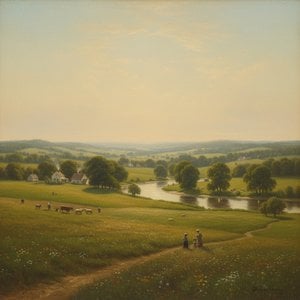
Born in 1920, John Potter Wheat possessed a gaze that sought the truth in the textures of the American landscape. His education at the Art Students League and the Yale School of Fine Arts provided him with a rigorous foundation, eventually earning him a Master of Fine Arts. He was a man of meticulous detail, a painter who understood that to capture a moment, one must first understand the weight of the clothing worn by its subjects and the specific equipment used by those living through history. His early years were defined by a deep devotion to the quietude of New England, where he spent much of his time painting churches and the weathered silhouettes of barns.
As his career progressed, his approach to the canvas underwent a transformation. He moved from the steady, observational nature of realism into a more complex territory, experimenting with the palette knife to build texture and exploring a style that drifted toward the surreal. This evolution allowed him to move beyond mere imitation, seeking instead to capture the essence of a scene through a more tactile and layered application of paint.
A Life of Commission and Conflict
Wheat’s life was marked by a willingness to step into the fray, often documenting the very events that shaped the modern era. His work was not confined to the quiet studios of academia but extended into the public sphere through large-scale murals and military commissions. His ability to translate history into visual narrative led him to several significant endeavors:
- The creation of murals for the OSS during the Second World War.
- The depiction of historical events within the walls of movie theaters.
- A massive mural for the South Central bank in Keokuk, Iowa, which illustrated the city's role in the westward expansion.
- A specialized commission by the US Army in 1968 to document the Vietnam War.
It was during his time in Vietnam, specifically between November and December of 1968, that Wheat practiced the art of en plein air watercolor. Working in the vicinity of Dong Tam, he captured the tension of the delta. His work from this period, such as "Action in the Delta" Corps Area IV, remains a vital record of the landscape and the atmosphere of the conflict, executed with a speed and immediacy that only the outdoor setting can demand.
The Legacy of Detail
The precision of his work remained a constant, even as his styles shifted. Whether he was working in watercolor on paper or applying thick strokes with a palette knife, he remained committed to an absolute truth regarding the era he depicted. This dedication to historical accuracy ensured that his murals and landscapes were more than mere decorations; they were visual documents of a specific time and place. His life, which came to an end in 1980, left behind a body of work that spans the breadth of the American experience, from the rural stillness of a New England church to the heavy, humid air of a wartime delta.
Perguntas e Respostas
Posso estudar o uso de cores de John Potter Wheat em todas as suas obras?
O uso da cor em John Potter Wheat, através das obras listadas em este site, pode ser estudado na página DNA da Paleta do artista.
Qual é o nível de popularidade das obras de John Potter Wheat?
A página de Estatísticas de John Potter Wheat apresenta estatísticas calculadas a partir das obras do artista listadas em este site.
Onde as obras de John Potter Wheat estão agrupadas por técnica?
Para encontrar todas as obras de John Potter Wheat por técnica, acesse a página de Por Técnica do artista.
Por quais outros nomes John Potter Wheat é conhecido(a)?
John Potter Wheat também é conhecido como John Wheat.