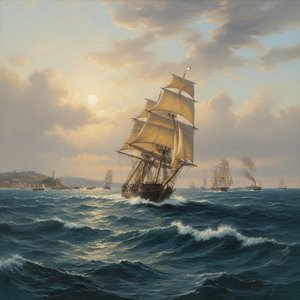
The Resilient Vision of James Britton
Born in the heart of Hartford, Connecticut, in 1878, James Britton emerged as a vital, if often underappreciated, voice in the American realist tradition. His journey was one defined by a profound dedication to the craft of painting, even when faced with the most pressing material hardships. Trained under the esteemed Connecticut artist Charles Noel Flegg, Britton mastered the nuances of realism, a technique that allowed him to capture the quiet dignity of his subjects and the atmospheric subtleties of the American landscape. His early professional life was marked by a versatile engagement with the media; he served as a staff artist for The Hartford Times and later transitioned into the role of an influential art critic for The Hartford Courant, demonstrating a deep intellectual connection to the evolving art scene of his era.
Britton’s artistic output was remarkably prolific, driven by an insatiable need to document the world around him. While he earned much of his livelihood through portraiture, it was his passion for landscapes and woodblock prints that truly captured his spirit. His life was often characterized by financial struggle, a reality that birthed a unique and resourceful approach to his medium. Lacking the means to frequently purchase new canvases, Britton became a master of adaptation, painting over existing materials with remarkable skill. This necessity led to some of his most charmingly idiosyncratic works, including paintings executed on cereal boxes and even a small egg carton. These pieces serve as a testament to his belief that art is not dependent on luxury, but on the vision of the artist and the raw impulse to create.
A Legacy of Advocacy and Community
Beyond the solitary act of painting, Britton was a tireless organizer and an advocate for the broader community of American artists. He understood that for art to flourish, it required both visibility and structure. In Connecticut, he played a foundational role in establishing the Connecticut Art Students League, fostering a space for growth and education. His influence extended into the vibrant art scene of New York City, where he became a founding member of a group known as The Eclectics. Through this collective, he sought to exhibit works that challenged the status quo and brought fresh perspectives to the public eye.
His commitment to the recognition of American talent was perhaps most evident in his editorial endeavors. In 1919, driven by a conviction that many talented domestic painters remained obscured by the shadows of European dominance, he created, edited, and published the periodical Art Review International. This publication lasted until 1925 and served as a vital platform for highlighting the merits of American art. As a critic for American Art News, he also provided essential commentary on pivotal moments in art history, such as the landmark Armory Show of 1913, positioning himself at the very center of the modern art discourse.
The Final Chapters and Enduring Spirit
The later years of Britton's life were marked by physical adversity. A severe traffic accident in 1928 left him with a compromised mobility that would shadow his remaining years. Despite the physical limitations imposed by his injury, his creative drive remained undiminished until his death on April 16, 1936. He left behind a legacy that spans various scales—from large-scale oils like Sag Harbor Studio to tiny, postcard-sized landscapes that capture fleeting moments of beauty.
Today, the work of James Britton is experiencing a well-deserved revival. His ability to find beauty in the mundane and his unwavering commitment to the American identity through art continue to resonate with collectors and historians alike. His life serves as a poignant reminder of the artist's role not just as a creator of images, but as a guardian of culture and a champion for the unseen.
Perguntas e Respostas
Por quais outros nomes ou pseudônimos James Britton é conhecido?
James Britton também é conhecido pelos nomes جيمس بريتون.
Posso explorar as obras de James Britton por tema?
As obras de James Britton podem ser exploradas por tema na página Atlas de Temas do artista.
Como posso acompanhar a obra de James Britton ano após ano?
A página de Linha do tempo das obras do artista apresenta as obras de James Britton ordenadas por data, ano a ano.
Quantas obras de James Britton estão disponíveis para explorar?
Você pode explorar 2 obras de arte obras de James Britton na página Todas as obras.