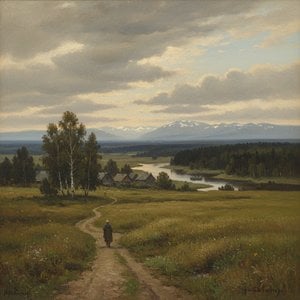
A Life of Quiet Determination
Fyodor Mikhailovich Slavyansky entered the world in 1817 within the village of Vyshkovo, located in the Tver Guberniya. His early years were defined by the heavy reality of his status as a serf belonging to the landlady Avdotya Nikolatelyna Semenova. Life for a young man in such circumstances was rarely shaped by personal choice, yet Slavyansky found a path toward a different existence through the brush and canvas.
In 1839, his life took a significant turn when he began working under Alexey Gavrilovich Venetsianov at the Safonkovo estate. This relationship was more than a simple apprenticeship; it was a lifeline. Venetsianov recognized the talent in his student and worked toward securing Slavyansky's freedom from servitude. By 1840, the path to formal training opened as Venetsianov petitioned the Academy to allow Slavyansky to attend drawing lessons. He spent those formative years absorbing the techniques of professors Varnek and Markov while continuing his practical work alongside his mentor.
The struggle for recognition and legal standing was a slow process, but by 1845, he had officially obtained the title of a freelance artist. This achievement marked the transition from a life of bonded labor to one of professional identity in the Russian art community.
Artistic Focus and Legacy
Slavyansky’s work was primarily centered on portraits. He possessed an eye for capturing the people around him, a skill evident in works such as his 1857 painting, On the Balcony, which depicts a self-portrait of the artist alongside his family. His paintings often reflected the quiet, domestic realities of the era.
Though he lived through a period of immense social change in Russia, Slavyansky remained rooted in the traditions he learned at the Academy and under Venetsianov. He passed away in Saint Petersburg on 18 February 1876. His life remains a notable example of how artistic dedication could bridge the gap between the life of a serf and that of a recognized painter.
Perguntas e Respostas
Onde posso explorar as obras de Fyodor Slavyansky mapeadas por tema?
O Atlas de Temas de Fyodor Slavyansky é uma página que mapeia as obras do artista por seus temas.
Posso navegar pelas obras de Fyodor Slavyansky por movimento?
A página Todos os Movimentos agrupa as obras de Fyodor Slavyansky por movimento artístico.
Como posso encontrar obras de Fyodor Slavyansky em uma paleta específica?
As obras de Fyodor Slavyansky podem ser exploradas por paleta de cores na página de Por paleta de cores do artista.
Como a carreira de Fyodor Slavyansky é dividida em períodos?
A trajetória de Fyodor Slavyansky desenrola-se período a período na página Linha do tempo do artista: uma linha do tempo horizontal das obras, agrupadas em capítulos por fases da carreira.