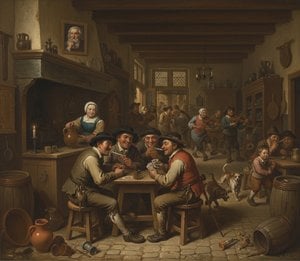
The Artisan's Path
Born in Oudenaarde to a decorative painter, Emmanuel Noterman’s early life was shaped by the tactile realities of craft. His hands first learned the precision of gilding before they ever held a fine brush for portraiture. This technical foundation, instilled by his father and nurtured by his maternal grandfather, Bernard Durieux, provided a disciplined starting point for an artist who would eventually find his true calling in the more spirited realms of animal and genre painting.
His formal education took him to the Academy of Fine Arts of Ghent, where he studied under Maes-Canini. While his early years were spent capturing the likenesses of individuals in Geraardsbergen and Brussels, a shift in direction was inevitable. In 1835, a move to Antwerp, guided by the advice of Pierre Kremer, redirected his focus toward the lively, often humorous, scenes that would define his career.
The Comedy of Manners
Noterman found a particular niche in the singeries—a genre of painting where monkeys are depicted engaging in human activities. These scenes often utilized costumes to mock human vices or specific occupations, turning the animal kingdom into a mirror for social satire. His ability to blend the naturalistic with the absurd allowed him to achieve a level of success that resonated in the Belgian salons of the era.
Beyond the satirical, his technical skill was frequently applied to the study of domestic animals. His depictions of dogs and cats were highly regarded, often set within the landscapes of his contemporary, Jean Pierre François Lamorinière. His artistic output was diverse, spanning several disciplines:
- Genre scenes involving human-like animal behavior
- Detailed portraiture of dogs and cats
- Etchings and printmaking
- Landscape-integrated animal studies
A Lasting Influence
The studio of Noterman served as a training ground for several notable figures in Belgian art. He passed his techniques to his brother, Zacharie Noterman, who would also specialize in animal subjects and singeries. His influence extended to his students, including Ernest Slingeneyer and Jan Stobbaerts, ensuring his approach to composition and subject matter would persist through the next generation of painters.
By the time of his death in Antwerp, Noterman had established himself as a significant figure in the local art scene, a member of the Freemason lodge La Persévérance. He moved from the rigid constraints of portraiture to a more playful, observational style, leaving behind a body of work that captured both the dignity of animals and the absurdity of the human condition.
Perguntas e Respostas
Existe uma visão geral de todos os temas que Emmanuel Noterman pintou?
A página Atlas de Temas mapeia as obras de Emmanuel Noterman por tema.
Existe uma cronologia da carreira de Emmanuel Noterman?
A trajetória de Emmanuel Noterman desenrola-se período a período na página Linha do tempo do artista: uma linha do tempo horizontal das obras, agrupadas em capítulos por fases da carreira.
Como posso ver todas as obras de Emmanuel Noterman?
Todas as obras de Emmanuel Noterman no este site podem ser exploradas na página de Todas as obras do artista.
Por quais outros nomes Emmanuel Noterman é conhecido(a)?
Emmanuel Noterman também é conhecido pelos nomes Emanuel Noterman, Noterman, Emanuel Notermann, エマニュエル・ノテルマン.