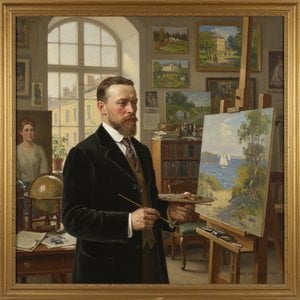
The Precision of a Documentarian
Conrad Sovelius was not a professional painter by trade, but a pharmacist whose secondary vocation provided a vital visual record of a disappearing era. His work functions as a topographical and social inventory of Kokkola and its surrounding rural landscapes during the late 1800s. He did not aim for abstraction; he aimed for accuracy. His watercolors capture the specificities of the Finnish landscape and architecture with a clarity that stems from a scientific mind. This was a man accustomed to the meticulousness of pharmacy, applying that same disciplined eye to the paper.
His output was diverse, extending far beyond the traditional canvas. He was a man of detail, recording everything from the layout of towns to the lineage of local families. His legacy is found in the granular details of Finnish history rather than in grand artistic gestures. He documented the physical and social structures of his home with a precision that makes his work indispensable to those studying the period.
A Life of Scientific and Visual Record
The intersection of his medical training and his artistic practice defined his unique contribution to Finnish history. His life was shaped by a transition from the rigorous study of pharmacy to a life of detailed observation in Kokkola. His work can be categorized by its functional and documentary nature:
- Detailed watercolors of Kokkola and its rural surroundings.
- Cartographic works and monograms.
- Genealogical records and family trees of Kokkolan families.
- A comprehensive list of approximately 1,300 individuals buried in the old section of Maria Cemetery.
- Decorative items such as lampshades.
His ability to pivot from the chemical precision of a pharmacist to the observational precision of a watercolorist is what gives his work its weight. He was a man of the late 19th century, capturing a world that was rapidly changing through the lens of a scientist.
The Value of the Local View
To look at a Sovelius watercolor is to see Kokkola as it actually existed, stripped of romanticism. His 1870 depiction of the Old Church of Kokkola is a primary example of this directness. He focused on the structural reality of the town and the specific character of the rural areas. This was not art for the sake of decoration, but art as a method of preservation. He recorded the architecture, the geography, and even the dead with the same objective intent. His work remains a vital resource for understanding the specificities of the Kokkola region during his lifetime.
Perguntas e Respostas
Quantas obras de Conrad Sovelius estão disponíveis para explorar?
Você pode explorar 1 obras de arte obras de Conrad Sovelius na página Todas as obras.
Onde e quando nasceu Conrad Sovelius?
Conrad Sovelius nasceu em Kokkola, em 1832.
Existe uma linha do tempo das obras de Conrad Sovelius?
As obras de Conrad Sovelius podem ser visualizadas em ordem cronológica na página de Linha do tempo das obras do artista.
Onde as obras de Conrad Sovelius estão agrupadas por técnica?
As obras de Conrad Sovelius podem ser exploradas por técnica na página de Por Técnica do artista.