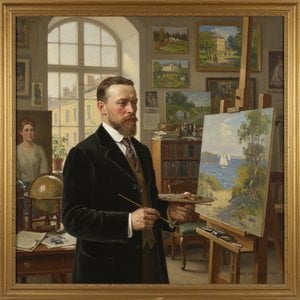
A Life Between Stockholm and Düsseldorf
August Jernberg entered the world on 16 September 1826, beginning a life that would eventually bridge the artistic traditions of Sweden and Germany. His early training took place within the halls of the Royal Swedish Academy of Fine Arts in Stockholm between 1843 and 1846. This foundation prepared him for a period of significant movement, as he traveled to Paris to study under Thomas Couture from 1847 to 1853. These years in France provided him with a technical vocabulary that would define his early output.
In 1854, Jernberg made the decision to settle in Düsseldorf, a move that placed him at the heart of the Düsseldorf school of painting. He was admitted as a member of the Kunstakademie Düsseldorf, marking his integration into one of the most influential artistic circles of the nineteenth century. He remained in this city for the remainder of his life, with only brief departures to other locations. His domestic life was also rooted in this period, having married Margareta Bjurling in 1848.
The Evolution of Subject and Style
The trajectory of Jernberg’s career saw a notable shift in focus as the decades progressed. During his early years, he concentrated on the precision required for portraits, alongside works depicting historical and biblical scenes. There was a certain gravity to these early subjects, reflecting the academic rigor of his training. However, by the 1860s, his interests drifted toward the more observational realms of genre and landscape painting.
This transition allowed him to explore different light and atmosphere through varied subject matter. His later work moved away from the structured narratives of history painting toward the quiet observations of daily life and natural scenery. While his son, Olof Jernberg, would later find distinction in marine painting, August’s own contributions remained anchored in the traditions he had mastered in both Stockholm and Paris.
Exhibitions and Final Years
Jernberg sought recognition through several notable public displays. He presented his work at the Scandinavian Art Exhibition in Stockholm in 1850 and later participated in the Exposition Universelle in Paris in 1855. These appearances allowed his peers to witness his development from a student of Couture to an established member of the Düsseldorf academy.
His professional life concluded in the same city where he had spent much of his maturity. He passed away on 22 June 1896, leaving behind a body of work that transitioned from the formal demands of portraiture to the more expansive views of the landscape. His legacy is found in the quiet permanence of his canvases, such as VÄRDSHUSFEST, which remains one of his most significant recorded auction achievements.
Perguntas e Respostas
Em quais movimentos August Jernberg atuou?
Os movimentos em que August Jernberg atuou podem ser conferidos na página de Todos os Movimentos do artista, que agrupa as obras por movimento.
Como a arte de August Jernberg evoluiu ao longo do tempo?
Um relato cronológico da obra de August Jernberg está disponível na página Linha do tempo do artista, onde as obras são apresentadas em ordem de criação, capítulo por capítulo.
Onde posso ver as obras de August Jernberg organizadas por atmosfera?
A Coleção por Humor de August Jernberg organiza as obras do artista por humor.