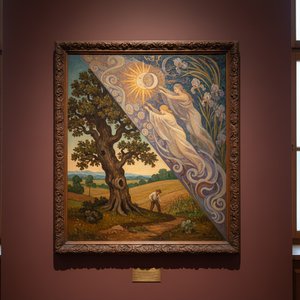
The Brush and the Book
Carl Ludwig Adolf Ehrhardt lived a life shaped by the quiet discipline of the studio and the classroom. Born in Berlin, he moved through the artistic circles of his time, eventually finding a home in Düsseldorf where he married in 1838. His hands were rarely still, moving between the broad strokes of Historienmaler—the history painter—and the meticulous, fine-lined work required for book illustration. He was a man of many roles: a painter, a teacher, and a student of art history, all while navigating the complexities of a family life that spanned from Berlin to Wolfenbüttel.
His work often looked backward, seeking out the weight of the past to fill a canvas. He did not merely paint scenes; he reconstructed moments of gravity. In his depictions of figures like Charlemagne mourning Fastrada, or the ambush of Friedrich I Barbarossa in Susa, there is a focus on the heavy, human cost of historical events. He sought to capture the stillness that follows a great upheaval, focusing on the tension held in a gesture or the way light falls across a grieving face.
A Life in Detail
The textures of his life were as varied as the subjects he chose to depict. His professional identity was tied to the ability to translate history into visual narrative, a skill that made him a sought-after illustrator. He worked with a precision that allowed his illustrations to live within the pages of books, bridging the gap between the grand scale of history painting and the intimate scale of the printed word. His legacy is found in these layers—the large-scale historical compositions and the smaller, more delicate studies of character and form.
His technical approach was marked by a commitment to the narrative. Whether he was working on a portrait or a scene of military conflict, such as the Teutonic Order at Kauen, the intent remained the same: to tell a story through the placement of a figure or the shadow of a blade. He was a man who understood that history is not just a series of dates, but a collection of specific, often lonely, human experiences.
Perguntas e Respostas
Posso estudar o uso de cores de Adolf Ehrhardt em todas as suas obras?
O perfil de cores da obra de Adolf Ehrhardt pode ser visualizado na página DNA da Paleta do artista.
Existe um tour virtual 3D das obras de Adolf Ehrhardt?
As obras de Adolf Ehrhardt podem ser visualizadas em uma galeria 3D na página Galeria 3D do artista.
A qual período histórico pertence a obra de Adolf Ehrhardt?
Adolf Ehrhardt atuou no período 19th Century. Este período situa a atividade do artista na história.