


 Visualizar na parede
 Compartilhar
 Compartilhar
 Detalhes

 Baixar imagem
 Semelhantes
 Raio X
 Slideshow
 Estatísticas
Leaf from the Muraqqa Gulshan
 Painting
- Mughal art
 1597
1597 68.0 x 52.0 cm
 Museu de Arte Nelson-Atkins
 Ler mais
Reprodução em Óleo Feita à Mão
Óleo sobre tela pintado à mão no tamanho e moldura de sua escolha, feito sob encomenda pelos nossos artistas. ( Alternar para Impressão Alternar para Imagem Digital)




P118B $10

P118H $10

P118W $10

P438Z $10

P508JH $12

P508YH $12

P805H $10

P805Z $10

P919BZ $10

P919G $10

P919XJ $10

P959ZH $10

P968JZ $12

W106C $8

W218G $10

W218JH $8

W218Y $10

W307PJ $10

W316G $10

W316PJ $8

W316Y $10

W398PJ $8

W4111J $10

W500HY $15

W500JH $15

W692G $12

W849H $8

W940BG $15

W953PJ $8




Escolha entre os nossos tamanhos pré-definidos que respeitam as proporções originais da obra de arte.

Pode inserir as suas próprias dimensões para se adequar a uma moldura ou espaço específico. Se o tamanho selecionado não corresponder às proporções da imagem original, iremos cortar a obra de arte ou estender a pintura com elementos adicionais pintados à mão. Um esboço digital será enviado para sua aprovação antes do início da produção.
Tenha em atenção que a pré-visualização no ecrã não reflete o corte ou extensão real. Apenas o esboço mostrará com precisão a composição final.
Embora tamanhos personalizados estejam disponíveis, recomendamos selecionar uma dimensão da lista predefinida para preservar as proporções originais.
Após o pedido, a equipa ArtsDot.com enviará um e-mail ao cliente para solicitar instruções e fornecer uma prévia do esboço.
Entrega mundial () em 3 a 4 semanas, em vez das 5 semanas padrão. (12 Setembro). Sem comprometer a qualidade.

Envio expresso gratuito para todo o mundo

Tela de Linho de Alta Qualidade

Seguro de transporte completo

Garantia de Reembolso de Impostos Alfandegários

Garantia de Fidelidade Cromática

Política de Devolução de 100 Dias (Apenas Defeitos)

Garantia de reembolso de 100%

Oferta de desconto por quantidade
 A opção de vidro está disponível apenas para tamanhos inferiores a 110 cm

Leaf from the Muraqqa Gulshan
Técnica de Reprodução
Tamanho da Reprodução
-


Preço Total
$ 263
A Glimpse into Mughal Courtly Life
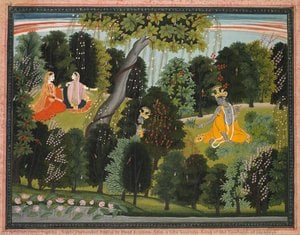
This exquisite folio, titled Leaf from the Muraqqa Gulshan, transports us directly into the opulent and intellectually vibrant world of Emperor Jahangir's court in the late 16th century. It is more than just a painting; it is a meticulously preserved moment of scholarly discourse set against a backdrop of idealized natural beauty. The scene captures three figures—a young Mughal prince, his attendant, and a distinguished Persian Sufi poet or scholar—engaged in deep conversation. Their attire, the distinct turbans, and the flowing chola worn by the scholar speak volumes about the cultural confluence that defined the Mughal era, where Persian refinement met indigenous Indian artistry.
Mastery of Technique and Naturalism
The technical brilliance displayed here is breathtaking. The naturalism achieved by the court artists is palpable; every fold of fabric, every gesture, seems imbued with life. Observe the delicate rendering of the setting: a babbling brook whispers across the foreground, while beneath a flowering tree, nature provides its gentle stage. Adding to this sense of vibrant life are the scattered birds—some perched, others taking flight—which lend an unparalleled depth and movement to the composition. The background further expands the narrative scope, juxtaposing serene Persian-style rock formations with a hint of European-inspired cityscape silhouetted against a vivid, late-afternoon sky. This masterful blending of local flora, exotic architecture, and dynamic wildlife showcases the apex of Mughal decorative arts.
The Interplay of Art Forms: Painting and Calligraphy
What elevates this piece to an object of profound historical significance is its format as part of an Imperial Mughal album. Historically, calligraphy was considered the zenith of art in Islamic cultures, treated with the reverence usually reserved for painting. The inclusion of beautifully rendered poetry—a translation from Faqir ‘Ali speaks of enduring affection—demonstrates how paintings and written word were inseparable companions. These albums served not merely as collections of pretty pictures, but as curated repositories of culture, knowledge, and devotion, where the calligrapher’s signature was as recognized as a master painter's.
Symbolism and Emotional Resonance
The gathering itself suggests a confluence of learning and spiritual pursuit. The open books held by the scholars are potent symbols of wisdom and dialogue, suggesting that true enlightenment is found through conversation and study. The poem quoted speaks to an enduring, deep-rooted connection—a metaphor for love or devotion that time cannot erode. For the modern collector or designer, this piece offers more than mere decoration; it offers a window into an era where intellectual life was celebrated with such lavish artistry. Reproducing this work allows one to bring home not just pigment on paper, but the very spirit of Mughal contemplation and refined human connection.
Obras Relacionadas




Biografia do Artista
early life and career
ali quli istajlu, a renowned painter from afghanistan, lived from 1551 to 1605. his life was marked by significant contributions to the mughal art movement, which flourished during the reign of the mughal empire in india. as a young artist, ali quli istajlu was educated under the instructions of shah ismail ii of the safavid dynasty in iran. this exposure to persian art and culture significantly influenced his work. later, he became a mughal courtier and served as the jagirdar of burdwan in west bengal from 1605 to 1607.artistic style and notable works
ali quli istajlu's artistic style was characterized by its unique blend of persian, turkoman, and indian influences. his work featured intricate patterns, vibrant colors, and detailed figures, which were hallmarks of the mughal art movement. some of his notable works include:- the great mongol shahnameh (a famous ilkhanid manuscript)
- mughal miniature paintings (characterized by small size, intricate detail, and vibrant colors)
- portraits of mughal emperors (including akbar, jahangir, and shah jahan)
legacy and impact
ali quli istajlu's contributions to the mughal art movement had a lasting impact on indian culture and society. his work helped spread persian culture and ideas throughout india, contributing to the development of a distinctly indian style of painting. today, ali quli istajlu's artwork can be found in various museums, including:- the metropolitan museum of art (new york)
- the british museum (london)
- the victoria and albert museum (london)
personal life and later years
ali quli istajlu was also known for his personal life, being the first husband of nur jahan (mehrunissa), who later married jahangir and became empress of india. he had a daughter, mihr-un-nissa begum, who married prince shahryar, the fifth and youngest son of jahangir. ali quli istajlu passed away in 1605, leaving behind a legacy that continues to be celebrated in the world of mughal art.- view ali quli istajlu's artwork on ArtsDot.com
- explore the mughal art movement on ArtsDot.com

ali quli istajlu
1551 - 1605 , Afghanistan
Dados Rápidos
- Artistic Movement Or Style: Mughal Painting
- Artists Or Movements Influenced By This Artist: Persian Art
- Artists Who Influenced This Artist: Shah Ismail II
- Date Of Birth: 1551 Kandahar Afghanistan
- Date Of Death: 1605
- Full Name: Ali Quli Istajlu
- Nationality: Afghan
- Notable Artworks:
- The Great Mongol Shahnameh
- Mughal Miniature Paintings
- Portraits of Mughal Emperors
- Place Of Birth: Kandahar Afghanistan
Artigos Relacionados
Hans von Aachen: Mannerism's Courtly Visionary & Imperial Portraiture
Explore the captivating world of Hans von Aachen, a leading Mannerist painter renowned for his exquisite imperial portraits & mythological scenes. Discover his legacy and influence on 16th-century European art.

Franz Xaver Winterhalter: Court Painter, Academician & Embodiment of Mid-19th Century Portraiture
Explore the life & art of Franz Xaver Winterhalter, the celebrated court painter of the 19th century. Discover his exquisite portraits of royalty and aristocracy – a symbol of prestige and refined taste.

Raja Ravi Varma: Bridging Tradition & Modernity in 19th-Century Indian Art
Explore the life & art of Raja Ravi Varma, a pioneer who fused European techniques with Indian iconography. Discover his iconic paintings, lasting legacy, and influence on modern Indian art at ArtsDot.
Ouro na Arte: 10 Pinturas Famosas que Brilham com Folha de Ouro | ArtsDot
Descubra 10 pinturas famosas que usam a folha de ouro para criar beleza e simbolismo atemporal. Explore obras renascentistas, ícones bizantinos e a arte sacra online. Encontre reproduções de alta qualidade em ArtsDot.com!

Simone Martini: Innovation, Spirituality & Courtly Refinement in Sienese Painting
Explore the captivating world of Simone Martini, a pivotal figure in Sienese painting & the International Gothic style. Discover his innovative techniques, spiritual depth, and lasting influence on early Renaissance art.