- Início

- Impressão em tela
- Roy Lichtenstein
- Imperfect Painting

 Encomendar pintura Comprar imagem em alta resolução
 Enviar
 Compartilhar
 Details
 Adicionar aos favoritos

 Baixar
 Semelhantes
 X-Ray
X-Ray
 Slideshow
Imperfect Painting


Giclê / Impressão de Arte
Impressão giclée ou em tela de qualidade de museu, com produção rápida e opções flexíveis de acabamento.
 Saiba mais



P118B $10

P118H $10

P118W $10

P438Z $10

P508JH $12

P508YH $12

P805H $10

P805Z $10

P919BZ $10

P919G $10

P919XJ $10

P959ZH $10

P968JZ $12

W106C $8

W218G $10

W218JH $8

W218Y $10

W307PJ $10

W316G $10

W316PJ $8

W316Y $10

W398PJ $8

W4111J $10

W500HY $15

W500JH $15

W692G $12

W849H $8

W940BG $15

W953PJ $8




Escolha entre os nossos tamanhos pré-definidos que respeitam as proporções originais da obra de arte.

Você pode inserir suas próprias dimensões para se ajustar a uma moldura ou espaço específico. Se o tamanho selecionado não corresponder às proporções da imagem original, iremos recortar a obra de arte ou estender a imagem com uma borda espelhada ou preenchimento sólido. Um mockup digital será enviado para sua aprovação antes do início da produção.
Por favor, observe que a visualização na tela não reflete o recorte ou a extensão real. Apenas o mockup mostrará com precisão a composição final.
Embora tamanhos personalizados estejam disponíveis, recomendamos selecionar uma dimensão da lista predefinida para preservar as proporções originais.
Entrega mundial () em 2 semanas, em vez das 4/5 semanas padrão. (1 Julho)

Envio Expresso Gratuito para todo o Mundo

Tela de Linho Premium

Seguro de envio completo

Garantia de Reembolso de Impostos Alfandegários

Garantia de Fidelidade de Cores

Política de Devolução de 60 Dias (Apenas para Defeitos)

Garantia de 100% de Reembolso

Desconto para múltiplas unidades
 A opção de vidro está disponível apenas para tamanhos inferiores a 110 cm

Imperfect Painting
Giclê / Impressão de Arte
Dimensões da Reprodução
-


Preço Total Final
-
Descrição da Obra
Imperfect Painting: A Geometric Exploration by Roy Lichtenstein
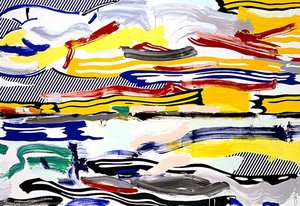
This striking geometric abstraction from 1987 reveals a lesser-known facet of Roy Lichtenstein’s prolific career. While instantly recognizable for his iconic Pop Art appropriations of comic book imagery, *Imperfect Painting* demonstrates the artist's continued engagement with formal experimentation and modernist principles throughout his life. This work diverges from his signature Ben-Day dots but retains his masterful command of color and composition.Deconstructing Form & Style
The artwork is a dynamic interplay of intersecting triangles and lines, creating a distinctly two-dimensional space. The composition eschews traditional perspective, instead prioritizing the relationships *between* shapes. This deliberate flatness aligns with the tenets of geometric abstraction – a style that emphasizes the inherent qualities of form and color over representational accuracy. Lichtenstein’s use of a limited palette—blues, grays, greens, and a vibrant orange—further enhances this focus on formal elements. The overall effect is both structured and subtly chaotic, suggesting an underlying tension within the ordered arrangement.Technique & Materials
Executed in acrylic paint on canvas, *Imperfect Painting* showcases Lichtenstein’s precision and control. The clean lines and sharply defined shapes suggest a meticulous approach, likely achieved with brushes or pens. While lacking the mechanical reproduction aesthetic of his Pop works, the piece still embodies a sense of calculated design – a hallmark of his artistic practice. The neutral lighting across the canvas ensures that the focus remains firmly on the interplay of color and form.Historical Context & Artistic Lineage
Created in 1987, towards the end of his career, *Imperfect Painting* reflects Lichtenstein’s ongoing dialogue with art history. The work echoes early 20th-century modernist movements like Constructivism and Suprematism, which similarly explored geometric abstraction as a means of expressing universal principles or spiritual truths. Notably, this piece shares visual affinities with Lichtenstein's “Modular Paintings” series (such as *Modular painting with four panels, #1*), where he further investigated the possibilities of non-representational forms and seriality.Symbolism & Emotional Resonance
While abstract, *Imperfect Painting* isn’t devoid of emotional impact. The intersecting lines can be interpreted as representing connections, conflicts, or even a fragmented reality. The “imperfect” nature hinted at in the title suggests an acceptance of ambiguity and a rejection of rigid perfection. It invites viewers to contemplate the inherent beauty within asymmetry and the dynamic energy created by opposing forces. The work doesn’t offer easy answers; instead, it prompts introspection and encourages individual interpretation.For Collectors & Interior Designers
- A Unique Lichtenstein: This piece offers a compelling alternative to the artist's more widely recognized Pop Art imagery.
- Versatile Aesthetic: The minimalist color palette and geometric forms make it suitable for a variety of interior design styles, from contemporary to mid-century modern.
- Conversation Starter: *Imperfect Painting* is sure to spark dialogue and add intellectual depth to any collection or space.
- Investment Potential: As a work by a leading figure in 20th-century art, this piece represents a valuable addition to any serious art collection.
Obras Relacionadas




Biografia do Artista
The Genesis of a Pop Visionary
Roy Fox Lichtenstein, born in the vibrant metropolis of New York City on October 27, 1923, indelibly altered the landscape of twentieth-century art. Emerging as a pivotal figure within the Pop Art movement, Lichtenstein didn’t simply reflect his era; he actively interrogated it, transforming commonplace imagery into compelling artistic statements. His upbringing in an upper-middle-class Jewish family fostered both a cultural awareness and an early artistic inclination. Childhood exposure to museums and concerts, coupled with a deep appreciation for jazz music, laid the groundwork for a creative spirit that would challenge conventional notions of fine art. Though initially drawn to realistic drawing and painting during his formative years, Lichtenstein’s formal training commenced at the Art Students League in 1939 under Reginald Marsh, followed by studies at Ohio State University – interrupted briefly by wartime service in the Army. These experiences provided a robust technical foundation that would later be brilliantly re-contextualized through the lens of mass culture and commercial aesthetics. The seeds of his signature style weren’t sown within the hallowed halls of artistic tradition but rather in the often-overlooked world of everyday imagery, particularly comic books and advertising.From Abstraction to Appropriation: A Pivotal Shift
Lichtenstein's early work demonstrated a clear engagement with Abstract Expressionism, mirroring the dominant aesthetic trends of the post-war period. However, this phase proved transitional, a stepping stone towards his revolutionary style. A crucial moment arrived during his tenure at Rutgers University where he encountered Allan Kaprow, whose influence reignited Lichtenstein’s interest in proto-pop imagery. This encounter sparked a critical shift in his artistic trajectory, leading him to question the established boundaries between “high” and “low” art. He began looking beyond the subjective expression of Abstract Expressionism towards the objective language of popular culture – specifically, comic books and advertising. The year 1961 marked a turning point with *Look Mickey*, a work that boldly appropriated characters from Disney comics, signaling the beginning of his signature style. This wasn’t mere imitation; it was an act of artistic re-evaluation, elevating commonplace imagery to the status of fine art. He didn't simply copy comic strips; he meticulously recreated them using techniques mimicking commercial printing processes, a deliberate blurring of the lines between original artwork and mass production. This appropriation wasn’t about celebrating consumerism uncritically but rather examining its pervasive influence on American society and challenging traditional artistic hierarchies.The Language of Ben-Day Dots and Bold Lines
Lichtenstein's artistic vocabulary is instantly recognizable: bold, primary colors, thick black outlines, and most famously, Ben-Day dots – a technique borrowed directly from the mechanical reproduction of comic books. These dots weren’t merely decorative; they were integral to his conceptual framework, representing the very process of mass production and challenging the traditional emphasis on the artist's hand. His paintings often enlarged details from comic strips to monumental scale, forcing viewers to confront the aesthetic qualities of an art form typically dismissed as trivial. Works like *Whaam!* (1963), *Drowning Girl* (1963), and *Oh, Jeff…I Love You, Too…But…* (1964) became iconic representations of Pop Art, capturing the anxieties and desires of a rapidly changing consumer culture. These weren’t simply depictions of comic book scenes; they were commentaries on themes of war, romance, and societal expectations, filtered through the visual language of mass media. He aimed to strip away any pretense of artistic subjectivity, presenting his work as objective reflections of American society – a mirror held up to its own manufactured reality. The deliberate flatness and lack of painterly gesture further emphasized this detachment, mimicking the impersonal nature of commercial printing.Major Achievements and Lasting Impact
Roy Lichtenstein’s influence extends far beyond the realm of painting. His innovative use of commercial techniques and appropriation paved the way for new generations of artists exploring themes of consumerism, media saturation, and cultural identity. The sale of *Masterpiece* in 2017 for $165 million solidified his position as one of the most commercially successful American artists of all time, but his legacy is not solely defined by monetary value. He challenged traditional notions of artistic authorship and originality, forcing a re-evaluation of what constitutes “art” itself. His work continues to inspire graphic designers, illustrators, and visual artists across various disciplines.- Major Achievements: Pioneered Pop Art style; achieved international recognition with groundbreaking exhibitions.
- Notable Works: *Whaam!*, *Drowning Girl*, *Oh, Jeff…I Love You, Too…But…*, *Masterpiece*.
- Teaching Career: Influenced aspiring artists at SUNY Oswego and Rutgers University.

Roy Lichtenstein
1923 - 1997 , Estados Unidos da América
Informações Rápidas
- Artistic Movement Or Style: Pop Art
- Artists Or Movements Influenced By This Artist:
- Designers
- Ilustradores
- Artists Who Influenced This Artist:
- Reginald Marsh
- Allan Kaprow
- Date Of Birth: 27 de outubro de 1923
- Date Of Death: 29 de setembro de 1997
- Full Name: Roy Fox Lichtenstein
- Nationality: Americano
- Notable Artworks:
- Whaam!
- Drowning Girl
- Masterpiece
- Place Of Birth: Nova Iorque, EUA
Artigos Relacionados

Os 10 Quadros Mais Famosos em Tons de Cinza: Arte, História e Decoração
Descubra os 10 quadros mais famosos em tons de cinza, da sutileza de Monet ao expressionismo. Explore a história, técnica e emoção por trás de obras-primas atemporais. Encontre reproduções de alta qualidade na ArtsDot.com!


A Subtileza do Neutro: Explorando a Abstração em Preto, Branco e Cinza na Decoração Contemporânea
Descubra a arte da decoração neutra com preto, branco e cinza! Guia completo para ambientes elegantes, minimalistas e atemporais. Dicas de especialistas e inspirações para transformar sua casa ou hotel.
Mark Rothko: As 25 Obras-Primas que Definem um Ícone da Arte Abstrata | ArtsDot
Descubra as 25 obras-primas de Mark Rothko, ícone do expressionismo abstrato. Explore a história, cores e emoção por trás de cada tela. Reproduções de arte exclusivas para sua casa em ArtsDot.com.

Beyond Form & Color: Geometric Abstraction's Evolution in 20th/21st Century Art
Explore the evolution of geometric abstraction from Cubism to contemporary art. Discover key artists like Malevich & Mondrian, investment insights, and expert collecting advice at ArtsDot.

As 10 Obras-Primas que Definiram a Pop Art | ArtsDot
Descubra as 10 obras-primas que revolucionaram a Pop Art! Explore a história de Andy Warhol, Roy Lichtenstein e outros ícones. Encontre reproduções de arte exclusivas para decorar sua casa com cores vibrantes e estilo em ArtsDot.com.