
 Acrylic On Canvas
- WallArt
- Dutch Golden Age
 1645
1645 39.0 x 56.0 cm
 Kunsthistorisches Museum

The picture follows your choices: , .
Descrição do Item
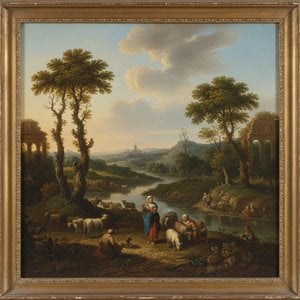
Experience the serene beauty of Philips Wouwerman's Dune Landscape (1645), a masterful depiction of Dutch Golden Age nature and maritime life housed at Vienna’s Kunsthistorisches Museum.
 Ler mais
Biografia do Artista
Philips Wouwerman (1619-1668): Mestre da pintura holandesa do Século de Ouro, conhecido por cenas de caça, paisagens e batalhas com destaque para a maestria na representação equina e a riqueza de detalhes em seus quadros.
Reprodução em Óleo Feita à Mão
Óleo sobre tela pintado à mão no tamanho e moldura de sua escolha, feito sob encomenda pelos nossos artistas. ( Alternar para Impressão Alternar para Imagem Digital)
More about this painting
 Visualizar na parede
 Compartilhar
 Compartilhar
 Detalhes
 Guia
Guia

 Baixar imagem
 Semelhantes
 Raio X
 Ver diaporama
 Q&A
Q&A Estatísticas
Order your painting in four simple steps
Take your time. You can change any answer; the price in your order card follows each choice.
1 Step one of four
Which size would you like?
These sizes keep the proportions of the original painting. The drawing shows your choice on a wall, above a two-metre sofa.
Or give your own measurements
Escolha entre os nossos tamanhos pré-definidos que respeitam as proporções originais da obra de arte.

Insira a largura e a altura desejadas para se ajustarem à sua moldura ou parede. Como esta obra é pintada à mão, para um tamanho com proporções diferentes, o artista poderá pintar um pouco mais ao redor da imagem ou reduzir ligeiramente a composição — você escolhe. Enviamos uma maquete digital para sua aprovação antes de iniciar a pintura. A imagem exibida nesta página não representa o resultado real — apenas a maquete mostra o resultado final.
2 Step two of four
How should it be prepared: rolled, stretched or framed?
The prices below are for the size you chose in step one.
Choose the edges of the stretched canvas
Choose your frame

White €1

Blurside €1

Extended €1

P118B €10

P118H €10

P118W €10

P438Z €10

P508JH €12

P508YH €12

P805H €10

P805Z €10

P919BZ €10

P919G €10

P919XJ €10

P959ZH €10

P968JZ €12

W106C €8

W218G €10

W218JH €8

W218Y €10

W307PJ €10

W316G €10

W316PJ €8

W316Y €10

W398PJ €8

W4111J €10

W500HY €15

W500JH €15

W692G €12

W849H €8

W940BG €15

W953PJ €8

H24-GOLD €30

H24-SILVER €30

H36-GOLD €45

H36-SILVER €45
Com moldura
Moulding: . Overall size with the frame: .
3 Step three of four
Would you like anything changed in the painting?
Most people answer no. Because each painting is made by hand, our artist can also adapt it for you.
After order, ArtsDot.com team will email client for instructions and provide a mockup preview
4 Step four of four
A few finishing options
All of them are optional. The answers already selected cost nothing extra.
Who paints it?
Entrega mundial () em 3 a 4 semanas, em vez das 5 semanas padrão. (29 Outubro). Sem comprometer a qualidade.
A nameplate, as in a museum?
Detalhes da Placa de Bronze Gravada
This elegant plaque features the artist's name and the title of the artwork, finely engraved for a timeless presentation.
It is made from bronze with a refined, elegant finish. The text is precisely laser-engraved for a sharp and permanent result. Measuring 9x2 cm, the plaque is compact yet easy to read. It's built to be durable and scratch-resistant, offering a professional, museum-quality look. Mounting is simple thanks to the included adhesive backing.
Detalhes da Placa de Acrílico Transparente
The plaque includes essential engraved details such as the artist's name, the title of the artwork, the date it was created, the type of media used-like oil on canvas or watercolor-a brief description of the piece, and a QR code that links to the complete artwork information.
It is crafted from clear acrylic, offering a sleek, modern appearance. The text is UV-engraved in black to ensure strong visual contrast. With a size of 10x15 cm, it ensures optimal readability. It comes equipped with two metal hooks for secure wall mounting. The plaque is designed to be weather-resistant, making it suitable for various environments, and it includes interactive features that work seamlessly with smartphone scanning.
Detalhes da Placa de Acrílico Preto
This elegant plaque includes engraved information such as the artist's name, the title of the artwork, the date it was created, the type of media used (like oil on canvas or watercolor), a short description of the artwork, and a QR code for quick access to more information.
The plaque itself is made from refined black acrylic with a premium finish. The text is laser-engraved in white for high contrast and readability. Its size is 10x15 cm, designed to be easy to read. It comes with two metal hooks for professional mounting. The design is sleek and fits any interior style. It is also weather-resistant and durable, with built-in digital integration for mobile compatibility.
A protective varnish?
When do you need it?
✓ Check and order
Your painting, as you ordered it

Dune Landscape
Técnica de Reprodução
Tamanho da Reprodução
-

Artista Sênior de Elite
Mais detalhes, refinamento e tempo de produção adicional
-

Moldura para Reprodução
-
-
Para obras de arte ou reproduções com mais de 105 cm (aproximadamente 41 polegadas) em qualquer um dos lados, a moldura será enviada como um kit desmontado. Este método garante uma entrega segura e evita danos durante o transporte.
Montagem profissional necessária — este não é um produto DIY (faça você mesmo).
O kit deve ser montado e a tela esticada por um profissional de molduraria experiente, utilizando cola de madeira (não inclusa), um alicate de esticar tela e grampos para manter as travessas alinhadas enquanto a cola seca. A montagem incorreta ou a tensão desigual da tela podem danificar permanentemente a obra de arte e não estão cobertas pela nossa garantia.
 Para obras de arte ou reproduções com mais de 105 cm (aproximadamente 41 polegadas) em qualquer um dos lados, a moldura será enviada como um kit desmontado. Este método garante uma entrega segura e evita danos durante o transporte.
Todas as barras de madeira maciça estão incluídas, precisamente cortadas ao tamanho certo.
Montado com os parafusos fornecidos, além de cola para madeira para as junções dos cantos, que não está inclusa e deve ser providenciada pelo seu moldurista.
São necessárias ferramentas profissionais não incluídas: um alicate de estiramento de tela (esticador) e grampos para manter as ripas alinhadas enquanto a cola seca.
Importante:
As junções dos cantos requerem cola para madeira, as ripas devem ser mantidas com grampos até que a cola esteja completamente seca, e o estiramento da tela na moldura montada requer um alicate de esticar tela. Nenhum destes itens está incluído no kit. Por favor, certifique-se de contar com um profissional de molduraria experiente antes de encomendar este tamanho.

Etiqueta de identificação
-
-

Verniz de Proteção
Verniz brilhante (realça as cores e protege contra a luz e a umidade)
-

Personalizar minha obra
Exemplos de alterações possíveis: Substituir o rosto por uma foto do cliente; Adicionar um animal de estimação (ex.: substituir gato por cachorro); Incluir uma mensagem oculta no fundo; Alterar a paisagem ou os elementos do fundo.
-

Urgente
Entrega mundial () em 3 a 4 semanas, em vez das 5 semanas padrão. (29 Outubro). Sem comprometer a qualidade.
-
Envio Expresso
Entrega mundial para em 5 semanas. (5 Novembro).
Com envio incluído
Preço Total
€ 232
A opção de vidro está disponível apenas para tamanhos inferiores a 110 cm
Included with every order
- Envio expresso gratuito para todo o mundo
- Tela de Linho de Alta Qualidade
- Seguro de transporte completo
- Garantia de Reembolso de Impostos Alfandegários
- Garantia de Fidelidade Cromática
- Política de Devolução em 100 Dias (Apenas para Defeitos)
- Garantia de reembolso de 100%
- Oferta de desconto por quantidade


A Serene Vista of Dutch Tradition: Exploring Philips Wouwerman’s Dune Landscape
Philips Wouwerman (baptized May 24, 1619 – died May 19, 1668) was a prolific and remarkably adaptable Dutch painter who cemented his place as one of the most celebrated artists of the Dutch Golden Age. Unlike many contemporaries focused on portraiture—though he produced several notable portraits—Wouwerman dedicated himself primarily to capturing the dynamism of the natural world and the visceral thrill of hunting expeditions, establishing him as a pioneer in landscape painting and a master storyteller through visual representation. His Dune Landscape, completed in 1645, exemplifies his distinctive approach and offers a window into the artistic sensibilities of his era.The Painter’s Vision: Style and Technique
Wouwerman's style is characterized by an unparalleled realism combined with expressive brushwork that imbues his canvases with palpable energy. He eschewed idealized depictions favored by some artists, opting instead for meticulous observation and detailed rendering—a hallmark of the *luminist* movement gaining traction during this period. The Dune Landscape showcases this commitment to accuracy; every ripple in the water’s surface, every grain of sand on the dune, is rendered with painstaking detail. His technique involved layering thin glazes of oil paint over a preparatory underpainting, allowing for subtle gradations of color and creating an illusion of depth that transcends mere representation. This masterful manipulation of light—particularly its reflection off the water—is arguably Wouwerman’s greatest achievement, transporting viewers into the very heart of the scene.A Snapshot of Seventeenth-Century Life
The painting depicts a coastal dune landscape populated by figures engaged in leisurely pursuits – men observing the sea and contemplating the beauty of their surroundings. This wasn't merely an aesthetic exercise; it reflected the broader cultural preoccupation with humanist ideals prevalent during the Dutch Golden Age. The inclusion of boats adds another layer of significance, symbolizing trade routes and the economic prosperity that fueled this artistic flourishing. Furthermore, Wouwerman’s depiction captures a moment of quiet contemplation amidst activity, suggesting a harmonious relationship between humanity and nature—a sentiment deeply rooted in Calvinist theology which emphasized God's dominion over creation.Symbolism Within the Frame
Beyond its visual splendor, Dune Landscape carries symbolic weight. The dune itself represents stability and permanence against the backdrop of turbulent seas, mirroring the philosophical debates surrounding predestination and free will that dominated intellectual discourse at the time. The figures on the dune are not simply observers; they embody human intellect and moral contemplation—a deliberate choice by Wouwerman to elevate the subject matter beyond mere visual pleasure. The artist’s careful composition directs the viewer's gaze outwards, encouraging reflection on the grandeur of God’s creation and humanity’s role within it.Legacy and Emotional Resonance
Philips Wouwerman’s Dune Landscape continues to resonate with audiences today because it transcends its historical context. Its luminous palette, masterful brushwork, and evocative depiction of a tranquil seascape evoke feelings of serenity and wonder—qualities that endure across centuries. It stands as a testament to the power of art to capture not only what is seen but also what is felt, cementing Wouwerman’s reputation as one of the most emotionally compelling painters of his generation. Its current residence at the Kunsthistorisches Museum in Vienna ensures its preservation for future generations to appreciate this enduring masterpiece.Perguntas e Respostas
Como faço para baixar a imagem de "Dune Landscape", de Philips Wouwermans?
A imagem de "Dune Landscape", de Philips Wouwermans pode ser baixada na página de download da obra: Download download de imagem digital em alta resolução.
Como "Dune Landscape" se integra aos temas e ao estilo de Philips Wouwermans?
"Dune Landscape" compartilha com as outras obras de Philips Wouwermans o seu estilo Dutch Golden Age e os temas recorrentes: dutch tradition, baroque style, hunting imagery, tranquility landscape, genre painting.
Que sentimento "Dune Landscape", de Philips Wouwermans expressa dentro de Dutch Golden Age?
A emoção Tranquil de "Dune Landscape" acompanha seu estilo Dutch Golden Age.
Obras Relacionadas


Philips Wouwermans
1619 - 1668, Países Baixos
Biografia do Artista
Philips Wouwerman: Um Mestre da Dinâmica Holandesa
Philips Wouwerman, nascido em Haarlem em 1619 e falecido em 1668, personifica a vitalidade e o talento do período dourado dos Países Baixos. Mais do que um simples pintor, ele foi um observador atento da vida cotidiana, um mestre na representação equina e um narrador visual cuja obra continua a cativar espectadores séculos depois de sua criação. Sua trajetória artística é marcada por uma evolução notável, desde influências iniciais até o desenvolvimento de um estilo inconfundível que o consagrou como um dos artistas mais importantes da época.
Os Primeiros Passos e Influências
A vida de Wouwerman começou em um ambiente familiar ligado à arte. Seu pai, Pouwels Joostsz Wouwerman, também era pintor, embora sua obra não tenha alcançado a mesma fama. Embora os detalhes precisos sobre seu treinamento inicial sejam escassos, acredita-se que ele recebeu uma base sólida de conhecimento artístico estudando com Frans Hals (1581/85–1666), um dos mais renomados pintores de retrato da época. A influência de Hals pode ter sido sutil, mas a experiência certamente moldou sua técnica e sensibilidade para o detalhe.
Inicialmente, Wouwerman se dedicou a retratar cenas do cotidiano, uma tradição conhecida como *bamboccianti*, influenciado por artistas como Pieter van Laer. Essas pinturas capturavam a vida dos camponeses, soldados e trabalhadores, com um realismo que refletia a realidade da época. A temática social e a representação de figuras comuns estabeleceram as bases para sua futura versatilidade artística.
A Evolução do Estilo: Da Cotidianeidade à Dinâmica
No início da década de 1640, Wouwerman começou a desenvolver um estilo próprio, caracterizado por elementos composicionais marcantes. Uma das características mais distintivas de suas obras é a inclinação diagonal do terreno, frequentemente acompanhada por uma árvore que funciona como um repoussoir – um dispositivo utilizado para criar profundidade e perspectiva. As figuras, muitas vezes em movimento com seus cavalos, preenchem essas cenas dinâmicas, transmitindo uma sensação de ação e vitalidade.
A partir da década de 1650, Wouwerman expandiu significativamente seu repertório temático, pintando cenas de gênero, paisagens com viajantes, batalhas de cavalaria, acampamentos militares e festas populares. Sua habilidade em retratar cavalos de diversas raças em movimento é particularmente notável, demonstrada por observadores como Frederik J. Duparc, que o descreveu como “sem dúvida o pintor holandês mais talentoso e bem-sucedido do século XVII”. A precisão anatômica dos animais, combinada com a captura da energia e do ritmo do movimento, elevam suas obras a um patamar de excelência artística.
A Maestria Equina e o Legado Artístico
Wouwerman não foi apenas um pintor de paisagens ou cenas militares; ele se tornou sinônimo de cavalos. Sua capacidade de capturar a beleza, a força e a elegância dos animais em movimento é inigualável. Seus quadros são testemunhos da sua profunda compreensão da anatomia equina e do seu talento para transmitir a sensação de velocidade e dinamismo.
Apesar de ter vivido em uma época de grande prosperidade econômica, Wouwerman enfrentou dificuldades financeiras ao longo de sua vida. No entanto, sua obra foi amplamente apreciada durante sua vida e continuou a ser valorizada no século XVIII, quando suas pinturas se tornaram objetos de desejo para colecionadores aristocráticos europeus. A influência de seu estilo pode ser vista em diversos artistas que o seguiram, consolidando seu lugar como um dos pilares da pintura holandesa do século XVII.
Um Artista Multifacetado e Sua Contribuição à Cultura
Philips Wouwerman foi muito mais do que um pintor; ele foi um observador atento da sociedade de sua época, um retratista habilidoso e um mestre na representação da vida cotidiana. Suas obras oferecem um vislumbre fascinante da cultura holandesa do século XVII, capturando a beleza da natureza, a vitalidade das atividades humanas e a complexidade das relações sociais.
Sua contribuição para o cânone da pintura holandesa é inegável. Wouwerman não apenas documentou sua época, mas também a transformou em arte, criando obras que continuam a inspirar e encantar espectadores de todo o mundo.

Artigos Relacionados
Nicolaes Berchem: Dutch Golden Age Pastoralism & the Evolution of Landscape Painting
Explore the captivating world of Nicolaes Berchem, a leading Dutch Golden Age painter. Discover his idyllic landscapes, masterful technique & lasting influence on art history. Learn more at ArtsDot.

Charles Leickert: Capturing the Dutch Golden Age Light – A Comprehensive Study of Technique, Context, and Legacy
Explore the captivating winter landscapes of Charles Leickert, a master of Dutch Golden Age light & atmosphere. Discover his techniques, symbolism, and lasting legacy – a comprehensive study for art enthusiasts and collectors.

Golden Age Reflections: Dutch Baroque Painting & Cultural Innovation
Explore the Dutch Golden Age of painting! Discover key artists like Vermeer & ter Borch, their innovative techniques, and the rich cultural context behind these Baroque masterpieces. Learn about collecting & appreciating this iconic art period.