
 Óleo sobre tela
- Arte de Parede
- Abstract Expressionism
 1948
1948- Modernismo
 243.0 x 121.0 cm

The picture follows your choices: , .
Descrição do Item
Explore Jackson Pollock’s iconic ‘No. 5, 1948’! A groundbreaking drip painting of abstract expressionism, chaos & vibrant color. Discover its history & lasting influence.
 Ler mais
Biografia do Artista
Jackson Pollock (1912-1956) foi um pintor americano revolucionário, pioneiro do Expressionismo Abstrato e conhecido por sua técnica de gotejamento. Suas obras icônicas capturam a energia e emoção da ação artística, influenciando profundamente a arte moderna.
Reprodução em Óleo Feita à Mão
Óleo sobre tela pintado à mão no tamanho e moldura de sua escolha, feito sob encomenda pelos nossos artistas. ( Alternar para Impressão Alternar para Imagem Digital)
More about this painting
 Visualizar na parede
 Compartilhar
 Compartilhar
 Detalhes
 Guia
Guia

 Baixar imagem
 Semelhantes
 Raio X
 Ver diaporama
 Q&A
Q&A Estatísticas
Order your painting in four simple steps
Take your time. You can change any answer; the price in your order card follows each choice.
1 Step one of four
Which size would you like?
These sizes keep the proportions of the original painting. The drawing shows your choice on a wall, above a two-metre sofa.
Or give your own measurements
Escolha entre os nossos tamanhos pré-definidos que respeitam as proporções originais da obra de arte.

Insira a largura e a altura desejadas para se ajustarem à sua moldura ou parede. Como esta obra é pintada à mão, para um tamanho com proporções diferentes, o artista poderá pintar um pouco mais ao redor da imagem ou reduzir ligeiramente a composição — você escolhe. Enviamos uma maquete digital para sua aprovação antes de iniciar a pintura. A imagem exibida nesta página não representa o resultado real — apenas a maquete mostra o resultado final.
2 Step two of four
How should it be prepared: rolled, stretched or framed?
The prices below are for the size you chose in step one.
Choose the edges of the stretched canvas
Choose your frame

White €1

Blurside €1

Extended €1

P118B €10

P118H €10

P118W €10

P438Z €10

P508JH €12

P508YH €12

P805H €10

P805Z €10

P919BZ €10

P919G €10

P919XJ €10

P959ZH €10

P968JZ €12

W106C €8

W218G €10

W218JH €8

W218Y €10

W307PJ €10

W316G €10

W316PJ €8

W316Y €10

W398PJ €8

W4111J €10

W500HY €15

W500JH €15

W692G €12

W849H €8

W940BG €15

W953PJ €8

H24-GOLD €30

H24-SILVER €30

H36-GOLD €45

H36-SILVER €45
Com moldura
Moulding: . Overall size with the frame: .
3 Step three of four
Would you like anything changed in the painting?
Most people answer no. Because each painting is made by hand, our artist can also adapt it for you.
After order, ArtsDot.com team will email client for instructions and provide a mockup preview
4 Step four of four
A few finishing options
All of them are optional. The answers already selected cost nothing extra.
Who paints it?
Entrega mundial () em 3 a 4 semanas, em vez das 5 semanas padrão. (29 Outubro). Sem comprometer a qualidade.
A nameplate, as in a museum?
Detalhes da Placa de Bronze Gravada
This elegant plaque features the artist's name and the title of the artwork, finely engraved for a timeless presentation.
It is made from bronze with a refined, elegant finish. The text is precisely laser-engraved for a sharp and permanent result. Measuring 9x2 cm, the plaque is compact yet easy to read. It's built to be durable and scratch-resistant, offering a professional, museum-quality look. Mounting is simple thanks to the included adhesive backing.
Detalhes da Placa de Acrílico Transparente
The plaque includes essential engraved details such as the artist's name, the title of the artwork, the date it was created, the type of media used-like oil on canvas or watercolor-a brief description of the piece, and a QR code that links to the complete artwork information.
It is crafted from clear acrylic, offering a sleek, modern appearance. The text is UV-engraved in black to ensure strong visual contrast. With a size of 10x15 cm, it ensures optimal readability. It comes equipped with two metal hooks for secure wall mounting. The plaque is designed to be weather-resistant, making it suitable for various environments, and it includes interactive features that work seamlessly with smartphone scanning.
Detalhes da Placa de Acrílico Preto
This elegant plaque includes engraved information such as the artist's name, the title of the artwork, the date it was created, the type of media used (like oil on canvas or watercolor), a short description of the artwork, and a QR code for quick access to more information.
The plaque itself is made from refined black acrylic with a premium finish. The text is laser-engraved in white for high contrast and readability. Its size is 10x15 cm, designed to be easy to read. It comes with two metal hooks for professional mounting. The design is sleek and fits any interior style. It is also weather-resistant and durable, with built-in digital integration for mobile compatibility.
A protective varnish?
When do you need it?
✓ Check and order
Your painting, as you ordered it

Number 5
Técnica de Reprodução
Tamanho da Reprodução
-

Artista Sênior de Elite
Mais detalhes, refinamento e tempo de produção adicional
-

Moldura para Reprodução
-
-
Para obras de arte ou reproduções com mais de 105 cm (aproximadamente 41 polegadas) em qualquer um dos lados, a moldura será enviada como um kit desmontado. Este método garante uma entrega segura e evita danos durante o transporte.
Montagem profissional necessária — este não é um produto DIY (faça você mesmo).
O kit deve ser montado e a tela esticada por um profissional de molduraria experiente, utilizando cola de madeira (não inclusa), um alicate de esticar tela e grampos para manter as travessas alinhadas enquanto a cola seca. A montagem incorreta ou a tensão desigual da tela podem danificar permanentemente a obra de arte e não estão cobertas pela nossa garantia.
 Para obras de arte ou reproduções com mais de 105 cm (aproximadamente 41 polegadas) em qualquer um dos lados, a moldura será enviada como um kit desmontado. Este método garante uma entrega segura e evita danos durante o transporte.
Todas as barras de madeira maciça estão incluídas, precisamente cortadas ao tamanho certo.
Montado com os parafusos fornecidos, além de cola para madeira para as junções dos cantos, que não está inclusa e deve ser providenciada pelo seu moldurista.
São necessárias ferramentas profissionais não incluídas: um alicate de estiramento de tela (esticador) e grampos para manter as ripas alinhadas enquanto a cola seca.
Importante:
As junções dos cantos requerem cola para madeira, as ripas devem ser mantidas com grampos até que a cola esteja completamente seca, e o estiramento da tela na moldura montada requer um alicate de esticar tela. Nenhum destes itens está incluído no kit. Por favor, certifique-se de contar com um profissional de molduraria experiente antes de encomendar este tamanho.

Etiqueta de identificação
-
-

Verniz de Proteção
Verniz brilhante (realça as cores e protege contra a luz e a umidade)
-

Personalizar minha obra
Exemplos de alterações possíveis: Substituir o rosto por uma foto do cliente; Adicionar um animal de estimação (ex.: substituir gato por cachorro); Incluir uma mensagem oculta no fundo; Alterar a paisagem ou os elementos do fundo.
-

Urgente
Entrega mundial () em 3 a 4 semanas, em vez das 5 semanas padrão. (29 Outubro). Sem comprometer a qualidade.
-
Envio Expresso
Entrega mundial para em 5 semanas. (5 Novembro).
Com envio incluído
Preço Total
€ 232
A opção de vidro está disponível apenas para tamanhos inferiores a 110 cm
Included with every order
- Envio expresso gratuito para todo o mundo
- Tela de Linho de Alta Qualidade
- Seguro de transporte completo
- Garantia de Reembolso de Impostos Alfandegários
- Garantia de Fidelidade Cromática
- Política de Devolução em 100 Dias (Apenas para Defeitos)
- Garantia de reembolso de 100%
- Oferta de desconto por quantidade


A Universe Unfurled: Decoding Jackson Pollock’s No. 5, 1948
Jackson Pollock’s *No. 5, 1948* isn't simply a painting; it is an event frozen in time – a visual record of energy, gesture, and the very act of creation. This monumental work stands as perhaps the most iconic example of Abstract Expressionism, captivating viewers for decades with its complex layering and seemingly chaotic beauty. It’s a piece that demands attention, sparking dialogue about art's purpose and the boundaries of representation.The Birth of Action Painting: Technique & Style
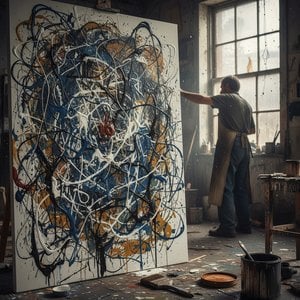
Pollock revolutionized painting by abandoning traditional methods. *No. 5, 1948* was created using his signature “drip” technique – pouring and flinging synthetic resin paints (often referred to as enamel) onto a fiberboard canvas laid horizontally on the floor. This allowed him complete physical freedom, moving around and *within* the painting itself. The result is an all-over composition devoid of focal points, where lines intertwine and overlap in a mesmerizing dance. The dominant hues of yellow, black, and white aren’t blended but rather exist as distinct strands, creating both depth and a sense of restless movement. This isn't about depicting something *from* the world; it’s about expressing an internal state *onto* the canvas.A Post-War Psyche: Historical Context
Created in the aftermath of World War II, *No. 5, 1948* reflects a broader cultural shift. The horrors of war had shattered traditional values and beliefs, leading artists to seek new forms of expression that could grapple with existential anxieties and the fragmented nature of modern life. Abstract Expressionism emerged as a response – an attempt to convey raw emotion and subjective experience through non-representational means. Pollock’s work, in particular, resonated with a generation grappling with uncertainty and seeking authenticity. He wasn't alone; artists like Mark Rothko and Willem de Kooning were also exploring similar themes, but Pollock’s radical technique set him apart.Beyond the Surface: Symbolism & Interpretation
While devoid of recognizable imagery, *No. 5, 1948* is rich in symbolic potential. The intricate web of lines can be interpreted as a representation of the subconscious mind – a tangled network of thoughts, feelings, and memories. Some see echoes of Native American sand paintings, reflecting Pollock’s early exposure to Indigenous art forms. Others find parallels with jazz music, particularly its improvisational nature and emphasis on rhythm and energy. Ultimately, the painting's meaning is open-ended, inviting viewers to project their own interpretations onto its surface. It’s a testament to the power of abstraction to evoke emotion without dictating narrative.Emotional Resonance & Lasting Legacy
*No. 5, 1948* evokes a range of emotions – from exhilaration and awe to anxiety and unease. Its scale is immersive, drawing the viewer into its swirling depths. The painting’s energy is palpable, conveying a sense of both control and abandon. Its influence on subsequent generations of artists is undeniable. Figures like Yayoi Kusama, with her obsessive patterns, and Clyfford Still, known for his jagged fields of color, owe a debt to Pollock’s pioneering spirit. Today, it remains one of the most valuable paintings in the world – a symbol of artistic innovation and the enduring power of abstract expressionism.Bringing the Masterpiece Home: Reproductions & Appreciation
Experiencing art shouldn't be limited by location or price tag. High-quality reproductions of *No. 5, 1948* allow you to bring Pollock’s vision into your own space. These meticulously crafted replicas capture the essence of the original – its texture, color palette, and dynamic energy – offering a compelling way to appreciate this landmark work of art. Whether adorning a modern living room or inspiring a creative workspace, *No. 5, 1948* continues to ignite imaginations and challenge perceptions.- Style: Abstract Expressionism, Action Painting
- Materials: Synthetic resin paints (enamel) on fiberboard
- Dimensions: 243 x 121 cm (8 ft x 4 ft)
- Current Location: Private Collection
Perguntas e Respostas
Qual é a tonalidade predominante que percorre "Number 5", de Jackson Pollock?
A tonalidade dominante de "Number 5", de Jackson Pollock é Gama de amarelos dourados. A tonalidade é o tom subjacente da paleta.
"Number 5" está em domínio público?
"Number 5", de Jackson Pollock está em em domínio público — seus direitos autorais expiraram. Este status determina como a imagem da obra pode ser reproduzida.
De que material é feita a obra "Number 5" e em qual estilo?
"Number 5", de Jackson Pollock combina a técnica de Óleo sobre tela com o estilo Abstract Expressionism. Técnica e movimento descrevem a execução e o estilo da obra.


Jackson Pollock
1912 - 1956, Estados Unidos da América
Biografia do Artista
Early Life and the Seeds of Innovation
Paul Jackson Pollock, born in Cody, Wyoming, in 1912, was a restless spirit from the outset. His early life was marked by frequent relocation as his father pursued work as a land surveyor across the vast landscapes of the American West. This itinerant existence instilled in young Pollock a deep connection to the natural world and an exposure to diverse cultures, particularly through encounters with Native American art during those surveying trips – impressions that would subtly permeate his artistic vision later in life. Though he never explicitly imitated Indigenous styles, the raw energy and spiritual resonance of these early experiences undoubtedly left their mark.
Pollock’s formal artistic training began at the Manual Arts High School in Los Angeles, followed by studies at the Art Students League of New York under the tutelage of Thomas Hart Benton. Benton, a prominent figure in the Regionalist movement, emphasized rhythmic composition and narrative themes rooted in American life. While Pollock initially absorbed these lessons, his inherent inclination leaned toward more abstract explorations. He was also profoundly impacted by Mexican muralists like José Clemente Orozco, whose powerful depictions of social struggle resonated deeply with him. These early influences laid a foundation, but it was the burgeoning world of Surrealism that truly unlocked Pollock’s artistic potential.
The Birth of Action Painting and a Revolutionary Technique
The 1930s saw Pollock experimenting with various techniques, seeking alternatives to traditional brushwork. He began pouring paint, exploring its fluidity and unpredictable nature. However, it was around 1947 that his artistic trajectory underwent a radical transformation. Abandoning the easel altogether, Pollock laid canvases directly on the floor, initiating what would become known as his “drip technique.” He then proceeded to drip, splash, and fling paint onto the canvas from above, orchestrating a dynamic dance between artist, medium, and surface.
This wasn’t merely about applying paint; it was about embodying the act of creation itself. Pollock's canvases became arenas for physical expression, capturing the immediacy of his gestures and emotions. The resulting paintings are characterized by their “all-over” composition – a lack of central focus that invites the viewer to explore the entire surface as a unified field of energy. Intricate networks of lines and colors intertwine, creating a visual complexity that is both captivating and challenging. He employed unconventional tools—sticks, knives, even syringes—to manipulate the paint in unpredictable ways, further emphasizing the spontaneous nature of his process.
This innovative approach positioned Pollock as a central figure in the burgeoning Abstract Expressionist movement, which emerged in post-World War II New York City. Abstract Expressionism prioritized spontaneous gesture, large scale, and non-representational imagery, reflecting a broader cultural shift away from traditional artistic conventions. His marriage to fellow artist Lee Krasner was also pivotal; she provided unwavering emotional support and actively encouraged his artistic development, recognizing the groundbreaking nature of his work.
Iconic Works and Lasting Legacy
Pollock’s most celebrated works—such as Number 1, 1950 (Lavender Mist), One: Number 31, 1950, Blue Poles: Number 11, 1952, and Convergence—are testaments to his revolutionary technique. These paintings are not simply images; they are records of a performance, imbued with the artist’s physical presence and emotional intensity. The dynamic energy that emanates from these canvases is palpable, drawing viewers into a world of pure abstraction.
His style transcends mere aesthetics; it's an exploration of process over product. Pollock sought to capture the immediacy of his actions and emotions on canvas, rejecting traditional notions of composition and representation. He delved into Jungian psychology, exploring archetypes and the subconscious in his art, seeking to tap into universal symbols and primal energies.
Pollock’s impact on the history of art is immeasurable. He fundamentally altered the way artists approached painting, breaking free from easel-based methods and embracing a more performative approach. His work helped solidify New York City's position as a global center for modern art, shifting the focus away from European dominance. His influence can be seen in the work of countless artists who followed, including those associated with Color Field painting and later forms of abstract expressionism.
A Complex Figure
Jackson Pollock’s life was marked by both artistic brilliance and personal struggles. He battled chronic alcoholism throughout much of his career, a condition that profoundly impacted his health and relationships. Despite these challenges, he remained fiercely dedicated to his art, constantly pushing the boundaries of creative expression. His reclusive nature and volatile personality often made him difficult to know personally, yet his work continues to resonate deeply with audiences around the world.
His legacy extends beyond the canvases themselves—it encompasses a revolutionary approach to painting that redefined artistic practice and forever altered the course of modern art. Pollock’s willingness to embrace spontaneity, challenge conventions, and explore the depths of human emotion cemented his place as one of the most important and influential artists of the 20th century.


Artigos Relacionados

Beyond Representation: Exploring the Evolution & Enduring Impact of Abstract Art
Explore the evolution of Abstract Expressionism & its profound impact on modern art. Discover key artists, defining styles, collecting insights & build your own significant collection with ArtsDot.

Top 10 Obras-Primas do Expressionismo Abstrato: Arte para Decorar e Inspirar | ArtsDot.com
Descubra as 10 obras-primas do Expressionismo Abstrato com Jackson Pollock, Mark Rothko e mais! Explore a história, técnica e emoção por trás de cada pintura. Encontre reproduções de arte exclusivas para decorar sua casa em ArtsDot.com.
Paul Jackson Pollock: A Radical Departure – Exploring Abstract Expressionism's Pioneering Figure and His Enduring Legacy
Explore the revolutionary art of Jackson Pollock & Abstract Expressionism. Discover his iconic drip paintings, lasting impact, and considerations for collecting this pivotal American artist. Expert insights at ArtsDot.