

 Visualizar na parede
 Compartilhar
 Compartilhar
 Detalhes
 Guia
Guia

 Baixar imagem
 Semelhantes
 Raio X
 Ver diaporama
 Q&A
Q&A Estatísticas
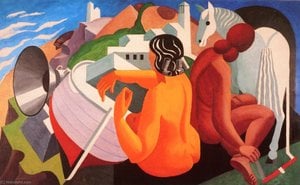
Orpheus and Eurydice
 Ler mais
A obra de arte exibida nesta página é protegida por leis de direitos autorais, o que significa que não podemos criar ou vender legalmente uma reprodução idêntica. Esta proteção é aplicada por meio de acordos internacionais, tais como a Convenção de Berna e pelas leis nacionais, incluindo as estabelecidas por Lei de Direitos Autorais dos EUA - Título 17.
Este método cumpre plenamente as regulamentações de direitos autorais, pois não envolve a cópia ou duplicação da obra protegida. Em vez disso, trata-se de uma reinterpretação criativa — uma nova pintura que é influenciada pela original, mas não idêntica a ela.
Giclée / Impressão de Arte
Impressão giclée ou em tela de qualidade de museu, com produção rápida e opções flexíveis de acabamento. ( Comprar pintura feita à mão Alternar para Imagem Digital)




































Escolha entre os nossos tamanhos pré-definidos que respeitam as proporções originais da obra de arte.

Insira a largura e a altura desejadas para se ajustarem à sua moldura ou parede. Uma impressão pode ser apenas cortada, nunca ampliada além da imagem original; portanto, um tamanho com proporções diferentes resultará na perda de parte da imagem. Enviamos uma maquete digital para sua aprovação antes de realizarmos a impressão. A imagem exibida nesta página não mostra o corte real — apenas a maquete o faz.
Entrega mundial () em 2 semanas, em vez das 4/5 semanas padrão. (2 Novembro)

Envio expresso gratuito para todo o mundo

Tela de Linho de Alta Qualidade

Seguro de transporte completo

Garantia de Reembolso de Impostos Alfandegários

Garantia de Fidelidade Cromática

Política de Devolução em 100 Dias (Apenas para Defeitos)

Garantia de reembolso de 100%

Oferta de desconto por quantidade
 A opção de vidro está disponível apenas para tamanhos inferiores a 110 cm

Orpheus and Eurydice
Giclée / Impressão de Arte
Tamanho da Reprodução
-


Preço Total
€ 55
Obras Relacionadas



Biografia do Artista
The lines of a dual life
Nikos Engonopoulos lived through a period where the boundaries between words and images often blurred. Born in Athens in 1907, his early years were marked by a move to Constantinople during the first World War. This movement between places preceded a formative time in Paris, where he studied at a lycee from 1923 to 1927. Upon returning to Greece, he followed the path of many of his generation, completing military service and working in various roles, from a bank translator to a designer for the Urban Planning Department of the Greek Ministry of Public Works.
His training at the Athens School of Fine Arts between 1932 and 1938 brought him into contact with teachers like Konstantinos Parthenis and Yannis Kefallinos. He also spent time as an apprentice to Fotis Kontoglou, absorbing the spirit of Byzantine art. This education was not confined to a single classroom; he sought out independent studies in Munich and several Italian cities. These varied exposures allowed him to develop a way of seeing that pulled from many different eras at once.
A language of symbols
The work produced by Engonopoulos often relies on the unexpected placement of figures. He used techniques such as egg tempera on wood, engraving, and woodcutting to bring together elements that do not naturally belong in the same space. His paintings frequently feature mythological characters, military figures, and the female form, all set against a backdrop that feels both ancient and modern. There is a specific way he uses color and drawing to connect the traditions of Byzantine iconography with the more fragmented logic of surrealism.
His creative output was never limited to the canvas. He was equally active in writing, producing poetry that shared the same surrealist impulses as his visual art. His collections, such as Do Not Distract the Driver and The Clavicembalos of Silence, used language to create much like his paintings used pigment. He also worked in theatre, designing costumes and creating mock-ups for plays like Caesar and Cleopatra. The way he approached a stage set or a book illustration was tied to the same interest in historical and folk Greek imagery.
Recognition and presence
The reception of his work was not always quiet. His first solo exhibition in 1939 drew sharp reactions from critics, yet he continued to build a steady presence in the Greek art scene. He was a founding member of the Armos art group in 1964 and later served as a professor of painting at the National Technical University of Athens. His reach extended beyond Greece, notably representing the country at the Venice Biennale in 1954 and participating in the Sao Paulo Biennale the following year.
Throughout his life, he received several honors for his contributions to both literature and the visual arts, including the First Poetry Award from the Greek Ministry of Education in 1958 and the Gold Cross of George I in 1966. His paintings remain in significant collections, such as the National Gallery of Greece and the Benaki Museum. He passed away in Athens in 1985, leaving behind a body of work that remains tied to the specific historical and cultural textures of the 20th century.

Nikos Engonopoulos
1907 - 1985
Dados Rápidos
- Artistic Movement Or Style: Surrealism, Generation of the '30s
- Artists Who Influenced This Artist:
- Andreas Embirikos
- Yannis Tsarouchis
- Giorgio de Chirico
- Yannis Moralis
- Lautreamont
- Full Name: Nikos Engonopoulos
- Nationality: Greek
- Notable Artworks:
- Bolivar, a Greek Poem
- The Death of Archimedes
- Two Philosophers and a Soldier
- Orpheus
- Place Of Birth: Athens, Greece
- Date Of Birth: 1907
- Date Of Death: 1985