

 Visualizar na parede
 Compartilhar
 Compartilhar
 Detalhes
 Guia
Guia

 Baixar imagem
 Semelhantes
 Raio X
 Ver diaporama
 Perguntas e Respostas
 Estatísticas
Red Jew


 Ler mais
A obra de arte exibida nesta página é protegida por leis de direitos autorais, o que significa que não podemos criar ou vender legalmente uma reprodução idêntica. Esta proteção é aplicada por meio de acordos internacionais, tais como a Convenção de Berna e pelas leis nacionais, incluindo as estabelecidas por Lei de Direitos Autorais dos EUA - Título 17.
Este método cumpre plenamente as regulamentações de direitos autorais, pois não envolve a cópia ou duplicação da obra protegida. Em vez disso, trata-se de uma reinterpretação criativa — uma nova pintura que é influenciada pela original, mas não idêntica a ela.
Giclée / Impressão de Arte
Impressão giclée ou em tela de qualidade de museu, com produção rápida e opções flexíveis de acabamento. ( Comprar pintura feita à mão Alternar para Imagem Digital)




P118B €10

P118H €10

P118W €10

P438Z €10

P508JH €12

P508YH €12

P805H €10

P805Z €10

P919BZ €10

P919G €10

P919XJ €10

P959ZH €10

P968JZ €12

W106C €8

W218G €10

W218JH €8

W218Y €10

W307PJ €10

W316G €10

W316PJ €8

W316Y €10

W398PJ €8

W4111J €10

W500HY €15

W500JH €15

W692G €12

W849H €8

W940BG €15

W953PJ €8




Escolha entre os nossos tamanhos pré-definidos que respeitam as proporções originais da obra de arte.

Insira a largura e a altura desejadas para se ajustarem à sua moldura ou parede. Uma impressão pode ser apenas cortada, nunca ampliada além da imagem original; portanto, um tamanho com proporções diferentes resultará na perda de parte da imagem. Enviamos uma maquete digital para sua aprovação antes de realizarmos a impressão. A imagem exibida nesta página não mostra o corte real — apenas a maquete o faz.
Entrega mundial () em 2 semanas, em vez das 4/5 semanas padrão. (9 Novembro)

Envio expresso gratuito para todo o mundo

Tela de Linho de Alta Qualidade

Seguro de transporte completo

Garantia de Reembolso de Impostos Alfandegários

Garantia de Fidelidade Cromática

Política de Devolução em 100 Dias (Apenas para Defeitos)

Garantia de reembolso de 100%

Oferta de desconto por quantidade
 A opção de vidro está disponível apenas para tamanhos inferiores a 110 cm

Red Jew
Giclée / Impressão de Arte
Tamanho da Reprodução
-


Preço Total
€ 56
A Visionary Encounter with the Red Jew
In the profound stillness of Marc Chagall’s 1915 masterpiece, Red Jew, we are invited into a realm where reality and dream coalesce. This striking portrait serves as a window into the artist's formative years, capturing a moment that feels both deeply personal and universally resonant. At first glance, the viewer is arrested by the central figure: a man clad in a somber black suit and hat, whose presence is anchored by a beard of startling, fiery red. This splash of crimson does not merely provide a focal point; it breathes life into the canvas, acting as a pulse of vitality against the more muted, structured elements of the composition. As the eye wanders, one notices the subtle presence of a secondary figure and the architectural hints of a house in the background, creating a sense of a lived-in, albeit fractured, world.
The technique employed by Chagall in this period reflects a masterful command of Cubist principles, yet it is infused with a lyrical softness that prevents the geometry from feeling cold or clinical. Rather than relying on harsh, rigid lines, Chagall utilizes layered thin washes of color to build an ethereal luminosity. This method allows light to seem as though it is emanating from within the canvas itself, blurring the boundaries between the subject and his environment. The way the hues are meticulously blended creates a dreamlike atmosphere, where the planes of the man's face and the structure of the background appear to vibrate with a quiet, spiritual energy.
The Echoes of Vitebsk and Cultural Identity
To truly appreciate Red Jew, one must look toward the turbulent landscape of Vitebsk, the artist’s beloved birthplace. Painted during a period of immense historical upheaval—marked by the tensions of World War I and the looming shadows of the Bolshevik revolution—the painting carries the weight of a world in transition. Chagall’s work is inseparable from the cultural duality of his upbringing, where the traditions of Russian Orthodoxy met the vibrant, rhythmic life of Jewish marketplaces. This piece acts as a vessel for those memories, capturing the essence of an identity that was being reshaped by political and social displacement.
The symbolism embedded within the portrait transcends simple representation. The man in the black suit is more than a single individual; he embodies the collective spirit of the Jewish community during a time of profound uncertainty. His vibrant red beard serves as a powerful metaphor for passion, resilience, and an unyielding defiance against the encroaching darkness of war and occupation. Through this use of folklore-inspired imagery, Chagall transforms a portrait into a narrative of survival and cultural preservation, making the artwork a poignant tribute to the endurance of the human spirit amidst the chaos of history.
An Essential Addition for Discerning Collections
For the art collector or interior designer, Red Jew offers an unparalleled opportunity to introduce a piece of profound emotional depth into a curated space. The painting’s unique ability to balance somber, historical gravity with a whimsical, luminous beauty makes it a versatile centerpiece. It possesses the rare quality of commanding attention through its bold color accents while simultaneously providing a contemplative, quiet energy that complements sophisticated modern or classical interiors.
Owning a high-quality reproduction of this Chagall masterpiece allows for the preservation of this historical and emotional legacy within one's own home. Whether placed in a gallery-style study or as a conversation starter in a contemporary living area, the painting serves as a constant reminder of the power of imagination to transcend even the most turbulent realities. It is not merely a decoration, but an invitation to dream, to remember, and to find beauty in the fractured planes of our shared human experience.
Perguntas e Respostas
Qual é a intensidade das cores de "Red Jew", de Marc Chagall?
As cores em "Red Jew", de Marc Chagall possuem uma intensidade Vivid.
Qual é o nível de popularidade de "Red Jew" dentro do Cubism?
"Red Jew", de Marc Chagall é classificada como Recognized e pertence ao movimento Cubism.
Qual é a intensidade do contraste em "Red Jew", de Marc Chagall?
O contraste entre claro e escuro de "Red Jew" é registrado como Statement. O contraste descreve a intensidade da diferença entre as áreas claras e escuras.
Obras Relacionadas


Biografia do Artista
A Life Painted in Dreams: The World of Marc Chagall
Marc Chagall, born Moishe Shagal in 1887 in the small Belarussian town of Liozna near Vitebsk, wasn’t merely a painter; he was a poet of color, a weaver of dreams, and a chronicler of memory. His life, spanning nearly a century, mirrored the tumultuous currents of the 20th century, yet his art remained steadfastly rooted in a deeply personal vision—one infused with the folklore of his Hasidic Jewish upbringing and an unwavering belief in the power of imagination. Vitebsk itself was more than just a birthplace; it became the emotional core of his artistic universe, a recurring motif populated by flying figures, whimsical animals, and the vibrant hues of remembered landscapes. The town’s unique blend of cultures—Russian Orthodox churches alongside bustling Jewish marketplaces—forged an aesthetic sensibility that would defy easy categorization throughout his long career. Though he sought formal training first with a local sign painter and later in St. Petersburg under Léon Bakst, and then in Paris at the Académie de la Grande Chaumière, Chagall never fully embraced any single artistic movement. He absorbed elements of Cubism, Symbolism, and Fauvism, but always filtered them through his own intensely personal lens, creating a style that was uniquely, unmistakably Chagall.Early Influences and Artistic Beginnings
Chagall’s formative years were marked by the traditions of Vitebsk’s Jewish community—a vibrant tapestry woven with religious rituals, folk tales, and ancestral memories. These influences profoundly shaped his artistic sensibility, informing his use of symbolism and his fascination with biblical narratives. His initial training encompassed practical skills honed in the craft of sign painting, followed by a more structured education at St. Petersburg Academy of Art under Léon Bakst, where he encountered the avant-garde spirit of Russian Symbolism. However, Chagall’s artistic path diverged from conventional academic pursuits. He prioritized experimentation and intuition over technical precision, rejecting rigid stylistic constraints in favor of expressive freedom. Paintings like I and the Village (1911) exemplify this approach—a deliberate departure from realistic representation that prioritizes emotional resonance and evocative imagery. The fragmented composition captures not just a landscape but also the artist’s subjective experience of place and time, foreshadowing his signature style.The Symbolist Vision: Color and Emotion
Chagall's artistic language quickly developed into one characterized by bold color palettes and emotionally charged imagery. He eschewed naturalistic hues in favor of vibrant shades—deep blues, fiery reds, luminous yellows—that conveyed feeling rather than factual accuracy. Figures appear to float or dance across the canvas, defying gravity and logic, creating a dreamlike atmosphere that invites viewers into his inner world. This stylistic technique wasn’t merely decorative; it was integral to Chagall's artistic philosophy—a conviction that art should transcend mere imitation of reality and capture the essence of human experience. Recurring motifs—flying figures, musical instruments, animals—became emblems of Chagall’s worldview, reflecting his spiritual beliefs and his fascination with folklore. These symbols weren’t presented in a didactic manner but rather interwoven into complex compositions that demanded contemplation and interpretation.The Revolution and Vitebsk Revisited
The Russian Revolution dramatically altered Chagall's life trajectory, returning him to Vitebsk—the town that had nurtured his artistic imagination since childhood. During this period, he actively participated in cultural initiatives aimed at revitalizing Jewish identity and fostering artistic creativity. He established an art school alongside Aleksandr Rodchenko, attracting young artists from across Russia who embraced the avant-garde spirit of the era. However, Chagall’s engagement with Soviet culture was fraught with tensions—a clash between his artistic vision and the ideological imperatives of the regime. Despite these challenges, he continued to produce groundbreaking works that explored themes of exile, faith, and human dignity.International Recognition and Artistic Legacy
Chagall's reputation soared internationally after World War II, attracting commissions from prominent patrons and securing exhibitions in major museums around the globe. He relocated to Paris in 1940, where he remained until his death in 1985—a period marked by prolific artistic output and profound personal reflection. His monumental stained glass windows for the Hadassah Hebrew University Medical Center synagogue in Jerusalem stand as a testament to his enduring influence on Jewish culture and spirituality. Furthermore, his paintings like Over Vitebsk (1920-1922) and White Crucifixion (1938) continue to resonate with audiences worldwide—powerful expressions of emotion and imagination that transcend cultural boundaries. Chagall’s legacy extends beyond his artistic creations; it resides in the enduring power of his vision—a vision that celebrates love, memory, and the boundless possibilities of the human spirit. He left behind a body of work that is both deeply personal and universally accessible, inviting viewers to lose themselves in a world painted with dreams and illuminated by hope.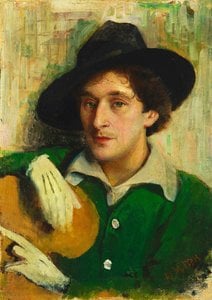
Marc Chagall
1887 - 1985 , Belarus
Dados Rápidos
- Artistic Movement Or Style: Cubismo, Surrealismo
- Artists Or Movements Influenced By This Artist:
- Surrealismo
- Modern artistas
- Artists Who Influenced This Artist:
- Bakst
- Delaunay
- Borovikovsky
- Date Of Birth: 6 julho 1887
- Date Of Death: 28 março 1985
- Full Name: Marc Chagall
- Nationality: Russo-Francês
- Notable Artworks:
- I e a Vila
- Sobre Vitebsk
- Place Of Birth: Liozna, Bielorrússia
Artigos Relacionados
Crimson Threads of Narrative: Exploring Symbolism & Representation in Artworks Featuring the Red Dress
Explore the rich symbolism of the red dress in art history! From ancient power displays to iconic portraits like Cézanne’s 'Madame Cezanne', discover the cultural and artistic significance behind this captivating color. Expert analysis & insights.

Mestres do Preto e Branco: 10 Pinturas Icônicas que Definem a Elegância Sombria
Descubra 10 pinturas icônicas dominadas pelo preto e branco, de Rembrandt a Goya. Explore a história, técnica e emoção por trás dessas obras-primas atemporais. Encontre reproduções de arte exclusivas em ArtsDot.com!

Mark Rothko: As 25 Obras-Primas que Definem um Ícone da Arte Abstrata | ArtsDot
Descubra as 25 obras-primas de Mark Rothko, ícone do expressionismo abstrato. Explore a história, cores e emoção por trás de cada tela. Reproduções de arte exclusivas para sua casa em ArtsDot.com.
As 10 Obras Mais Famosas Dominadas pelo Preto Marsala: Arte e Decoração
Descubra as 10 pinturas mais icônicas dominadas pelo preto marsala! Explore a história, artistas e técnicas por trás de obras-primas do barroco ao expressionismo. Encontre reproduções de arte exclusivas para decorar seu lar com elegância em ArtsDot.com.

As 10 Pinturas Mais Famosas Dominadas pelo Preto: Arte, História e Decoração
Descubra as 10 pinturas mais icônicas dominadas pelo preto! Explore a história, técnica e emoção por trás de obras-primas do Romantismo, Realismo e Expressionismo. Encontre reproduções de arte exclusivas na ArtsDot.com.


