


A imagem segue as suas escolhas: , .
Descrição do Item
Marc Chagall’s ‘Lisa with a Mandolin,’ an Expressionist portrait from 1914, captures a dreamy scene of a woman playing music in a vibrant room filled with symbolic details. Discover this iconic artwork and bring its enchanting beauty into your space.
 Ler mais
Biografia do Artista
Explore o universo artístico de Marc Chagall (1887-1985), pintor russo-francês renomado por suas obras surrealistas, temas folclóricos judaicos e vitrais impressionantes! Descubra seu legado único.
Reprodução em Óleo Feita à Mão
Óleo sobre tela pintado à mão no tamanho e moldura de sua escolha, feito sob encomenda pelos nossos artistas. ( Alternar para Impressão Alternar para Imagem Digital)
Esta obra está protegida por direitos autorais
A obra de arte exibida nesta página é protegida por leis de direitos autorais, o que significa que não podemos criar ou vender legalmente uma reprodução idêntica. Esta proteção é aplicada por meio de acordos internacionais, tais como a Convenção de Berna e pelas leis nacionais, incluindo as estabelecidas por Lei de Direitos Autorais dos EUA - Título 17.
Como uma alternativa respeitosa e legal, oferecemos obras de arte personalizadas e pintadas à mão, inspiradas na obra original. Nossos artistas profissionais e experientes estudam cuidadosamente o estilo, a atmosfera e a essência artística da obra original para criar uma peça nova e única que evoque a mesma sensação — permanecendo como uma criação original por direito próprio.
Este método cumpre plenamente as regulamentações de direitos autorais, pois não envolve a cópia ou duplicação da obra protegida. Em vez disso, trata-se de uma reinterpretação criativa — uma nova pintura que é influenciada pela original, mas não idêntica a ela.
Saiba mais sobre esta pintura
 Visualizar na parede
 Compartilhar
 Compartilhar
 Detalhes
 Guia
Guia

 Baixar imagem
 Semelhantes
 Raio X
 Ver diaporama
 Perguntas e Respostas
 Estatísticas
Encomende a sua pintura em quatro passos simples
Não tenha pressa. Você pode alterar qualquer resposta; o preço no seu carrinho de compras será atualizado conforme cada escolha.
1 Passo um de quatro
Qual tamanho você gostaria?
Estes tamanhos mantêm as proporções da pintura original. A ilustração mostra a sua escolha numa parede, acima de um sofá de dois metros.
Ou informe suas próprias medidas
Escolha entre os nossos tamanhos pré-definidos que respeitam as proporções originais da obra de arte.

Insira a largura e a altura desejadas para se ajustarem à sua moldura ou parede. Como esta obra é pintada à mão, para um tamanho com proporções diferentes, o artista poderá pintar um pouco mais ao redor da imagem ou reduzir ligeiramente a composição — você escolhe. Enviamos uma maquete digital para sua aprovação antes de iniciar a pintura. A imagem exibida nesta página não representa o resultado real — apenas a maquete mostra o resultado final.
2 Passo dois de quatro
Como deve ser preparado: enrolado, esticado ou emoldurado?
Os preços abaixo referem-se ao tamanho escolhido na primeira etapa.
Escolha as bordas da tela esticada
Escolha sua moldura

Branco €1

Bordas esfumaçadas €1

Bordas estendidas €1

P118B €10

P118H €10

P118W €10

P438Z €10

P508JH €12

P508YH €12

P805H €10

P805Z €10

P919BZ €10

P919G €10

P919XJ €10

P959ZH €10

P968JZ €12

W106C €8

W218G €10

W218JH €8

W218Y €10

W307PJ €10

W316G €10

W316PJ €8

W316Y €10

W398PJ €8

W4111J €10

W500HY €15

W500JH €15

W692G €12

W849H €8

W940BG €15

W953PJ €8

H24-GOLD €30

H24-SILVER €30

H36-GOLD €45

H36-SILVER €45
Com moldura
Moldura: . Dimensões totais com a moldura: .
3 Passo três de quatro
Gostaria de alterar algo na pintura?
A maioria das pessoas responde que não. Como cada pintura é feita à mão, nosso artista também pode adaptá-la para você.
Após o pedido, a equipe da ArtsDot.com enviará um e-mail ao cliente para instruções e fornecerá uma prévia da montagem
4 Passo quatro de quatro
Algumas opções de acabamento
Todos eles são opcionais. As respostas já selecionadas não têm custo adicional.
Quem o pintou?
Entrega mundial () em 3 a 4 semanas, em vez das 5 semanas padrão. (5 Novembro). Sem comprometer a qualidade.
Uma placa de identificação, como em um museu?
Detalhes da Placa de Bronze Gravada
This elegant plaque features the artist's name and the title of the artwork, finely engraved for a timeless presentation.
It is made from bronze with a refined, elegant finish. The text is precisely laser-engraved for a sharp and permanent result. Measuring 9x2 cm, the plaque is compact yet easy to read. It's built to be durable and scratch-resistant, offering a professional, museum-quality look. Mounting is simple thanks to the included adhesive backing.
Detalhes da Placa de Acrílico Transparente
The plaque includes essential engraved details such as the artist's name, the title of the artwork, the date it was created, the type of media used-like oil on canvas or watercolor-a brief description of the piece, and a QR code that links to the complete artwork information.
It is crafted from clear acrylic, offering a sleek, modern appearance. The text is UV-engraved in black to ensure strong visual contrast. With a size of 10x15 cm, it ensures optimal readability. It comes equipped with two metal hooks for secure wall mounting. The plaque is designed to be weather-resistant, making it suitable for various environments, and it includes interactive features that work seamlessly with smartphone scanning.
Detalhes da Placa de Acrílico Preto
This elegant plaque includes engraved information such as the artist's name, the title of the artwork, the date it was created, the type of media used (like oil on canvas or watercolor), a short description of the artwork, and a QR code for quick access to more information.
The plaque itself is made from refined black acrylic with a premium finish. The text is laser-engraved in white for high contrast and readability. Its size is 10x15 cm, designed to be easy to read. It comes with two metal hooks for professional mounting. The design is sleek and fits any interior style. It is also weather-resistant and durable, with built-in digital integration for mobile compatibility.
Um verniz protetor?
Para quando você precisa?
✓ Verifique e peça
A sua pintura, conforme encomendada

Lisa with a Mandolin
Técnica de Reprodução
Tamanho da Reprodução
-

Artista Sênior de Elite
Mais detalhes, refinamento e tempo de produção adicional
-

Moldura para Reprodução
-
-
Para obras de arte ou reproduções com mais de 105 cm (aproximadamente 41 polegadas) em qualquer um dos lados, a moldura será enviada como um kit desmontado. Este método garante uma entrega segura e evita danos durante o transporte.
Montagem profissional necessária — este não é um produto DIY (faça você mesmo).
O kit deve ser montado e a tela esticada por um profissional de molduraria experiente, utilizando cola de madeira (não inclusa), um alicate de esticar tela e grampos para manter as travessas alinhadas enquanto a cola seca. A montagem incorreta ou a tensão desigual da tela podem danificar permanentemente a obra de arte e não estão cobertas pela nossa garantia.
 Para obras de arte ou reproduções com mais de 105 cm (aproximadamente 41 polegadas) em qualquer um dos lados, a moldura será enviada como um kit desmontado. Este método garante uma entrega segura e evita danos durante o transporte.
Todas as barras de madeira maciça estão incluídas, precisamente cortadas ao tamanho certo.
Montado com os parafusos fornecidos, além de cola para madeira para as junções dos cantos, que não está inclusa e deve ser providenciada pelo seu moldurista.
São necessárias ferramentas profissionais não incluídas: um alicate de estiramento de tela (esticador) e grampos para manter as ripas alinhadas enquanto a cola seca.
Importante:
As junções dos cantos requerem cola para madeira, as ripas devem ser mantidas com grampos até que a cola esteja completamente seca, e o estiramento da tela na moldura montada requer um alicate de esticar tela. Nenhum destes itens está incluído no kit. Por favor, certifique-se de contar com um profissional de molduraria experiente antes de encomendar este tamanho.

Etiqueta de identificação
-
-

Verniz de Proteção
Verniz brilhante (realça as cores e protege contra a luz e a umidade)
-

Personalizar minha obra
Exemplos de alterações possíveis: Substituir o rosto por uma foto do cliente; Adicionar um animal de estimação (ex.: substituir gato por cachorro); Incluir uma mensagem oculta no fundo; Alterar a paisagem ou os elementos do fundo.
-

Urgente
Entrega mundial () em 3 a 4 semanas, em vez das 5 semanas padrão. (5 Novembro). Sem comprometer a qualidade.
-
Envio Expresso
Entrega mundial para em 5 semanas. (12 Novembro).
Com envio incluído
Preço Total
€ 235
A opção de vidro está disponível apenas para tamanhos inferiores a 110 cm
Incluído em todos os pedidos
- Envio expresso gratuito para todo o mundo
- Tela de Linho de Alta Qualidade
- Seguro de transporte completo
- Garantia de Reembolso de Impostos Alfandegários
- Garantia de Fidelidade Cromática
- Política de Devolução em 100 Dias (Apenas para Defeitos)
- Garantia de reembolso de 100%
- Oferta de desconto por quantidade


A Dreamscape of Memory: Marc Chagall’s “Lisa with a Mandolin”
Marc Chagall's "Lisa with a Mandolin," painted in 1914, is more than just a portrait; it’s an immersion into the artist’s deeply personal world – a realm where memory and dream intertwine. Born Moishe Shagal in Liozna, Belarus, Chagall’s formative years were steeped in the rich folklore of his Hasidic Jewish community, a heritage that would profoundly shape his artistic vision for decades to come. This particular work exemplifies this influence, transporting us to a space both familiar and fantastical, anchored by the vibrant hues of remembrance and infused with a poignant sense of longing. The painting captures Lisa Rabinovich, a childhood friend of Chagall’s, seated in a chair, lost in the act of playing her mandolin. Her gaze, directed towards an unseen window, suggests contemplation and perhaps a wistful return to cherished moments.Expressionist Techniques and Color as Emotion
Created during a pivotal period in Chagall's artistic development, “Lisa with a Mandolin” firmly establishes his place within the Expressionist movement. While rooted in representational forms, Chagall employs a highly subjective approach to color and perspective, prioritizing emotional impact over strict realism. The bold use of red – dominating the wall behind Lisa – isn’t merely decorative; it pulsates with intensity, conveying passion, perhaps even a hint of melancholy. Chagall's technique is characterized by loose brushstrokes and a flattened picture plane, creating an almost dreamlike quality. He utilizes impasto—thickly applied paint—to build texture and emphasize the physicality of his subjects, particularly Lisa’s hands as they move across the strings of the mandolin. The slightly distorted proportions and unconventional spatial arrangement contribute to the painting's overall sense of unease and emotional depth, hallmarks of Expressionism’s goal to convey inner feelings rather than objective reality.Symbolic Layers: Folklore, Faith, and Intimacy
The symbolism within “Lisa with a Mandolin” is rich and layered, drawing heavily from Chagall's cultural context. The mandolin itself – a traditional Jewish instrument – represents music, joy, and connection to heritage. Lisa’s pose, reminiscent of biblical figures and folk art traditions, further reinforces this connection to faith and storytelling. The presence of the two chairs adds another layer of meaning; one occupied by Lisa, representing her individual experience, while the other in the background suggests a shared space, a memory being revisited. The red wall, often interpreted as symbolizing passion or even danger, could also represent the vibrant energy of the Jewish marketplace where Chagall spent his childhood. The painting is fundamentally an intimate portrait, capturing not just Lisa’s physical appearance but also her inner life and emotional state.A Timeless Masterpiece for Collection and Interior Design
“Lisa with a Mandolin” remains one of Marc Chagall's most beloved works, admired for its evocative power and masterful execution. This hand-painted reproduction captures the essence of the original, offering an exceptional opportunity to bring this iconic artwork into your home or office. Its vibrant colors and dreamlike quality make it a stunning addition to any collection, while its historical significance and artistic merit ensure its enduring appeal. Whether you are an art enthusiast, a collector seeking to expand your portfolio, or an interior designer aiming to create a space of profound beauty and emotional resonance, this reproduction offers a unique window into the visionary world of Marc Chagall. NonePerguntas e Respostas
Quanta luz as cores de "Lisa with a Mandolin" parecem refletir?
As cores de "Lisa with a Mandolin" apresentam uma luminância Soft Shadow.
Em que fase da carreira de Marc Chagall se situa "Lisa with a Mandolin", considerando a sua data?
Dada a sua data de 1914, "Lisa with a Mandolin" insere-se no período Early Expressionism de Marc Chagall.
Qual é a tonalidade predominante de "Lisa with a Mandolin", de Marc Chagall?
A tonalidade dominante de "Lisa with a Mandolin", de Marc Chagall é Golden Yellow Range. A tonalidade é o tom subjacente da paleta.
Obras Relacionadas



Marc Chagall
1887 - 1985, Belarus
Biografia do Artista
A Life Painted in Dreams: The World of Marc Chagall
Marc Chagall, born Moishe Shagal in 1887 in the small Belarussian town of Liozna near Vitebsk, wasn’t merely a painter; he was a poet of color, a weaver of dreams, and a chronicler of memory. His life, spanning nearly a century, mirrored the tumultuous currents of the 20th century, yet his art remained steadfastly rooted in a deeply personal vision—one infused with the folklore of his Hasidic Jewish upbringing and an unwavering belief in the power of imagination. Vitebsk itself was more than just a birthplace; it became the emotional core of his artistic universe, a recurring motif populated by flying figures, whimsical animals, and the vibrant hues of remembered landscapes. The town’s unique blend of cultures—Russian Orthodox churches alongside bustling Jewish marketplaces—forged an aesthetic sensibility that would defy easy categorization throughout his long career. Though he sought formal training first with a local sign painter and later in St. Petersburg under Léon Bakst, and then in Paris at the Académie de la Grande Chaumière, Chagall never fully embraced any single artistic movement. He absorbed elements of Cubism, Symbolism, and Fauvism, but always filtered them through his own intensely personal lens, creating a style that was uniquely, unmistakably Chagall.Early Influences and Artistic Beginnings
Chagall’s formative years were marked by the traditions of Vitebsk’s Jewish community—a vibrant tapestry woven with religious rituals, folk tales, and ancestral memories. These influences profoundly shaped his artistic sensibility, informing his use of symbolism and his fascination with biblical narratives. His initial training encompassed practical skills honed in the craft of sign painting, followed by a more structured education at St. Petersburg Academy of Art under Léon Bakst, where he encountered the avant-garde spirit of Russian Symbolism. However, Chagall’s artistic path diverged from conventional academic pursuits. He prioritized experimentation and intuition over technical precision, rejecting rigid stylistic constraints in favor of expressive freedom. Paintings like I and the Village (1911) exemplify this approach—a deliberate departure from realistic representation that prioritizes emotional resonance and evocative imagery. The fragmented composition captures not just a landscape but also the artist’s subjective experience of place and time, foreshadowing his signature style.The Symbolist Vision: Color and Emotion
Chagall's artistic language quickly developed into one characterized by bold color palettes and emotionally charged imagery. He eschewed naturalistic hues in favor of vibrant shades—deep blues, fiery reds, luminous yellows—that conveyed feeling rather than factual accuracy. Figures appear to float or dance across the canvas, defying gravity and logic, creating a dreamlike atmosphere that invites viewers into his inner world. This stylistic technique wasn’t merely decorative; it was integral to Chagall's artistic philosophy—a conviction that art should transcend mere imitation of reality and capture the essence of human experience. Recurring motifs—flying figures, musical instruments, animals—became emblems of Chagall’s worldview, reflecting his spiritual beliefs and his fascination with folklore. These symbols weren’t presented in a didactic manner but rather interwoven into complex compositions that demanded contemplation and interpretation.The Revolution and Vitebsk Revisited
The Russian Revolution dramatically altered Chagall's life trajectory, returning him to Vitebsk—the town that had nurtured his artistic imagination since childhood. During this period, he actively participated in cultural initiatives aimed at revitalizing Jewish identity and fostering artistic creativity. He established an art school alongside Aleksandr Rodchenko, attracting young artists from across Russia who embraced the avant-garde spirit of the era. However, Chagall’s engagement with Soviet culture was fraught with tensions—a clash between his artistic vision and the ideological imperatives of the regime. Despite these challenges, he continued to produce groundbreaking works that explored themes of exile, faith, and human dignity.International Recognition and Artistic Legacy
Chagall's reputation soared internationally after World War II, attracting commissions from prominent patrons and securing exhibitions in major museums around the globe. He relocated to Paris in 1940, where he remained until his death in 1985—a period marked by prolific artistic output and profound personal reflection. His monumental stained glass windows for the Hadassah Hebrew University Medical Center synagogue in Jerusalem stand as a testament to his enduring influence on Jewish culture and spirituality. Furthermore, his paintings like Over Vitebsk (1920-1922) and White Crucifixion (1938) continue to resonate with audiences worldwide—powerful expressions of emotion and imagination that transcend cultural boundaries. Chagall’s legacy extends beyond his artistic creations; it resides in the enduring power of his vision—a vision that celebrates love, memory, and the boundless possibilities of the human spirit. He left behind a body of work that is both deeply personal and universally accessible, inviting viewers to lose themselves in a world painted with dreams and illuminated by hope.


Artigos Relacionados
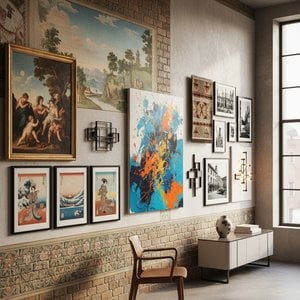
Transforming Spaces: A Comprehensive Exploration of Wall Decor Through Art History & Contemporary Practice
Explore the art of transforming spaces with our comprehensive guide to wall decor. From historical movements to contemporary trends, discover how to curate impactful interiors and commission bespoke artwork for a truly personalized aesthetic.

Giclée Prints: Archival Quality & Aesthetic Nuances for the Discerning Collector
Explore the world of giclée prints with ArtsDot. Learn about archival quality, aesthetic nuances & investment potential. Expert guidance for discerning art collectors seeking museum-quality reproductions and lasting value.

Andy Warhol: As 25 Obras Essenciais do Ícone da Pop Art | ArtsDot
Descubra as 25 obras mais emblemáticas de Andy Warhol, o ícone da Pop Art! Explore a história por trás de Marilyn Monroe, Campbell's Soup Cans e outras criações vibrantes. Encontre reproduções de arte exclusivas para decorar sua casa com estilo em ArtsDot.com.