

 Visualizar na parede
 Compartilhar
 Compartilhar
 Detalhes
 Guia
Guia

 Baixar imagem
 Semelhantes
 Raio X
 Ver diaporama
 Perguntas e Respostas
 Estatísticas
Couple with a bird

- 48.0 x 32.0 cm


 Ler mais
Obtenha um arquivo pronto para impressão que vai muito além da visualização na web. Cada imagem digital que vendemos provém de um arquivo mestre de alta resolução em nosso banco de dados — geralmente entre 5.000 e 15.000 pixels de largura — para que você possa imprimir em grandes formatos, realizar cortes precisos ou reproduzir detalhes minuciosos com total confiança.
Nenhum arquivo sai do nosso estúdio sem passar por um cuidadoso processo de revisão. Um especialista digital verifica as cores em relação à pintura original e as corrige se necessário, aumentando então a clareza e o detalhe com ferramentas profissionais de retoque — sempre mantendo a fidelidade às pinceladas e ao estilo do artista. O resultado é uma imagem que se assemelha à pintura, e não a um scan com filtros.
Aprovação antes da finalização: nosso especialista enviará a imagem por e-mail em até 72 horas para sua revisão. Não ficou satisfeito? Solicite melhorias ou correções, ou peça o reembolso caso a qualidade não atenda às suas expectativas.
Esta é a qualidade em que confiam editoras, estúdios de design, galerias e gráficas.
Imagem Digital
Baixe um arquivo de alta resolução para exibição pessoal, impressão e projetos criativos. ( Alternar para Impressão Comprar pintura feita à mão)
Incluído em cada compra de imagem digital
Entrega Digital Especializada e Garantida
Ao escolher o ArtsDot.com, você não está apenas adquirindo uma imagem — você está recebendo uma obra de arte digital profissionalmente aprimorada, elaborada com precisão e com garantia de satisfação. Aqui está tudo o que acompanha seu pedido, automaticamente:

Entrega rápida por e-mail
O seu arquivo de imagem digital em alta resolução será enviado por e-mail em até 72 horas após o pedido — pronto para uso imediato.

Arquivo Digital com IA Otimizado
Sua obra de arte é otimizada profissionalmente por meio de ferramentas avançadas de IA e edição manual, garantindo o máximo de detalhes, clareza e precisão de cores.

Reenvio gratuito vitalício
Apagou ou perdeu o seu ficheiro acidentalmente? Não se preocupe – nós reenviamos para si a qualquer momento, gratuitamente.

Sem Taxas de Importação - Sempre
Desfrute da sua obra de arte instantaneamente, sem taxas alfandegárias, impostos ou custos de entrega — downloads digitais são sempre isentos de taxas.

Garantia de Fidelidade de Cores
Garantimos que sua imagem digital reflita as cores originais com a maior fidelidade possível, utilizando ferramentas profissionais e gerenciamento de cores.

Garantia de satisfação de 100 dias
Se não estiver satisfeito com a sua imagem digital, nós a revisaremos ou reembolsaremos 100% dentro de 100 dias — sem perguntas.

Garantia de Reembolso 100%
Não está satisfeito? Receba o reembolso total em até 100 dias após o recebimento do seu arquivo digital — sem perguntas.

Descontos para pedidos em lote
Compre 3 imagens, economize 10% - Compre 5, economize 15% - Compre 10+, economize 20%. Ideal para projetos criativos, galerias e agências.
A Dream of Union: Exploring Chagall’s ‘Couple with a Bird’
Marc Chagall's ‘Couple with a Bird,’ created in 1959, is a captivating black and white drawing that encapsulates the artist’s signature blend of surrealism, symbolism, and deeply felt emotion. Measuring 48 x 32 cm, this work offers an intimate glimpse into Chagall’s exploration of love, connection, and the human relationship with nature – themes recurrent throughout his prolific career.Style & Technique: Expressionist Roots in a Surreal Landscape
While often categorized as a surrealist, Chagall's style is uniquely his own—a vibrant synthesis of influences. ‘Couple with a Bird’ demonstrates elements of both Expressionism and Surrealism. The drawing isn’t concerned with realistic representation; instead, it prioritizes emotional impact through distorted forms and expressive linework. Executed primarily in pen and ink, the piece showcases Chagall's masterful use of hatching and cross-hatching to build texture, depth, and dramatic contrasts between light and shadow. The swirling lines and overlapping shapes create a sense of dynamic movement, drawing the viewer into the dreamlike scene. The flattened perspective further enhances this otherworldly quality, rejecting traditional spatial conventions in favor of an evocative atmosphere.Subject & Symbolism: Love, Freedom, and Entrapment
The composition centers on two intertwined figures – a man and woman – enveloped by a dense, almost chaotic profusion of floral and foliage forms. This juxtaposition is key to understanding the work’s symbolism. The couple's embrace suggests intimacy and connection, yet their positioning within the overwhelming vegetation hints at potential entrapment or struggle. The bird itself—a recurring motif in Chagall’s oeuvre—is a potent symbol of freedom, hope, and spiritual aspiration. Its presence elevates the scene beyond a simple depiction of romantic love, suggesting a yearning for transcendence. The man's hat could be interpreted as representing authority or perhaps a disguise, adding another layer of complexity to the narrative.Historical Context: A Life Bridging Cultures
Born in Belarus in 1887 and later flourishing as an artist in France, Marc Chagall’s life was marked by cultural displacement and artistic innovation. His upbringing within a vibrant Jewish community profoundly influenced his visual language, imbuing his work with folkloric motifs and symbolic references. As an early modernist, he absorbed influences from Cubism and Symbolism but ultimately forged his own path, creating a style that celebrated both personal experience and universal themes. ‘Couple with a Bird’ reflects this synthesis—a deeply personal vision expressed through a distinctly modern aesthetic.Emotional Resonance: Melancholy & Mystery
The overall emotional tone of ‘Couple with a Bird’ is one of melancholic beauty and intriguing mystery. The rough texture created by the hatching technique adds to the raw, expressive quality of the artwork, evoking feelings of vulnerability and longing. While the intertwined figures suggest closeness, there's also an underlying sense of unease—a hint that their connection exists within a complex and perhaps precarious world. This ambiguity is precisely what makes the work so compelling, inviting viewers to project their own interpretations onto its evocative imagery.For Collectors & Designers:
- A striking example of Chagall’s graphic work, offering a more accessible entry point into his oeuvre than his larger paintings.
- The monochromatic palette makes it versatile for various interior design schemes—from minimalist to eclectic.
- Its symbolic richness and emotional depth add layers of meaning to any space.
- A captivating piece that sparks conversation and invites contemplation.
Perguntas e Respostas
Qual paleta e cor predominante definem "Couple with a bird"?
"Couple with a bird" é definido por uma paleta Neutrals com destaque para White (#f1efed).
Qual é o nível de popularidade de "Couple with a bird" dentro do Surrealism?
"Couple with a bird" é classificada como Iconic entre as obras do Surrealism no catálogo.
A que fase da trajetória de Marc Chagall "Couple with a bird" pertence?
Dentro da trajetória de Marc Chagall, "Couple with a bird" pertence ao período Mature Period. Esta fase permite compará-la com outras obras do artista.
Obras Relacionadas


Biografia do Artista
A Life Painted in Dreams: The World of Marc Chagall
Marc Chagall, born Moishe Shagal in 1887 in the small Belarussian town of Liozna near Vitebsk, wasn’t merely a painter; he was a poet of color, a weaver of dreams, and a chronicler of memory. His life, spanning nearly a century, mirrored the tumultuous currents of the 20th century, yet his art remained steadfastly rooted in a deeply personal vision—one infused with the folklore of his Hasidic Jewish upbringing and an unwavering belief in the power of imagination. Vitebsk itself was more than just a birthplace; it became the emotional core of his artistic universe, a recurring motif populated by flying figures, whimsical animals, and the vibrant hues of remembered landscapes. The town’s unique blend of cultures—Russian Orthodox churches alongside bustling Jewish marketplaces—forged an aesthetic sensibility that would defy easy categorization throughout his long career. Though he sought formal training first with a local sign painter and later in St. Petersburg under Léon Bakst, and then in Paris at the Académie de la Grande Chaumière, Chagall never fully embraced any single artistic movement. He absorbed elements of Cubism, Symbolism, and Fauvism, but always filtered them through his own intensely personal lens, creating a style that was uniquely, unmistakably Chagall.Early Influences and Artistic Beginnings
Chagall’s formative years were marked by the traditions of Vitebsk’s Jewish community—a vibrant tapestry woven with religious rituals, folk tales, and ancestral memories. These influences profoundly shaped his artistic sensibility, informing his use of symbolism and his fascination with biblical narratives. His initial training encompassed practical skills honed in the craft of sign painting, followed by a more structured education at St. Petersburg Academy of Art under Léon Bakst, where he encountered the avant-garde spirit of Russian Symbolism. However, Chagall’s artistic path diverged from conventional academic pursuits. He prioritized experimentation and intuition over technical precision, rejecting rigid stylistic constraints in favor of expressive freedom. Paintings like I and the Village (1911) exemplify this approach—a deliberate departure from realistic representation that prioritizes emotional resonance and evocative imagery. The fragmented composition captures not just a landscape but also the artist’s subjective experience of place and time, foreshadowing his signature style.The Symbolist Vision: Color and Emotion
Chagall's artistic language quickly developed into one characterized by bold color palettes and emotionally charged imagery. He eschewed naturalistic hues in favor of vibrant shades—deep blues, fiery reds, luminous yellows—that conveyed feeling rather than factual accuracy. Figures appear to float or dance across the canvas, defying gravity and logic, creating a dreamlike atmosphere that invites viewers into his inner world. This stylistic technique wasn’t merely decorative; it was integral to Chagall's artistic philosophy—a conviction that art should transcend mere imitation of reality and capture the essence of human experience. Recurring motifs—flying figures, musical instruments, animals—became emblems of Chagall’s worldview, reflecting his spiritual beliefs and his fascination with folklore. These symbols weren’t presented in a didactic manner but rather interwoven into complex compositions that demanded contemplation and interpretation.The Revolution and Vitebsk Revisited
The Russian Revolution dramatically altered Chagall's life trajectory, returning him to Vitebsk—the town that had nurtured his artistic imagination since childhood. During this period, he actively participated in cultural initiatives aimed at revitalizing Jewish identity and fostering artistic creativity. He established an art school alongside Aleksandr Rodchenko, attracting young artists from across Russia who embraced the avant-garde spirit of the era. However, Chagall’s engagement with Soviet culture was fraught with tensions—a clash between his artistic vision and the ideological imperatives of the regime. Despite these challenges, he continued to produce groundbreaking works that explored themes of exile, faith, and human dignity.International Recognition and Artistic Legacy
Chagall's reputation soared internationally after World War II, attracting commissions from prominent patrons and securing exhibitions in major museums around the globe. He relocated to Paris in 1940, where he remained until his death in 1985—a period marked by prolific artistic output and profound personal reflection. His monumental stained glass windows for the Hadassah Hebrew University Medical Center synagogue in Jerusalem stand as a testament to his enduring influence on Jewish culture and spirituality. Furthermore, his paintings like Over Vitebsk (1920-1922) and White Crucifixion (1938) continue to resonate with audiences worldwide—powerful expressions of emotion and imagination that transcend cultural boundaries. Chagall’s legacy extends beyond his artistic creations; it resides in the enduring power of his vision—a vision that celebrates love, memory, and the boundless possibilities of the human spirit. He left behind a body of work that is both deeply personal and universally accessible, inviting viewers to lose themselves in a world painted with dreams and illuminated by hope.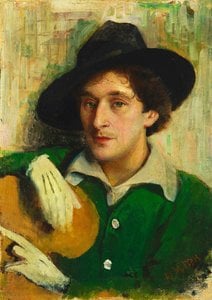
Marc Chagall
1887 - 1985 , Belarus
Breve Biografia
- Artistic Movement Or Style: Cubismo, Surrealismo
- Artists Or Movements Influenced By This Artist:
- Surrealismo
- Modern artistas
- Artists Who Influenced This Artist:
- Bakst
- Delaunay
- Borovikovsky
- Date Of Birth: 6 julho 1887
- Date Of Death: 28 março 1985
- Full Name: Marc Chagall
- Nationality: Russo-Francês
- Notable Artworks:
- I e a Vila
- Sobre Vitebsk
- Place Of Birth: Liozna, Bielorrússia